Grid Your Teeth

And just keep on paying. Or how about grid and bare it?

Germany’s power grid hasn’t kept up with the explosion of new alternative energy sources — particularly the offshore windparks being built in the Baltic Sea and the North Sea off the country’s north coast. Many of those projects are at a standstill, with no way to deliver the power they generate to the mainland.

On Wednesday Merkel’s cabinet hopes to agree on a stop-gap measure to compensate power companies for losses accrued as a result of the delays, but again it will be German consumers who will ultimately suffer.

“The primary reason for the problem lies in the ‘third path’ policymakers have chosen to lead us into the renewable future. There is neither a centrally planned economy to steer the energy system nor are the rules of the market economy allowed to regulate the system according to the laws of supply and demand. Instead, a model of ‘decentralized planned economy’ is being pursued. Municipalities, states, the federal government and the European Union are all creating plans independent of each other and of those affected. There is no coordination…. The result is a fair amount of chaos with policymakers struggling to keep up. Everyone is aware that the situation cannot continue if the renewable energy revolution is to be a success. As such, the question is whether we want to move from where we are today in the direction of a centrally planned economic model or rather in the direction of market economy principles.”
The 30 Percent Solution

That’s how much more German households will likely have to pay for energy in the coming years due to the country’s way cool “energy turnaround.”

Investments of at least 150 billion euros will be needed in the next few years and that’s just the beginning and absolutely positively nothing is working out reibungslos (smoothly) as not planned. And that’s the crux of the biscuit: This is what happens when you do your panicked decision making first and your planning later.

“Wir müssen davon ausgehen, dass die Gestaltung der Energiewende länger dauert als geplant.”

No One Can Explain German Power Grid Instability

But as far as I can tell, it seems to have begun sometime shortly after the Fukushima nuclear disaster in Japan.

Sudden fluctuations in Germany’s power grid are causing major damage to a number of industrial companies. While many of them have responded by getting their own power generators and regulators to help minimize the risks, they warn that companies might be forced to leave if the government doesn’t deal with the issues fast…

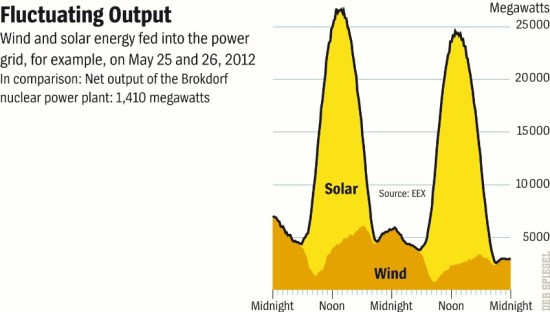
The problem is that wind and solar farms just don’t deliver the same amount of continuous electricity compared with nuclear and gas-fired power plants. To match traditional energy sources, grid operators must be able to exactly predict how strong the wind will blow or the sun will shine.

“Every company — from small businesses to companies listed on the DAX — are buying one (APC emergency power generators) from us.” 

World’s Largest Brown Coal Power Plant Inaugurated In Germany To Help Save Environment

This German energy turnaround stuff can get really complicated, I find.

But as far as I can tell, dirty energy is clean energy here, too. As long as it’s German-made, that is.

“Dieser Neubau ist ein herausragender Beitrag zum Gelingen der Energiewende.” 

Clean Power Cleaning Us Out

The German textile industry, among others, is mad as hell and isn’t going to take it anymore. Not when it comes to having to pay billions into the governments way cool Ökoenergie-Förderung (clean energy surcharge = tax).

That is why three companies now plan to challenge this surcharge subsidizing renewable energy in court.

More good government in action again, I guess. Energy companies have to pay the price for electricity generated through renewable technologies, and transfer the extra cost on to their customers. While energy-intensive industries like aluminum or steel are free from the surcharge, most of the textile industry has to pay.

“You cannot get an energy turnaround for free.”

Biomass Movement Is Over (If You Want It)

Remember the days when crops were something people would eat?

Well the German National Academy of Sciences Leopoldina has just found out that that maybe wasn’t such a bad idea after all.

The German mania for “bioenergy” seems to have already had its day in the solar-powered sun. The academy’s report “Bioenergy – Chances and Limits” concludes that bioenergy is just a lot of bio gas (or hot bio air, if you prefer).

It plays “a minor role in the transition to renewable, sustainable energy sources in Germany at the present time and probably in the future,” requiring more surface area, creating higher greenhouse gas emissions and being more harmful to the environment than other renewable sources.

So what are we going to do with all those imported soybeans now? Eat them? Hey, the plan looked good on green paper, though.

“Die Produktion von Biokraftstoffen stellte eine extrem ineffiziente Nutzung der verfügbaren landwirtschaftlichen Fläche dar.”

Germany Confused About Japan’s “Retreat” From A Nuclear-Free Future

And here we thought that Germans were good at math.

Until Fukushima, Japan satisfied about 30 percent of its electricity demands with nuclear power, while renewable energy made up about 10 percent of the power supply. If one leaves out hydroelectric power, renewables hardly make up more than 1 percent.

“Japan needs a vision.”

We Must Save The World But It Must Be Affordable

Cheap, in other words.

Germans everywhere are slowly waking up to the fact that their revolutionary switch to renewable energy sources is going to cost way too way much more than they ever thought they would ever have to pay – and the German government has now woken up to this.

That is why they have now begun a quiet backpedaling policy designed to prepare the German population for a slow turnaround from the energy turnaround that hasn’t even begun to turn around yet.

“For me it’s a priority that electricity remains affordable,” Germany’s new Environment Minister Peter Altmaier says, for instance.

He also says he doubts that Germany will be able to reach its goal of introducing one million electric cars by 2020.

Nor does he think that Germany will be able to cut its energy consumption by 10 percent that year, a precondition for reaching the illusory goal of 35 percent renewables the government is still aiming for, sort of.

This is the German Environment Minister talking here, folks. So you get the message, don’t you? And if you don’t get it now, you’ll get it later.

Regierung fürchtet die Strompreis-Wut der Wähler

German Solar Energy Industry Tanks, German Tanks Don’t

Unable to compete in the global market without the subsidy drug, state-ordained “energy turnaround” or not, Germany’s solar energy industry is getting eaten alive by cheap Chinese imports as we speak, so-to-speak.

“Ah, screw it,” German industrialists elsewhere in the country say to that. “We’ll just keep making a killing producing what we’ve always produced best: War technology. Tanks, Saudi Arabia!”

“But it’s not like we don’t continue to support the Arab Spring or anything,” another tankful German industrialist added ruefully.

German paper says Saudis want 600-800 tanks.

What’s 20 (30? 40?) Billion Euros These Days?

It’s peanuts, man. Renewable peanuts.

Damn. This gives power madness a whole new meaning.

Germany mapped out a 20 billion euro ($25 billion) plan on Tuesday to expand its power grid and avoid a “power gap” as Europe’s largest economy switches away from nuclear to renewable energy.

Germany’s government, the federal energy network regulator and transmission grid firms unveiled joint plans for thousands of kilometres of new electricity lines to 2022, to help distribute volatile renewable energy.

Operators say some 3,800 kilometers of new power lines needed through 2022.