Airbus (Some Call It Airbias) Needs More Germans

At least that’s what the Germans will tell you if you ask them, which of course nobody is.

OK, we’re actually talking about EADS here. “The German government is deeply concerned by the concentration and centralisation of research and development competencies in the headquarters in Toulouse, which have to a large degree led to the current imbalance,” a pissed off big-time German politician has lamented.

So much for Franco-German understanding (yet again). And if it were up to the Germans, they would even see to it that EADS ensure “equal numbers of French and German nationals occupy positions in the top five leadership levels,” although how you would equally distribute five people is unclear to me (government can do this kind of stuff, you know).

But none of this will lead to anything, folks. I can tell you that right now. The Airbus Chief Executive and designated EADS boss isn’t about to let any pigheaded German government official tell him what to do. His name is Thomas Enders and he’s a pigheaded German himself.

EADS was formed in 2000 from French, German and Spanish assets as a counterweight to U.S. aerospace and defense giants.

Speaking Of Ingratitude

Don’t the Libyans appreciate everything the Germans have done for them? Gee, I guess they don’t.

Before the Libyan revolution, Germany was the country’s second-largest trading partner. But then Germany abstained in a 2011 UN vote to militarily intervene in its civil war. Now that the war is over, German businesses and think tanks are finding that most Libyans want little to do with them.

“Water doesn’t flow uphill on its own / And wars, too, don’t stop themselves.”

Thanks But No Thanks

Undank ist der Welten Lohn (nothing is so hard as man’s ingratitude).

What were you expecting, Germany? The Greeks have politely but firmly said no to a recent offer made by 160 German tax collectors who were ready, willing and able to fly down to Greece and help their Greek tax collector buddies gather Greek taxes in a more efficient and Teutonic-like manner.

The Greeks may be broke, but they’re not crazy. Not even Germans can stand German tax collectors

Als Begründung müssen die “hart arbeitenden griechischen Beamten” herhalten.

Germans Still Scared Of The Internetz

Actually, it’s only the older, digital immigrant kind of Germans who are still scared of the Veb. You know, around 85 to 90 percent of the population?

And these are the folks who want politicians to introduce ever more stringent anti-Internet legislation (more is more here) and get all hysterical about data privacy for data that nobody’s interested in and ran Google Street View out of town and would never think of ever putting their faces (or anything else) on Facebook, provided they could even find the dad dern thing, and think that flash mobs are real mobsters with machine guns and stuff like that and on and on and on. And, oh yeah, these are also the folks who vote here. So there we have it. Old dogs, nix tricks. Tricks are for kids.

Sogenannte Digital Outsiders hält die Angst, die Kontrolle über ihre persönliche Daten zu verlieren, davon ab, überhaupt online zu gehen. Sie fürchten zudem, mit einem versehentlichen falschen Tastendruck das Internet zu löschen.

“Tax Advice Mission” Impossible

How about a little more sensitivity here, Greece? Germans are only trying to help.

And it doesn’t look like they’re going to stop trying to help you anytime soon, either. That’s why if they can’t get that “budget commissioner” they proposed to help monitor the Greek government’s (lack of) management of its finances, some 160 German tax collectors have now selflessly volunteered for assignments in Greece to help gather Greek taxes more efficiently. And as you can imagine, when it comes to taxation and tax collection, German efficiency can really hurt.

A recent flurry of acrimonious exchanges between Athens and Berlin reflect deepening doubts among mainly northern members of the 17-nation euro zone about Greece’s ability and willingness to overhaul its economy to satisfy lenders’ demands.

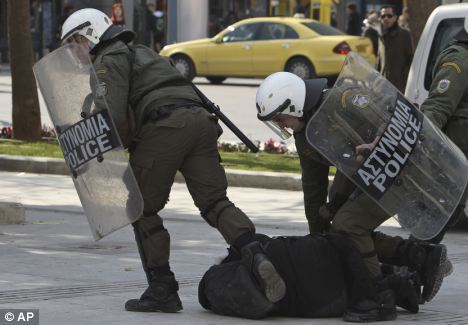
Bundeswehr Protesting Koran Burning Now, Too

In a sharp response to the pure unadulterated fear caused them by the deadly protests now taking place in Afghanistan after the inadvertent burning of copies of the Koran by a US soldier…

The German military has decided to join in the protests itself by rapidly deploying the closure of one of their bases in the north of the country and having their soldiers hightail it in the opposite direction really schnell like where they can run around in sheer panic and large concentric circles not knowing what to do next while screaming oh my God we are all going to die or something to that effect. The few, the proud, the Bundeswehr.

The base would have been shuttered in March, but officials worried its security could not be maintained in the face of the demonstrations.

Endless War And Violence?

And it’s the worse that it’s ever been. And it’s only getting worse, right?

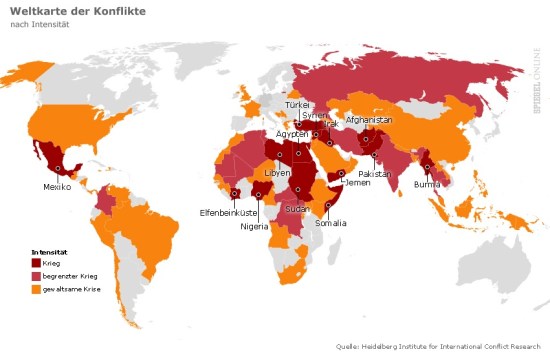
And if you ask this Heidelberg research group who just put out their “Conflict Barometer,” they will tell you that more wars took place worldwide in 2011 than at any time since 1945 (and 2012 doesn’t look all too promising, either).

But what does that mean?

If you really want to put our dreadful, horrible and unspeakably violent age into true historical perspective, do yourself a favor and take a look at what this guy has to say about it.

Thanks for the letting me stumble on to/over this, ¡No Pasarán!

In ihrem “Konflikt-Barometer” zählen Heidelberger Forscher so viele Kriege wie seit 1945 nicht mehr.

Cut The Loses And Run

The German government is about to cut solar subsidies by 30%.

Despite the massive investment, solar power accounts for only about 0.3% of Germany’s total energy. This is one of the key reasons why Germans now pay the second-highest price for electricity in the developed world (exceeded only by Denmark, which aims to be the “world wind-energy champion”).

According to Der Spiegel, even members of Chancellor Angela Merkel’s staff are now describing the policy as a massive money pit. Philipp Rösler, Germany’s Minister of Economics and Technology, has called the spiralling solar subsidies a “threat to the economy.”