They have enough state broadcasting to do on their own as it is, thank you.
The Russian state broadcasters will retaliate by taking the German state broadcaster off the air, of course. Oh why oh why can’t we learn to state broadcast together in peace?
Russia to target German media in response to German ban on RT TV – Russia will retaliate against Germany for banning the German-language service of Russian broadcaster RT, and the response will impact German media accredited in Russia and internet “intermediaries”, the foreign ministry said on Wednesday.
When it comes to potential sanctions against Russia over Ukraine? Gee, I wonder why.
Germany’s Reliance on Russian Gas Limits Europe’s Options in Ukraine Crisis – Berlin is vulnerable if the West sanctions Russia over Ukraine and Moscow responds by cutting off exports.
Or valenki. Or whatever it is he’s wearing right now.
Germany is threatening Russia with dialogue again. That’s what moral superpowers do.
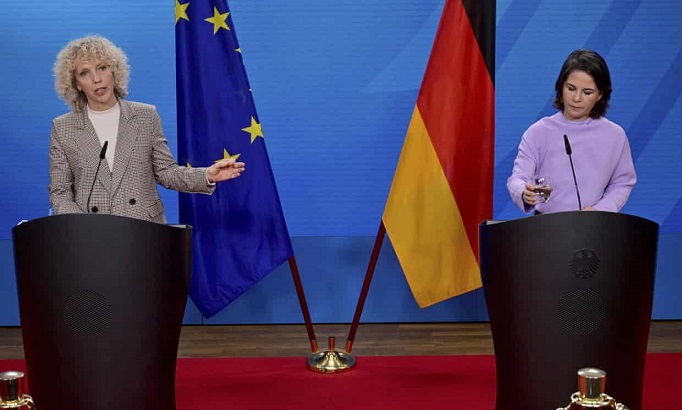
Annalena Baerbock: the German minister staring down Russia over Ukraine – New foreign minister won critics’ respect after meeting with Sergei Lavrov, but has work cut out in push for diplomacy.
Here’s an example: Peinlich stolpert Biden durch seine Pressekonferenz. Meaning: Biden stumbles embarrassingly through his press conference.
A year after his inauguration, the U.S. president is glossing over his mediocre record. On the eve of a possible Russian invasion of Ukraine, of all times, he makes a serious verbal mistake.
Thank goodness. They remain determined to not only keep using nuclear energy, but to ramp up their program.
The French, for their part, haven’t been able to make clear to the Germans a startling discovery they made a few years ago: Nuclear power is reliable because it produces day and night. The German renewables, well, aren’t, don’t and never will.
France ramps up nuclear power as Germany closes plants in the name of clean energy.
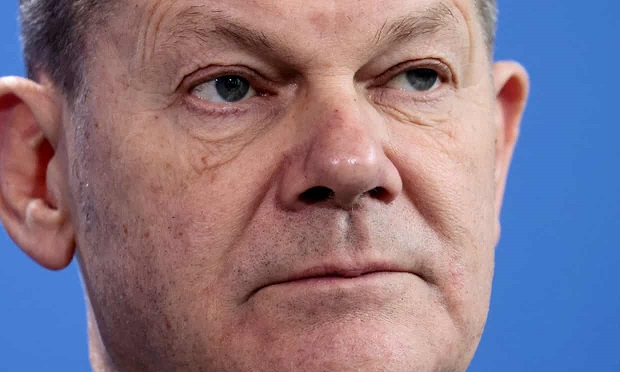
Chancellor Angela Merkel soon caved to public pressure and announced Germany would phase out all nuclear power within 10 years. Her government kept that promise. Germany’s new chancellor, Olaf Scholz, wants to speed up the phase-out of coal and eventually natural gas. He promises that by the end of this decade, 80% of Germany’s energy will be from renewables. And he doesn’t include nuclear in that category.
Coronavirus digest: Germany designates all neighboring countries ‘high risk’ – Germany has put Austria on its travel warning list, meaning all of its neighbors are now designated high-risk. Meanwhile, several Latin American countries have reported record daily infections.
While the number of available intensive care beds continues to rise.
Almost makes you wonder if this latest variant isn’t all that dangerous (am I allowed to wonder that?). Hey, when in doubt (and your everyday, run-of-the-mill top health official apparently always is) just increase the panic level one more notch.
Germany: Omicron wave breaks new weekly cases record – The new wave of coronavirus infections in Germany has now surpassed numbers last seen in November. Experts are warning of the threat this poses to the unvaccinated.
Please? For health reasons? And then there’s COVID too.
Berlin Shortens Film Festival, Requires Vaccination and Testing – The 2022 Berlinale hopes new COVID-19 restrictions will allow it to have in-person screenings and events in February.
The Berlin International Film Festival has cut three days off its official screening schedule for 2022 and introduced new coronavirus measures, requiring attendees to be both fully vaccinated or recently recovered from a COVID-19 infection, plus show a recent negative COVID test.
Berlin 2022 will now run Feb. 10-16, with the festival’s Gold and Silver Bear honors handed out on Wednesday, Feb. 16. The final four days of the festival, Feb. 17-20, will feature repeat screenings of festival titles in cinemas around the German capital. Traditionally, Berlin sets aside one day for these “public screenings.”
You can catch that Omicron cold there lickety-split there these days.
Germany has added to the list of high-risk areas the highest number of countries in over a year at once, including several European Union Member States, amid the increase of Coronavirus cases throughout the world, and in particular, the spread of the Omicron variant.
Updating the list of countries highly affected by the virus on Friday, January 7, 2022, the Robert Koch Institute, which is the German government research institute responsible for disease control and prevention, has expanded the same list by adding the following:
Angola Argentina Australia The Bahamas Bahrain Belize Bolivia Cape Verde The Democratic Republic of the Congo Ivory Coast Estonia Fiji France – the French overseas departments of French Guiana, Guadeloupe, Martinique, Mayotte, St. Martin and St. Barthélemy Gabon Ghana Grenada Guinea Island Israel Jamaica Qatar Kenya Comoros Kuwait Luxembourg Mali Mauritania The Netherlands – the overseas parts of the Kingdom of the Netherlands of Aruba and Curaçao Nigeria Panama Rwanda Zambia Sweden Sierra Leone South Sudan Togo Uganda Uruguay The United Arab Emirates