Pirouettes and Unpredictability

We Germans call the shots here in Europe, sort of.

It’s just that we don’t know what we’re going to be calling next.

“Anybody out there still think Germany is running Europe — or for that matter can or will dominate it in time?

The question fits the moment after the German refusal to vote in favor of allied military intervention in Libya, the government’s pullout from nuclear energy largely for reasons of emotion and domestic political calculation, and its willingness last week to put off possibly decisive steps to end Greece’s debt misery.

Over a period of just about three months, that is a lot of unpredictability and policy pirouettes for allies who might have thought German leadership, on the upside, would be rational, competent and closely bound to the West.”

But We Mentioned Human Rights

You got your values, then you got your interests. Then you have the value of your interests. Then you have the interest you get on the value of those interests.

So, in other words, always look after your own interests if you want good value.

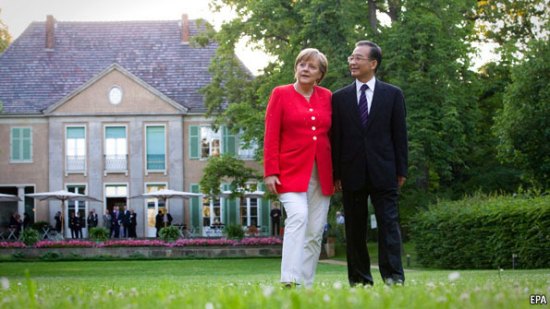
Chinese Premier Wen Jiabao and German Chancellor Angela Merkel also targeted an increase of bilateral trade to 200bn euros ($284bn; £178bn) over the next five years.

Germany is by far China’s biggest trading partner in the European Union.

China and Germany are the two biggest exporters in the world. 

Green Electricity Threatening Energy Turnaround

Yeah, I know. You thought that Germany’s Energiewende (energy turnaround) was synonymous with green or eco-power (I did too). But if you listen to what some scientist types are saying (Rheinisch-Westfälischen Institut für Wirtschaftsforschung or RWI, for instance)–and you won’t, and nobody else will either–the present state of renewable energy in Germany is so clearly deficient and so way too costly (especially when it comes to generating solar energy) that they recommend rethinking the whole big turnaraound thang (not that all that much thinking had gone into it in the first place or anything, that rethinking part was just a figure of speach).

Some of these folks are even starting to call this mess Der große Solarschwindel (The Great Solar Energy Scam). But, like I said, nobody is particularly interested in hearing about things like this. Or do you want the Green Shirts to come knocking on your door one night? And after all, money is no object here. It never is when it isn’t your own.

Es bestehen derzeit in Deutschland so große Defizite in Bezug auf Leitungsbau, Speicherkapazitäten und bei der Vernetzung mit den europäischen Nachbarn, dass es vorerst nicht ratsam erscheint, mit dem Ausbau regenerativer Stromerzeugungskapazitäten fortzufahren.

German Recycling Destroying Umwelt

Bad consumer! Environmental groups are alarmed and warning that the entire German reusable bottle system as we know it may soon be on the verge of collapse. And it’s all because of you, ihr Flaschen (“you bottles,” a German idiom for losers). You’re recyling the wrong bottles (the plastic ones, these are “bad”).

Horror of horrors or something. Just when Big Green Brother finally got you to robotically return your bottles to the reusable bottle robots located at your local supermarket, like you should, for your own good, you start buying more plastic returnables (thinking that these are as “good” as good old glass ones), causing the share of environmentally friendly bottles in circulation to sink from 70 to 50 percent. If this continues, the whole system will become “unprofitable,” whatever that means.

It seems that Fearless Leader’s five-year plan actually called for a percentage of 80 percent of environmentally friendly bottles to be in circulation so you have all failed miserably and will now have to be reprogrammed at your own cost again so that you know better and start buying the good glass recyclable bottles instead. And returning them to the robots (the machine ones). After you have emptied them, I mean (the bottles). Ah, the hell with it. They’ll explain it all to you better later.

Eine bessere Kennzeichnung und ökologisch differenzierte Steuer werden verlangt.

Debt Expert Deutschland

SPIEGEL ONLINE: Mr. Ritschl, Germany is coming across like a know-it-all in the debate over aid for Greece. Berlin is intransigent and is demanding obedience from Athens. Is this attitude justified?

Ritschl: No, there is no basis for it.

SPIEGEL ONLINE: Most Germans would likely disagree.

Ritschl: That may be, but during the 20th century, Germany was responsible for what were the biggest national bankruptcies in recent history. It is only thanks to the United States, which sacrificed vast amounts of money after both World War I and World War II, that Germany is financially stable today and holds the status of Europe’s headmaster. That fact, unfortunately, often seems to be forgotten.

SPIEGEL ONLINE: What happened back then exactly?

Ritschl: From 1924 to 1929, the Weimar Republic lived on credit and even borrowed the money it needed for its World War I reparations payments from America. This credit pyramid collapsed during the economic crisis of 1931. The money was gone, the damage to the United States enormous, the effect on the global economy devastating.

SPIEGEL ONLINE: The situation after World War II was similar.

Ritschl: But right afterwards, America immediately took steps to ensure there wouldn’t be a repeat of high reparations demands made on Germany. With only a few exceptions, all such demands were put on the backburner until Germany’s future reunification. For Germany, that was a life-saving gesture, and it was the actual financial basis of the Wirtschaftswunder, or economic miracle (that began in the 1950s). But it also meant that the victims of the German occupation in Europe also had to forgo reparations, including the Greeks.

“He warns the country should take a more chaste approach in the euro crisis or it could face renewed demands for World War II reparations.”

A Country Named Sue

You sue, I sue, we all do (sue). And here I thought Germany was the land of Konsens (consensus – not common sense). At least when it comes to doing this nuclear phaseout thang, I mean. Fooled again.

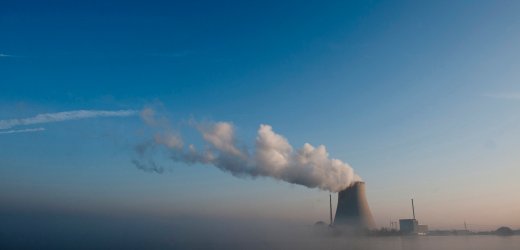
OK, it is logical and predictable that Germany’s power companies now have hurt feelings and are preparing to take legal action against the government’s decision to shut down their nuclear power plants because, well, the government is shutting down their nuclear power plants.

But what about all the thousands of lawsuits being prepared by power-line, wind energy and other regional resistance group apponents the nation over set to flood the lawsuit market once these big honkin’ power-line thingies start going up? You know, the power-lines that will transport the good offshore wind farm energy from the north to the bad industrial south?

Why can’t we (as in you) learn to live together in simple peace and harmony? Now that the nuclear power dragon has finally been slain, I mean. Come on, folks. Join hands, form a circle, sit down and talk.

Specifically, they will invoke Article 14 of the German constitution, which addresses the question of whether the companies’ assets are being expropriated, and if they are therefore entitled to compensation. After that, the amount of compensation would be negotiated in civil courts. According to internal calculations, the industry envisions a potential sum of €20 billion ($29 billion). The burden would ultimately fall on taxpayers.

“Frau am Steuer…das wird teuer!”

“A woman at the wheel, that’ll cost you!”

Who would have thought that? According to Germany’s Federal Agency for Electricity, the German electricity grid is in a thoroughly chaotic condition these days. No one can explain why. And the cost of purchasing needed electricity (nuclear generated) at the European Energy Exchange has already gone up 10 percent and further increases are expected to follow soon. It’s bizarre. It’s almost as if some crazy person had shut down eight nuclear power plants here or something.

Yup, Angie Merkel’s Fukushima-driven German angst Atomaustieg (nuclear phase-out) may have indeed been absolutely necessary and of critical urgency (opinion polls, folks, you gots to give the people what they want), but hysteria does have its price. Even in Germany, I mean. But who cares? I know the Germans pretty well and I am convinced that they are all going to be more than willing to pay radically higher electricity bills in order to avoid the, uh, tsunami threat on the home front.

What I really don’t understand is the economics at play here. There is clearly an overabundance of hysteria in this country, right? Shouldn’t that make the price of hysteria, like, cheaper or something? I’d ask an economist but you know how the adage goes: For every economist there is an equal and opposite economist.

“Das Bundeskartellamt erwartet als Folge des Atomausstiegs steigende Strompreise. An der Strombörse sind die Preise bereits um zehn Prozent gestiegen.”

Über Euro Über Alles?

Time for a new European currency yet?

“The real threat to the euro isn’t that a weak peripheral country like Greece might withdraw in an effort to devalue its way to competitiveness, but rather that Germany might want to pull out.”

This guy makes a very interesting point. He goes into what he defines as the three main problems that have led Greece, Portugal, Ireland and Spain (not yet, but soon) to the dismal position they are now in and suggests that because of the coming bailout fatique, the only way to save the union is, well, to divide it. This could best be done by introducing an Über Euro in the non-bailout nations.

“Germany’s incentive to leave grows with each bailout, and Berlin could ultimately make a simple calculation that extrication will be less costly than continuing the sacrifice needed to keep the euro.”

To avoid this, one could strike a grand bargain by creating this new currency. “These nations then announce that all obligations between their citizens will henceforth be denominated in the new currency, the Über Euro, which would eventually be managed by the Bundesbank. The Über Euro would initially be set at a value of perhaps 1.3 euros, setting the stage for an export boom for countries that continue to use the euro. This would allow the remaining eurozone members to restore their competitiveness without having their financial systems go bankrupt; it also would allow Germany to sell the plan as saving Europe without breaking up the EU.”

“Should the remaining euro countries continue irresponsible fiscal policies, the European Central Bank (which would continue to be their central bank), would slowly monetize their debt. The euro would continue to depreciate against the Über Euro and perhaps end up as junk currency. …The ECB’s stature would be diminished and its balance sheet probably trashed.”

Sounds like a good plan to me (for world domination?). But I’m not very good with money, either.

There is no inherent reason the European project cannot proceed with two currencies and the citizenry may force this outcome.

PS: Beware, Greece. As the Wall Street Journal puts it, there’s a Wolfgang at your door.

Germans Meant “Work Harder”

Down south (in battling the Greek debt crisis, for instance). Not longer. A study based on OECD and Eurostat figures has determined that Germans work less annually than their no good and lazy Southern European neighbors.

The study indicates that “a German’s average annual work duration (1,390 hours) was substantially lower than for a Greek (2,119), an Italian (1,773) a Portuguese (1,719) and a Spaniard (1,654).”

But at least for that the Germans work more intensely, right? Not according to that study, they don’t.

But at least they mean well, or something?

“Germany’s productivity per head remains close to the average of southern European countries. Its hourly productivity rate is above average but not better than France or Greece,”