What happened?

The Greens happened.

Now it’s US-Amerika‘s turn (some call it The Banana Republic).

Germany went from envy of the world to the worst-performing major developed economy. What happened?

For most of this century, Germany racked up one economic success after another, dominating global markets for high-end products like luxury cars and industrial machinery, selling so much to the rest of the world that half the economy ran on exports.

Jobs were plentiful, the government’s financial coffers grew as other European countries drowned in debt, and books were written about what other countries could learn from Germany.

No longer. Now, Germany is the world’s worst-performing major developed economy, with both the International Monetary Fund and European Union expecting it to shrink this year.

Green Diplomacy

It’s a lot like Green energy utopia. It has nothing to do with the real world.

Real world diplomacy rule number one: Never actually speak the truth.

Beijing summons German ambassador after foreign minister calls Xi Jinping a ‘dictator’ – While they are major trade partners, Berlin-Beijing ties have been fraying as some in the German government take a harder line over issues ranging from human rights to Taiwan.

Baerbock, who has pushed for a more hawkish line, made the remarks in a Fox News interview on Thursday during a visit to the US.

While talking about the Ukraine war, she said: “If Putin were to win this war, what sign would that be for other dictators in the world, like Xi, like the Chinese president? So therefore Ukraine has to win this war.”

We’re number one!

At saving the planet.

Too bad we’re destroying ourselves in the process.

Strike one: Germany’s nuclear phase-out.
Strike two: Its self-inflicted energy dependency on Russia.
Strike three: Still believing that renewable energy can run an industrialized country.

Green energy prices are killing German industry right before our very eyes.

Germany predicted to be the only major European economy to contract this year as recession lingers – The German economy has struggled in the wake of Russia’s invasion of Ukraine, with Berlin having to, very quickly, end years of energy dependency on the Kremlin. The International Monetary Fund said in July that Germany would likely contract by 0.3% this year.

Speaking of the agony of got beat…

You win a few, you lose a few more.

Germany routed 4-1 by Japan in friendly as pressure mounts on coach Hansi Flick – Germany was jeered by its home crowd Saturday after slumping to a 4-1 loss to Japan to pile yet more pressure on coach Hansi Flick, nine months out from hosting the European Championship.

The German defence allowed Japan a string of chances on the counter and the result highlights the lack of progress since a 2-1 loss to Japan played a key role in Germany going out of last year’s World Cup in the group stage. Flick’s team has not won any of its last five games and conceded 13 goals in that time.

German of the day: alles bestens

That means everything is fine, cool, hunky-dory.

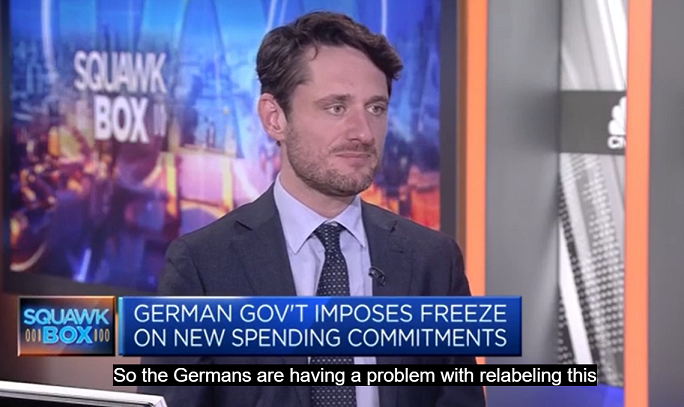
Falling industrial output for three straight months ain’t no big deal, says German Green Vice Chancellor Robert Habeck. And “not everything is bad,” he added. Wow. That’s actually unbridled optimism for a Green.

Habeck defends German economy as output drops – Vice Chancellor Robert Habeck said Germany remains a “highly attractive location” for investors. But the statistics agency said industrial output fell for a third straight month, and that wasn’t the only negative news.

Englisch of the Day: Guarantee

This is an assurance that another’s obligation will be fulfilled, or something presented as such security; guaranty. In this case, they mean with taxpayer money.

And the guarantee is that the Germany economy is guaranteed to fall flat on its face if the German government continues its odd obsession with remaining dependent on China as a business partner. It’s recent dependency on Russan gas was just that much fun, I guess.

German guarantees for China investments plummet -document.

The volume of investment guarantees provided by the German government to companies investing in China has collapsed this year, a government document showed, highlighting the impact of Berlin’s efforts to end over-reliance on the country.

Only 51.9 million euros ($56.26 million) in guarantees have been issued so far this year, according to the document seen by Reuters, less than a tenth of the 745.9 million euros in guarantees issued over the whole of last year.

Go Green, Go Broke

I know, it doesn’t ryhme as well as with “woke” but it’s OK. They’re woke too.

We’ll see for how much longer, though.

Nearly two-thirds of Germans want new government, poll says – A survey shows nearly two-thirds of voters want to pull the plug on Germany’s ruling coalition. The poll comes immediately after figures that show most Germans are unhappy with Chancellor Olaf Scholz and his government.

As many as 64% of Germans who answered in the survey released on Saturday said a change of government would make the country a better place…

Pollsters also asked about the so-called “traffic light” coalition of center-left Social Democrats (SPD), the Greens, and the neoliberal Free Democrats (FDP). Voters were asked how it measured up against Chancellor Angela Merkel’s “Grand Coalition” of conservative Christian Democrats/Christian Socialists (CDU/CSU) and the SPD.

German of the day: Unschlagbar

That means unbeatable.

Like Germany itself. Germany is unbeatable when it comes to beating Germany. Take German bureaucracy, for example. Please.

Germany is becoming expert at defeating itself – Bureaucracy and strategic blunders are starting to pile up.

In “the twelve tasks of asterix”, an animated film from 1976, one of the feats the diminutive Gaul must perform is to secure a government permit. To do so he must visit a vast office called The Place That Sends You Mad. In a recent open letter Wolfram Axthelm, the head of the German Wind Energy Association, likened modern Germany’s infuriating bureaucracy to Asterix’s challenge. A particular gripe was the 150-odd permits demanded by Autobahn GmbH, a state-owned firm that runs Germany’s vaunted motorways, for transporting outsize components of wind turbines, such as blades. Between byzantine rules on load dimensions, faulty software, perennial roadworks and a lack of personnel to process complaints, a backlog of some 20,000 applications has built up. A company that recently trucked a turbine from the port of Bremen to a site in the northern state of Schleswig-Holstein found that although the distance is barely 100km (62 miles), road restrictions made the journey five times that long…