Gold-obsessed German Smuggler Drops Plans To Rob Fort Knox

But gets caught at Athens International Airport attempting to smuggle half a ton of gold and silver out of Greece to Germany instead.

Goldfinger

Wait a second. Aren’t the Germans the ones who are supposed to be smuggling their gold (as in Geld) into Greece these days?

The man was trying to board a Lufthansa flight back to Germany when the airline uncovered nearly 1,000 lbs. of what the BBC calls silver “tablets” in a cargo container.

Germans Tired Of Being Cast As The Euro Zone’s Scapegoats

But once they take a nap and rest a little bit, they won’t be so tired anymore.

Scapegoats

Sometimes Germany was too weak, sometimes too strong. Or, as Henry Kissinger, a former American secretary of state, put it, referring to Germany just after unification in 1871, it was “too big for Europe, but too small for the world”. Today, Mr Simms (Cambridge University) argues, “it sits uneasily at the heart of an EU that was conceived largely to constrain German power but which has served instead to increase it, and whose design flaws have unintentionally deprived many other Europeans of sovereignty.”

The question is whether Germany can use its power by unapologetically leading. Given Germany’s past, its political culture militates against even trying.

“It’s nice to go to a conference of ‘young leaders’, but you don’t want a conference of ‘junge Führer’.”

Rich Germans Actually The Euro Zone Po Folks

As recently reported, rich Germans have suddenly and inexplicably become the poor men of Europe, relatively speaking.

Poor

According to the latest ECB Vermögensstudie (wealth study), the Cypriots, of all people, are among the richest citizens in the euro zone. Germans, on the other hand, have come in at last place.

Wait a second. Wasn’t there something recently about Cyprus striking a 10-billion euro bailout deal with the European Union? I must have got that wrong (or the Cypriots certainly got that right).

Ausgerechnet die Zyprer gehören zu den reichsten Bürgern der Euro-Zone, Deutschland steht am Ende der Rangliste.


Europe’s Largest And Most Prosperous Nation Shocked About Being Treated Unfairly

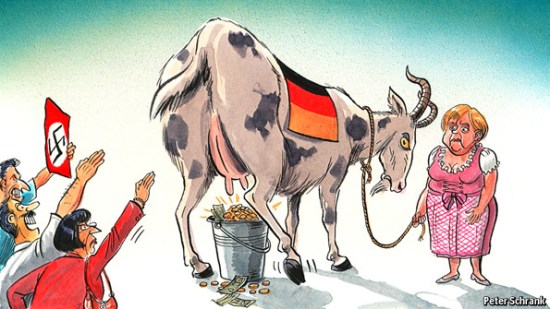
The intense negative reactions to the Cyprus bailout program, including the constant comparisons made to Germany’s Nazi past, appear to have taken many Germans by complete surprise. Most simply cannot understand why people do not like them just because they are big and strong.

Merkel

Germany has contributed more than 220 billion euros, or $280 billion, pledged through loans and financial support packages for Greece, Ireland, Portugal and Spain, all negotiated with those countries’ euro zone partners, for instance. And yet unfair allegations continue to be made.

Nor were Germans alone in insisting on reforms from those European partners seeking financial assistance. The Netherlands, Finland and Austria are frequently mentioned as countries that hold a similar position, yet Germany always ends up being the target of anger.

“We just don’t get it,” one German politician was quoted as saying. “It’s as if they don’t like us just because we are big and strong, because of our affluence and our power. It’s as if they resent our very existence because of this and because of the new soft hegemony we are now practising in Europe. They feel that we are materialistic, hedonistic, egotistical and shallow. I don’t know, in the end they’re just envious and jealous.”

“I mean,” he then continued. “It’s not is if we were some sinister dominating powerhouse like the USA or anything, spreading its corruptive capitalistic influence too widely around the globe the way it does, smothering the rest of us with it’s commercial and materialistic view of life and the world. We’re just well-intentioned Germans, remember?”

“Germany acts in solidarity so that crisis countries will have a perspective in the future. I wish that those people at the top — the president of the E.U. Commission and the E.U. president — would defend Germans against unfair allegations.”

The Worst Is Over

Or something.

Growth

For much of the financial crisis that started in 2007, Germany remained strong and held the envy of modern economies around the world.

In 2010, the industrious country known for its fiscal discipline had GDP growth of 4.2%, followed by respectable 3% GDP growth in 2011.

Unfortunately, for Germans and the world, there are increasing signs the German economy is being marred by the global crisis. In 2012, GDP growth was a meager 0.7%. More significantly, GDP actually contracted by 0.5% in the fourth quarter.

Währung – Deutschland: Devisen: Euro gibt nach – IWF prognostiziert auch für 2013 Rezession im Euroraum

Buy Our Debt, Please

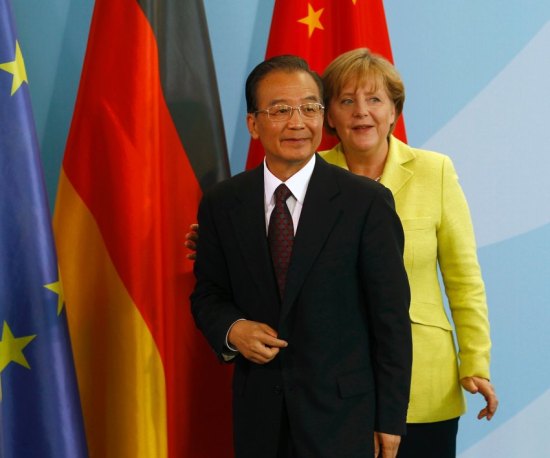
Angela Merkel just finished up another quick and dirty visit to China, this time to calm the Chinese down about the euro zone debt crisis and, well, to grovel for money. Neither aim was achieved just yet. But hey, you’ve got to be really patient with the Chinese, I’m told.

“The trip has a lot of ambitions: one, is to explain the euro zone debt crisis to the Chinese and two, convince the Chinese to keep supporting the euro zone and buying the bonds from some of the euro zone countries such as Italy and Spain and also Germany.”

And just in case you were wondering, no. She did not find the time to express German concern for human rights violations in China during this visit.

As Europe’s crisis persists, China increasingly sees Germany—its largest European trading partner—as a vital player in pulling the continent out of its slump, analysts say. Mr. Wen said his talks with Ms. Merkel Thursday have made him “more confident” in Europe’s ability to resolve the crisis.

Bonds, German Bonds

That’s the thing about a crisis: There’s always a winner, too. Take the euro crises, for instance. And the demand for German bonds these days.

Demand for German bonds, seen as the safest haven in the euro zone, has pushed Berlin’s borrowing costs so low that some investors are effectively paying Germany for the privilege of lending it money.

Damn. This gives German bondage a whole new meaning.

Low interest rates on German bonds are translating into billions in savings. Now economists have calculated that the country should be able to balance its budget by next year — something that is likely to increase criticism of Germany’s crisis management.

…The perception that Germany is benefiting financially from the crisis while imposing strict austerity measures on countries in southern Europe is unlikely to win many friends for Chancellor Angela Merkel, who is already highly unpopular in countries such as Greece.

“Tax Advice Mission” Impossible

How about a little more sensitivity here, Greece? Germans are only trying to help.

And it doesn’t look like they’re going to stop trying to help you anytime soon, either. That’s why if they can’t get that “budget commissioner” they proposed to help monitor the Greek government’s (lack of) management of its finances, some 160 German tax collectors have now selflessly volunteered for assignments in Greece to help gather Greek taxes more efficiently. And as you can imagine, when it comes to taxation and tax collection, German efficiency can really hurt.

A recent flurry of acrimonious exchanges between Athens and Berlin reflect deepening doubts among mainly northern members of the 17-nation euro zone about Greece’s ability and willingness to overhaul its economy to satisfy lenders’ demands.

Merkel To Discuss Human Rights While In China

Very, very, discretely, that is. If at all.

After all, what are draconian measures against Chinese civil rights activists, state censorship and unrest in Tibet compared to all those trillions of dollars of Chinese currency reserves just waiting to be invested in debt-ridden euro zone countries like, well, her own? And waiting and waiting and waiting, I might add.

Who says grovelling will get you nowhere? Maybe I did. But at least it’s worth a try.

“Chinese investments are expressly welcome. They will be sought, used and appreciated — both in Germany and in the rest of the euro zone.” 

Or Maybe It Does Stink (Our Debt)

What, me worry?

The German debt agency was forced to retain almost half of a sale of 6 billion euros due to a shortage of bids by investors, sparking fears that Europe’s debt crisis is now even starting to threaten Berlin.

The German government is still resisting calls (from France and elsewhere) to allow the ECB to act more decisively.

“It is a complete and utter disaster,” one financial expert dude in London said. “And everybody has hurt feelings,” I replied. “And that’s the main thing.”

It’s starting to get ugly, folks, in other words. Uh, are we having a panic yet?

“The debt crisis is burrowing ever deeper, like a worm, and is now reaching Germany.”