Europe’s largest emitter of CO2 wants to start burying it in the ocean.
Do you have any idea how much dirt that would take?
OK, they want to bury it in sub-seabed storage. But still.
Germany to allow carbon capture, underwater storage – German Economy Minister Robert Habeck says Berlin will need to allow sub-seabed storage of CO2 produced in certain industries in order to reach its goal to be carbon neutral by 2045.
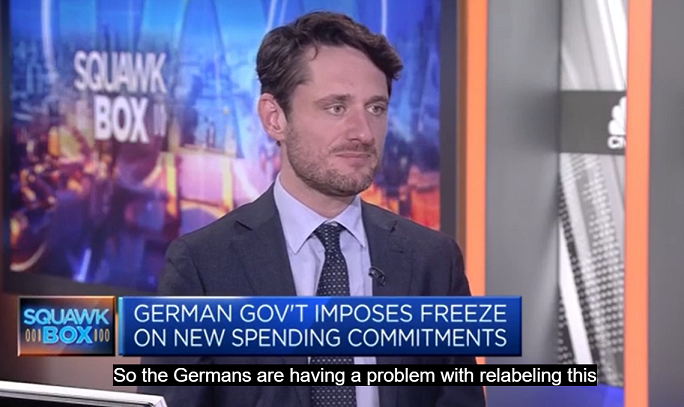
Germany’s economy is on shaky ground and glimmers of hope are few and far between – Good news has been sparse for the German economy. And the latest economic data has not done much to change this.
A few key 2023 data points, namely factory orders, exports and industrial production, were out last week and indicated a weak end to the year that saw questions about Germany being the “sick man of Europe” resurface.
Into the brave new renewable energy future. The German government has announced it will spend €16 billion to build four major natural gas plants to meet the electricity demand their beloved renewable energy technology simply can’t meet.
A brilliant move, and long expected. Overdue, actually. You see, wind and solar power are so unreliable that you must always build a second “dirty” system (CO2 is a BAD “pollutant,” remember?) to back them up. This way you get to spend twice as much as you would have if you had only used the dirty system to begin with. Or, heavens forbid, if you had used nuclear energy to begin with (it doesn’t produce any CO2). This way, in other words, you can save the planet with one hand while you continue to pollute it with the other.
After scrapping nuclear reactors, Germany to spend billions on new gas power plants – The fossil fuel expansion is needed to ensure long-term energy security, according to industry and the government.
In a statement Monday, officials said the new strategy came “in addition to the consistent expansion of renewable energies,” and was key to ensuring steady power supplies “even in times where there is little sun and wind.”
German industrial output drops unexpectedly in November – German industrial production fell unexpectedly in November by 0.7% compared to the previous month, the federal statistics office said on Tuesday.
As reported earlier, this only confirms that the Green plan to shut down Germany in order to save the planet is running like clockwork.
When your industries start to tank because of the high costs caused by Green renewable energy fantasies, you produce less.
The less you do, the less CO2.
Germany’s 2023 CO2 emissions fall to lowest in 70 years but drop not yet sustainable – study.
Germany’s carbon dioxide emissions in 2023 fell to their lowest since the 1950s due to less coal-fired power and reduced output by energy-intensive industries, but the decline is unsustainable without climate policy changes, a study said on Thursday…
Industry emissions met government targets, falling 12% year-on-year, at 144 million tonnes, following an 11% drop in energy-intensive output, it added, warning that that fall could be lost this year with the sector’s recovery.
Germany’s Greens thought their moment had finally come…But then, last month, Germany’s top court handed down a ruling that effectively stripped the ruling coalition of the full financial firepower it needs to make those ambitions a reality.
The bombshell ruling by Germany’s Constitutional Court blew a €60 billion hole in the country’s finances, leaving the government scrambling to fill the gap. At the same time, the ruling sharply limits the government’s ability to draw from special funds created to circumvent the country’s constitutional debt brake, which restricts the federal deficit to 0.35 percent of GDP except in times of emergency.
These special funds were supposed to help finance several projects which are core to the Greens’ agenda — such as the transition of steel plants to hydrogen energy, subsidies for battery and microchip production, and the modernization of the country’s railway network.
A government with Net Zero Honesty? Good luck with that.
The truth hurts too much.
Germany Faces the Green Fiscal Truth – The constitutional court rules Berlin will have to fund net zero honestly.
Things have gone from bad to worse in Germany this week after a court ruling that’s forcing the government to do something truly shocking: level with voters about how much the net-zero energy transition will cost. Please pass the smelling salts.
This is a classic German Green phenomenon. As soon as they’re given power, they promptly proceed to shoot themselves in the foot by proposing “solutions” to non-existent problems that “regular folks” simply can’t understand, much less afford. They’ve been given enough rope, in other words.
How Germany’s Greens Lost Their Luster – The party was riding high when it entered the government two years ago. Now it is stumbling, blamed for driving voters to the far right.
What a difference two years make. And a Russian invasion of Ukraine. And rising energy costs. And a host of missteps that some even within the party concede has stalled the Greens’ momentum.
Today the Greens are widely viewed as a drag on the government of the Social Democratic chancellor, Olaf Scholz, which one poll gave a mere 19 percent approval rating. The Greens have drawn withering attacks from even their own coalition partners. To their opponents, the Greens have overreached on their agenda and become the face of an out-of-touch environmental elitism that has alienated many voters, sending droves to the far right.
Like, what are we supposed to do? Take the concerns of our fellow citizens seriously (see Migrant Madness, unaffordable energy, the housing crisis, inflation, Ukraine, etc.)?
That’s out of the question.
Germany bewildered about how to halt the rise of the AfD – The far right’s rise is sending shock waves through the country’s political landscape.
In Germany, news regarding the seemingly unstoppable rise of the right-wing Alternative for Germany (AfD) appears on an almost weekly basis. But nowadays this isn’t just true of the notoriously AfD-friendly states in east Germany, it’s also spreading further west.
In Saxony, Thuringia and Brandenburg, the AfD is currently running well above 30 percent. The party is gaining ground in the former West German states of Hesse and Bavaria as well, where it is expected to land at around 15 percent in this weekend’s elections.
The Green obsession with doing without is in full nighttime bloom.
Germany passes law to make energy savings compulsory – Germany’s lower house of parliament on Thursday passed a bill to make saving energy compulsory in all economic sectors, a move intended to help fight climate change and curb use of imported fossil fuels.
The Energy Efficiency Act, introduced by the Greens-led economy ministry, includes regulation for energy savings in public buildings, industry and fast-growing data centres across Germany, with the goal of a 26.5% cut by 2030 from 2008.
Spurred by fears that persistently low Russian gas supplies could lead to shortages, the German government introduced some initial energy-saving measures last year, including banning heating for private swimming pools and encouraging people to work from home.






 Observing Hermann