Category Archives: Hypocrisy
Pirouettes and Unpredictability
We Germans call the shots here in Europe, sort of.
It’s just that we don’t know what we’re going to be calling next.
“Anybody out there still think Germany is running Europe — or for that matter can or will dominate it in time?
The question fits the moment after the German refusal to vote in favor of allied military intervention in Libya, the government’s pullout from nuclear energy largely for reasons of emotion and domestic political calculation, and its willingness last week to put off possibly decisive steps to end Greece’s debt misery.
Over a period of just about three months, that is a lot of unpredictability and policy pirouettes for allies who might have thought German leadership, on the upside, would be rational, competent and closely bound to the West.”
Germany’s Latest Contribution To The Arab Spring
These must be special Panzer for Peace or something, these 200 ultra-modern Leopard battle tanks Germany is now prepared to supply to Saudi Arabia.
This is a dramatic reversal of Germany’s decade-long policy of not furnishing that zany authoritarian kingdom with heavy weapons and is clearly designed to send a strong message to freedom-loving Arab protesters everywhere (the Saudi military recently helped put down protests in Bahrain, if you recall).
Whether that is the right message or not, that’s another question.
According to the Stockholm International Peace Research Institute (SIPRI), the main buyers of German weapons systems in the years 2006 through 2010 were:
Greece (with a share of 15 percent)
South Africa (11 percent)
Turkey (10 percent)
South Korea (nine percent)
Malaysia (seven percent)
SIPRI said that Germany advanced from fifth to third place among the biggest arms sellers between 1998 and 2009, even though a previous center-left government pledged in 2000 to pursue a “restrictive'” policy on exporting defense technology.
But We Mentioned Human Rights
You got your values, then you got your interests. Then you have the value of your interests. Then you have the interest you get on the value of those interests.
So, in other words, always look after your own interests if you want good value.
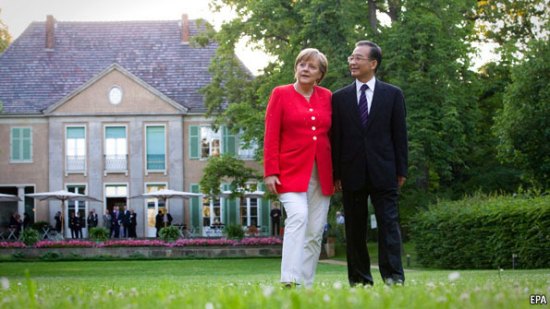
Chinese Premier Wen Jiabao and German Chancellor Angela Merkel also targeted an increase of bilateral trade to 200bn euros ($284bn; £178bn) over the next five years.
Germany is by far China’s biggest trading partner in the European Union.
China and Germany are the two biggest exporters in the world.
Guns R Us
How magnanimous or something. Now that NATO is running out of munitions to use in the Libya conflict (go Europe!), Germany has decided not to obstain from sending weapons to its allies.
The positive response to the politically sensitive demand is another concession to its allies by the German government, which has been heavily criticized in recent weeks because of its Security Council abstention in the March vote, which resulted in a resolution authorizing the use of force to protect Libya’s civilian population. Russia and China also abstained.
“NATO allies must pool funds or face decline: Gates”
Debt Expert Deutschland
SPIEGEL ONLINE: Mr. Ritschl, Germany is coming across like a know-it-all in the debate over aid for Greece. Berlin is intransigent and is demanding obedience from Athens. Is this attitude justified?
Ritschl: No, there is no basis for it.
SPIEGEL ONLINE: Most Germans would likely disagree.
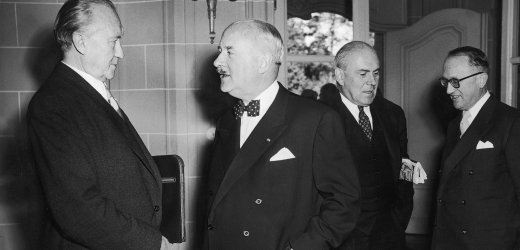
Ritschl: That may be, but during the 20th century, Germany was responsible for what were the biggest national bankruptcies in recent history. It is only thanks to the United States, which sacrificed vast amounts of money after both World War I and World War II, that Germany is financially stable today and holds the status of Europe’s headmaster. That fact, unfortunately, often seems to be forgotten.
SPIEGEL ONLINE: What happened back then exactly?
Ritschl: From 1924 to 1929, the Weimar Republic lived on credit and even borrowed the money it needed for its World War I reparations payments from America. This credit pyramid collapsed during the economic crisis of 1931. The money was gone, the damage to the United States enormous, the effect on the global economy devastating.
SPIEGEL ONLINE: The situation after World War II was similar.
Ritschl: But right afterwards, America immediately took steps to ensure there wouldn’t be a repeat of high reparations demands made on Germany. With only a few exceptions, all such demands were put on the backburner until Germany’s future reunification. For Germany, that was a life-saving gesture, and it was the actual financial basis of the Wirtschaftswunder, or economic miracle (that began in the 1950s). But it also meant that the victims of the German occupation in Europe also had to forgo reparations, including the Greeks.
“He warns the country should take a more chaste approach in the euro crisis or it could face renewed demands for World War II reparations.”
A Country Named Sue
You sue, I sue, we all do (sue). And here I thought Germany was the land of Konsens (consensus – not common sense). At least when it comes to doing this nuclear phaseout thang, I mean. Fooled again.
OK, it is logical and predictable that Germany’s power companies now have hurt feelings and are preparing to take legal action against the government’s decision to shut down their nuclear power plants because, well, the government is shutting down their nuclear power plants.
But what about all the thousands of lawsuits being prepared by power-line, wind energy and other regional resistance group apponents the nation over set to flood the lawsuit market once these big honkin’ power-line thingies start going up? You know, the power-lines that will transport the good offshore wind farm energy from the north to the bad industrial south?
Why can’t we (as in you) learn to live together in simple peace and harmony? Now that the nuclear power dragon has finally been slain, I mean. Come on, folks. Join hands, form a circle, sit down and talk.
Specifically, they will invoke Article 14 of the German constitution, which addresses the question of whether the companies’ assets are being expropriated, and if they are therefore entitled to compensation. After that, the amount of compensation would be negotiated in civil courts. According to internal calculations, the industry envisions a potential sum of €20 billion ($29 billion). The burden would ultimately fall on taxpayers.
The Green Plague (Another Green Shirt Terror Post)
Now it’s tainted German sprouts that have caused the deadly E. coli (Ehec) outbreak (but remember, the source of the outbreak seems to change here every few hours–ask Spanish organic cucumber farmers). Sprouts? That’s another one of them there green organic foods, ain’t it?
Anyway, one German Spiegel reader who goes by the name of alex300 is mad as hell and isn’t going to take it anymore. I feel his pain and stuff. He writes:
“What have we learned from the organic crisis?
1. That green organic farmers can cause more damage than Chernobyl and Fukushima together. How many deaths have been attributed to Fukushima? Just one worker who died of a heart attack. How many deaths do we have to thank for the green organic madness? More than 2000 contaminated by health stores and organic sprouts, about 1000 of them with irreparable brain and kidney damage, and 21 dead.
2. That biogas plants are much more dangerous than nuclear reactors. An atomic reactor can contaminate a 30 km area around it, max. The multiresistant bacteria that breed in biogas plants can wipe out all of humanity.
No power to the green organic plague!”
I hope alex300 is feeling better now. I sure do. For now.
Was haben wir aus der Biokrise gelernt?
1. Die grünen Biobauer können viel mehr schaden anrichten als Tschernobyl und Fukushima zusammen. Wie viele Tote hat Fukushima verschuldet? Nur einen Arbeiter, der an einem Herzinfarkt verstarb. Wie viele Tote haben wir dank dem grünen Biowahn? Mehr als 2000 verseuchten durch Reformhäuser und Biosprossen, ca. 1000 mit irreparablen Hirn- und Nierenschäden und 21 Toten.
2. Die Biogasanlagen sind wesentlich gefährlicher als die AKWs. Ein AKW kann maximal 30 km Umgebung gefährlich verseuchen. Die multiresistenten Bakterien, die in Biogasanlagen brüten, können die ganze Menschheit auslöschen.
Keine Macht der grünen Bioseuche!
Germans Meant “Work Harder”
Down south (in battling the Greek debt crisis, for instance). Not longer. A study based on OECD and Eurostat figures has determined that Germans work less annually than their no good and lazy Southern European neighbors.
The study indicates that “a German’s average annual work duration (1,390 hours) was substantially lower than for a Greek (2,119), an Italian (1,773) a Portuguese (1,719) and a Spaniard (1,654).”
But at least for that the Germans work more intensely, right? Not according to that study, they don’t.
But at least they mean well, or something?
“Germany’s productivity per head remains close to the average of southern European countries. Its hourly productivity rate is above average but not better than France or Greece,”
German (Carbon) Footprints in The Sand
What are we cheering about again? (This is another one of those Green Shirt terror posts.)
In a democracy, you can say A, but you can also say B, just as you can rely on the assumption that nothing has to last forever. Everything can be changed, amended, courses reversed. In short, the very life and soul of democracy is that there are always other options.
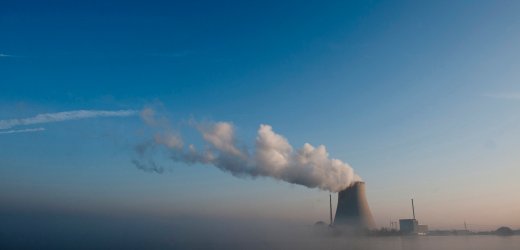
Germany’s federal government is now abusing that basic rule in a scandalous way. There can be no doubt that the country needs to be looking at a smart mix of different energy sources for the future, and that developing viable alternatives to atomic power is an urgent necessity. Yet the manner in which the federal government has rushed to its decision to put a definitive stop to the use of nuclear energy by 2022 runs counter to all rules of democratic procedure. It began when, for politically motivated and tactical reasons alone, the government went back on the agreement made last fall — just seven months ago — to extend the life span of nuclear power plants. After the Japanese plant Fukushima began leaking radiation, it felt compelled to cede to public pressure by making a rapid move away from atomic power. Backtracking in the blink of an eye, the government moved so quickly partly out of fear of the Greens, and entirely without discussion or reflection.
… Germany has shown no respect for the energy policies of other E.U. countries, and particularly no trace of consideration for the East-West split that exists in Europe over nuclear power. Instead, Germany has chosen to go it alone on this issue, assuming a kind of avant-garde, “moral high ground” role that is not always going to play well elsewhere.
Die Bundesnetzagentur schlägt Alarm: Wegen des Atomausstiegs befürchtet die Behörde bereits in der kommenden Woche zu Pfingsten Schwierigkeiten beim Stromtransport.
PS: And lest we forget…