But Isn’t Everybody In Sweden Dead By Now?

How could their economy be in relatively good shape? They were BAD (compared to head of the class Germany) because they didn’t do that COVID-19 lockdown thing. I don’t understand.

Sweden

The 18 members of the DAX 30 index of Germany’s biggest firms that have already reported swung from a healthy profit in the second quarter of 2019 to a loss almost as big this year. For many companies, including Volkswagen, a giant carmaker, and BASF, the world’s biggest chemicals concern, results were even worse than analysts had expected. The income of the 27 Swedish firms in Stockholm’s OMX 30 that have reported so far fell by 49%, bad but much better than the DAX. If you include adjusted earnings of two opaque investment vehicles in the OMX, income actually rose…

In public, CEOs of big German companies generally praised their government’s tougher policies. Privately, though, some shared the fears expressed openly by the BVMW, the association of Mittelstand firms that represents 3.5m businesses with up to 250 employees. In an open letter in May the BVMW called on the government to lift the lockdown “before it is too late” and criticised it for lacking an exit strategy.
German Of The Day: Tiefer Fall

That means a steep fall. Very steep in this case. Really, really, really steep already.

Fall

You would have to back in history some ninety years to find a comparable peacetime decline in German economic activity.

But why would anybody want to do that?

Germany’s Economic Slump Shows Scale of Europe’s Challenge – The 10.1% drop in output in the region’s largest economy is a harbinger of worse figures elsewhere. Spain, France and Italy will probably report even deeper contractions on Friday, reflecting a recession that prompted an unprecedented policy response from governments.

Man wird in der Geschichte bis zur Weltwirtschaftskrise vor rund neunzig Jahren zurückgehen müssen, um in Friedenszeiten einen vergleichbaren Sturz der wirtschaftlichen Tätigkeit in Deutschland zu entdecken.

It’s Magic!

It’s as if none of this Corona crap ever happened at all!

Magic

Maybe that’s because none of this Corona crap ever did happen. Not like it was supposed to happen, I mean. Not that anybody ever really knew how it was supposed to happen but everybody knows now that it simply didn’t happen that way. Folks sure got riled up though, didn’t they?

Germany poised for big economic recovery – The German economy is expected to shrink by more than 6% this year. But a new study found the country could be in for a big economic recovery next year.

In a best-case scenario, the economy could recover in about five months, the institute said. This would result in a more mild economic slump of just 3.9% in 2020.

But in a worst-case scenario, the recovery could also take as long as 16 months. The economy could then shrink by 9.3% this year, with growth of 9.5% forecast for 2021.

“In that case, the recovery would stretch into 2022.”

If We’re Really Lucky, June Is Going To Suck

May was REALLY awful.

Exports

And we don’t even want to talk about June.

The mood among German exporters recovered somewhat in May after a “catastrophic” April, the first full month of coronavirus lockdown measures in Europe’s largest economy, the Ifo institute said on Tuesday.

“Virtually every sector still expects further declines, yet these will be less sharp than had been expected in the previous month,” the Munich think tank said in a monthly release.

The Ifo export indicator, based on a survey of around 2,300 manufacturing businesses, rose in May to -26.9 from -50.2. It is a net reading for respondents expecting an increase minus those who see a decline.

More Bad News

For the perennial doom-and-gloom folks in charge of what we are supposed to think – at least here in Germany.

Gloom

As if the popular uprising against the Coronavirus shutdown here wasn’t enough.

Bundesbank sees early signs of recovery in German economy – Central bank expects easing of lockdown to boost activity in Europe’s largest economy

“There is currently much to suggest that overall economic developments will move up again in the course of the second quarter as a result of the easing measures and a recovery is under way.”

It’s Only Money

Other people’s money. But still.

Money

The schwarze Null or “black zero” (meaning a balanced budget) was yesterday. A supplementary budget for 2020 at about 40 percent the size of the original one will now be approved by the German cabinet to help fight the economic woe being caused by the corona pandemic.

Germany tears up fiscal rule book to counter coronavirus pandemic – Berlin to raise €150bn in new debt to bolster ailing economy.

German Of The Day: Rückgang

That means decline.

Spielball

You know. Like the Decline and Fall of the Merkel Empire?

Biggest German industry slump in a decade revives recession fears – German industrial output suffered its biggest fall in December since the recession-hit year of 2009, a shock drop highlighting the weakness in manufacturing that risks dragging Europe’s largest economy into contraction again.

Deutsche Industrieproduktion bricht ein – “Spielball der Weltkonjunktur.”

The Third Time’s The Charm

Or it will be. Or it could be. Maybe.

Growth

Germany’s Second Economic Miracle Is Ending – The cognoscenti of international economics are once again agape, and not in a flattering way, at the budget surpluses Germany’s government keeps running, when instead it should be stimulating the economy with tax cuts and higher spending. The surplus revealed this week for 2019, at 13.5 billion euros ($15 billion), is the fifth in a row, and the biggest ever.

Many Germans still regard such numbers as signs of economic virtue and virility, as they keep slashing public debt and reveling in high employment numbers. Alas, these positive indicators are likely to be lagging, not leading. That’s because an unusual era is drawing to an end, one that was likened by Bert Ruerup, one of Germany’s top economists, to a “second economic miracle.” (The first was West Germany’s long postwar rally).

In the past 15 years — somewhat coincidentally, the reign of Angela Merkel as chancellor — Germany turned from the “sick man of Europe” to the continent’s export powerhouse and growth engine. In the next 15 years, Germany won’t necessarily become sick again. But, as Ruerup puts it, it could simply turn economically “gray,” with meager growth indefinitely.

German Of The Day: Abschwung

That means downturn.

Downturn

German industry hit by biggest downturn since 2009 – Output falls 5.3% in year to October, weighing on eurozone growth outlook.

Germany’s sprawling industrial sector is suffering its steepest downturn for a decade, underlining how the engine of the eurozone’s biggest economy is sputtering.

In der deutschen Industrie geht der Abschwung mit einem schwachen Start ins vierte Quartal weiter. Im Oktober haben die Betriebe ihre Gesamtproduktion erneut deutlich zurückgefahren.


Speaking Of The German Automobile Industry

And German industry in general. They couldn’t laugh off Tesla. Now the punches are coming in hot and heavy.

DaimlerAuto

German Industrial Job Losses Top 80,000 With Daimler Cuts – Germany’s economy may have narrowly avoided a recession, but the pressure on the country’s industry shows no sign of abating.

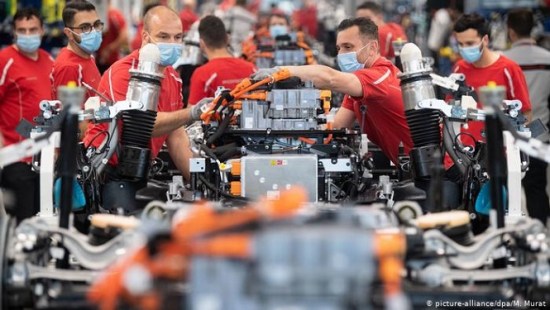
Daimler AG said this week it will shed 10% of management positions at its Mercedes unit, lifting the tally of job cuts announced this year across Germany’s manufacturing sector to more than 80,000, according to Bloomberg calculations.

Companies from Volkswagen AG to Siemens AG are letting workers go as Germany’s powerful automotive industry struggles with a shift toward electrification and self-driving cars, and makers of machinery and robots are hit by slower exports and trade disputes. Makers of well-known German products such as Meissen porcelain and WMF kitchenware are also trimming their workforce.