Tag Archives: Hitler
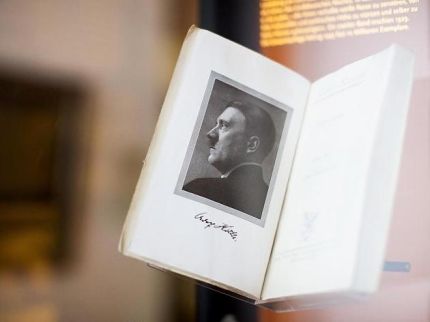
Swords To Pflugscharen?
You can stop the import of Mein Kampf in Germany, why not stop the export of expensive weapons systems out of Germany?

The Munich Institute for Contemporary History has been working for years on a “scientific edition” of Hitler’s book. In 2012 the state government gave the green light, now it wants to stop the project*.

Meanwhile… On the occasion of his ninety-fifth birthday, Helmut Schmidt has called on the federal government to stop German weapons exports.”It is time to raise an objection,” the former chancellor wrote in the ZEIT. Germany is the world’s third largest weapons exporter and ranks before China, Japan, France and England, directly after the USA and Russia. “A development that displeases me greatly. And one that needs to be stopped by the coming coalition government in Berlin.”
Er habe Verständnis für “die Unlust der heutigen Deutschen”, “Aber ich halte es für abwegig, statt Soldaten Waffen zu schicken.”
* Germany does not ban “Mein Kampf,” but Bavaria has used its ownership of the copyright to block domestic publication until now. Late Tuesday, the state premier’s chief of staff, Christine Haderthauer, said that Hitler’s anti-Semitic memoir amounts to incitement and that the state would file a criminal complaint if anyone tried to publish it in the future. In Germany, copyright expires 70 years after an author’s death.
You Gotta Have Courage
68 years after Adolf Hitlers’s death, Left party town councillors in the German city of Goslar have decided it is now time for the city to show its colors and some backbone and fearlessly strip the unpopular Nazi leader of his honorary citizenship.
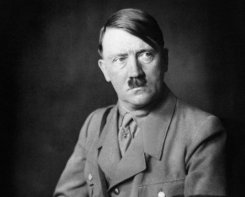
It’s civil courage like this that made Germany what it is today. Or something.
Some 4,000 German towns made Hitler an honorary citizen, and many have since stripped him of the title, some right after the war, while others did it only recently, such as the southern town of Trier in 2010.
The Richard Wagner Bicentennial Jubilee Fun Time Celebration Bash Is Well Underway
But the Partystimmung (party atmosphere) can be a little problematic at times.
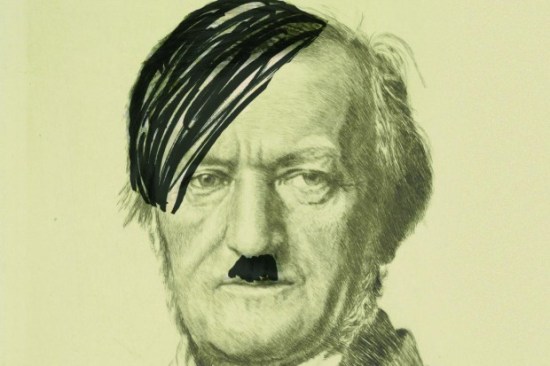
How do you celebrate the bicentenary of a great composer who also happened to be an anti-Semite, who posthumously inspired Hitler, and whose works featured prominently in the cultural life of the Third Reich?
That’s easy, really. You do what you’ve got to do with Wagner (if you’re a Wagner fan or a German unable to ignore him). As Friedrich Nietzsche said 125 years ago: “The Germans have cooked up a Wagner whom they can honor. And they are thankful for being able to misunderstand him.”
And as Woody Allen said quite some time later: “I just can’t listen to any more Wagner, you know…I’m starting to get the urge to conquer Poland.”
“Die Deutschen haben sich einen Wagner zurechtgemacht, den sie verehren können: … sie sind damit dankbar, dass sie missverstehn.”
Germans Tired Of Being Cast As The Euro Zone’s Scapegoats
But once they take a nap and rest a little bit, they won’t be so tired anymore.
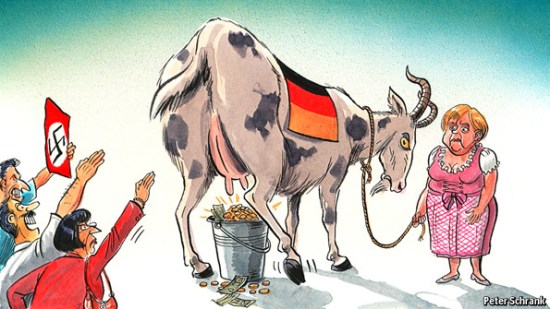
Sometimes Germany was too weak, sometimes too strong. Or, as Henry Kissinger, a former American secretary of state, put it, referring to Germany just after unification in 1871, it was “too big for Europe, but too small for the world”. Today, Mr Simms (Cambridge University) argues, “it sits uneasily at the heart of an EU that was conceived largely to constrain German power but which has served instead to increase it, and whose design flaws have unintentionally deprived many other Europeans of sovereignty.”
The question is whether Germany can use its power by unapologetically leading. Given Germany’s past, its political culture militates against even trying.
“It’s nice to go to a conference of ‘young leaders’, but you don’t want a conference of ‘junge Führer’.”
Europe’s Largest And Most Prosperous Nation Shocked About Being Treated Unfairly
The intense negative reactions to the Cyprus bailout program, including the constant comparisons made to Germany’s Nazi past, appear to have taken many Germans by complete surprise. Most simply cannot understand why people do not like them just because they are big and strong.

Germany has contributed more than 220 billion euros, or $280 billion, pledged through loans and financial support packages for Greece, Ireland, Portugal and Spain, all negotiated with those countries’ euro zone partners, for instance. And yet unfair allegations continue to be made.
Nor were Germans alone in insisting on reforms from those European partners seeking financial assistance. The Netherlands, Finland and Austria are frequently mentioned as countries that hold a similar position, yet Germany always ends up being the target of anger.
“We just don’t get it,” one German politician was quoted as saying. “It’s as if they don’t like us just because we are big and strong, because of our affluence and our power. It’s as if they resent our very existence because of this and because of the new soft hegemony we are now practising in Europe. They feel that we are materialistic, hedonistic, egotistical and shallow. I don’t know, in the end they’re just envious and jealous.”
“I mean,” he then continued. “It’s not is if we were some sinister dominating powerhouse like the USA or anything, spreading its corruptive capitalistic influence too widely around the globe the way it does, smothering the rest of us with it’s commercial and materialistic view of life and the world. We’re just well-intentioned Germans, remember?”
“Germany acts in solidarity so that crisis countries will have a perspective in the future. I wish that those people at the top — the president of the E.U. Commission and the E.U. president — would defend Germans against unfair allegations.”
Morsi Arrives In Berlin To Mark The Eightieth Anniversary Of Hitler’s Rise To Power
Or at least that’s what I assume he’s here for.

“We have seen worrying images in recent days, images of violence and destruction.”
More Godwin’s Law In Action
And it’s particularly popular with Germans, for some strange reason: “In other words, Godwin observed that, given enough time, in any online discussion—regardless of topic or scope—someone inevitably makes a comparison to Hitler or the Nazis.”

OK, technically this wasn’t online, but the latest unnecessary comparison to Hitler came from a certain Andreas Köhler, head of a German doctor lobby group here (die Kassenärztliche Bundesvereinigung).
“Julius Caesar, Charlemagne, Napoleon, Adolf Hitler, Angela Merkel – the list of leaders is very long when it comes to those who have tried to unite Europe. And these attempts have always failed because no one can imagine living together in one and the same European house.”
Uh, is the doctor in?
Ein KBV-Sprecher sagte der dpa, aus der rein internen Feier seien Sätze ohne weiteren Zusammenhang nach außen gelangt.
Do you have that in brown?
“I didn’t know how much the name would disturb people.”
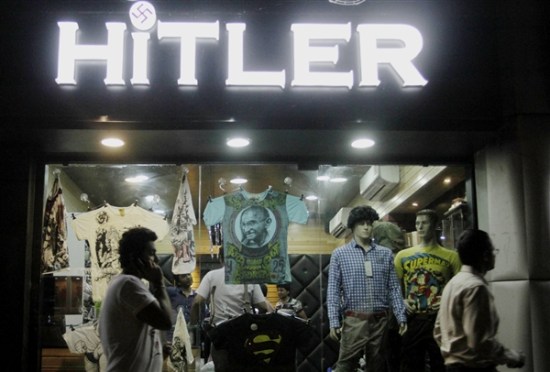
He added that to him Hitler was just the nickname given to his business partner’s grandfather, who was known for his “strict nature.”
Nicht zum ersten Mal gibt es in Indien Ärger um den Namen Hitler. Mal nannte ein Restaurantbetreiber sein neues Café “Hitler’s Cross”, mal nahm ein Händler eine Bettwäsche mit dem Namen “The Nazi Collection”, bedruckt mit Hakenkreuzen, ins Sortiment auf.
CliffsNotes For Mein Kampf?
I don’t know, man. Adding critical commentary to Mein Kampf? It’s pretty full of critical commentary already if you ask me.

And as a schoolbook? Not good. With kids the way they are these days, if you have to start including commentaries in the text of Mein Kampf to debunk Hitler’s “arguments,” you’re only going to give them ideas.
“Das Ziel ist die Entmystifizierung des Buches.”
 Observing Hermann