Big Sister Assures Germans That 47-Percent Price Hike Actually Not Such A Bad Thing If You Think About It

Not.

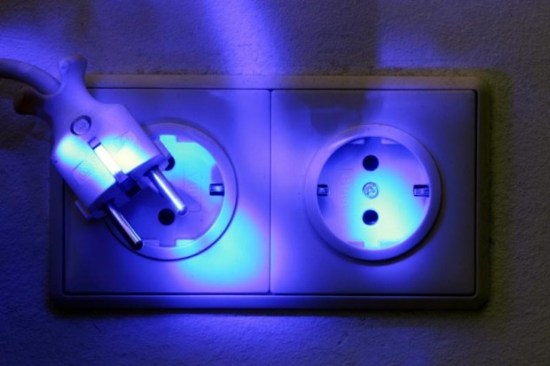
Worried about grassroots unrest after Germany’s electrical grid operators announced they were nearly doubling the charge consumers will pay to finance subsidies for renewable energy as Germany phases out nuclear power, Big Sister herself has reacted boldly and decisively by going into hiding and pretending as if none of this were really happening.

Long used to this tactic, worried German consumers were assured, sort of, as they will now be paying an additional 60 euros per year, “taking overall add-on power taxes up to about 185 euros.” But that’s just the start, of course.

Sheesh. Why do Germans see everthing energy turnaround-related so negatively these days? You know, like as in black? Or like as in blackouts, I should say?

“The costs for consumers and industry of the electricity price charge for renewable energy has risen to an unbearable degree.”
Phase-Out Fizzling Out

Support for Germany’s Atomausstieg (nuclear phase-out) ain’t what it used to be, it seems. And it seems to have something to do with Geld (money), or something. With reality, in other words.

According to an Emnid survey, 77 percent of German voters asked say it is very important that energy costs remain affordable while only 53 percent care if the nuclear phase-out succeeds or not.

Welcome back to the real world, volks, I mean folks. Hey, you are here in Germany after all. And there is a clearly discernable pattern here. Once the first wave of hysteria is over, it always goes back to es darf eben nichts kosten (OK, but only as long as it doesn’t cost anything).

Für sie ermittelte Emnid auch, dass zwei Drittel der Bürger maximal 50 Euro pro Jahr mehr für Strom zahlen wollen.

This Still Doesn’t Beat Obama’s Nobel Peace Prize

But it comes close.

Many euroskeptics clearly just don’t get it. Of course the Norwegian Nobel Committee’s decision to award the Nobel Peace Prize to the European Union is “beyond parody,” “laughable” and an “April Fool’s Joke.” That’s been the whole point of the thing for years now.

Hasn’t it?

In Britain, Friday’s award has been the subject of particularly heated commentary. Iain Martin, a columnist with the conservative Daily Telegraph dismissed the prize as “beyond parody.” He writes that the prize has been awarded prematurely because “we have no idea how the experiment to create an anti-democratic federation will end.” Besides, he writes, “daftest of all is the notion that the EU itself has kept the peace.” Instead, he writes, it was the Brits and the Americans who brought peace to the Continent.

Even the EU-friendly Economist columnist Charlemagne writes, “Hmmm,” questioning the timing of the award, given that the EU is currently threatened with a break-up.

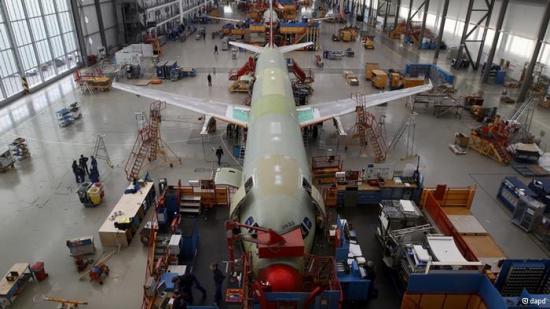
BEA-EADS-RIP

Massive political resistance or pure economic theory? Or both?

“From an economic perspective, this should of course be avoided. Pure economic theory would say that the state should stay out of it and leave the market alone.”

“The massive political resistance was ultimately too great to overcome.”

Romney Still Bad

Germans weren’t fooled one minute by Mitt Romney’s impressive performance during the first presidential debate (just see photo below).

And now they are being reassured by German Presseorgane (press organs) that the sudden, completely unexpected and, well, near miraculous drop in the American unemployment rate to 7.8% will ensure that the right guy (as in left guy) will get re-elected after all.

Alles wird gut (everything will fall into place). Alles wird gut… Oder?

Noch nie wurde ein US-Präsident bei einer Arbeitslosenquote über acht Prozent wiedergewählt.

Back Then When The World Was Still In Order

This is just what we need these days: Uplifting communist photography. More specifically, a nostalgic retrospective of art photography produced in communist East Germany.

They just don’t make German democratic republics like they used to.

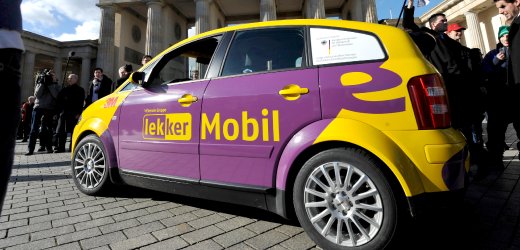
Electric Cars Have Already Reached A Whopping 0.01 Percent Of All Registered Cars In Germany

That’s some, uh, 4,600 vehicles. At this rate, the German government’s plan to have 1 million electric cars on the road by 2020 will be reached easily.

Or maybe not. Because those pesky German consumers still haven’t got the message and think that these babies are too expensive and don’t have a long enough range to make them attractive as, you know, as cars.

So that’s why the German government, flexible as it is, has now said that their goal of 1 million electric cars by 2020 (set last year) has now become a goal of 600,000 electric cars by 2020. I can’t wait to see what next year’s goal for 2020 will be like.

Damn. I’m impressed. This German Energiewende (energy turnaround) is getting easier and easier to reach all the time.

“If we don’t create incentives, then the whole thing is going to fail,” the Green party said in a statement.

German “Critical Thinking” vs. American Debate Culture

Here is another interesting German commentary by American Eric T. Hansen in Die Zeit.

I’d like to translate it all, but I can’t, so I won’t (no time). Here are a few highlights, though:

Critical thinking does not allow for self-criticism. Where would we be then?

Critical thinking is not debating, it’s finding concensus, or, as I call it, harmony nagging (Harmonienörgeln): Two people criticize a third person so long until the two become friends.

If I want to hear a new or even a different perspective on something, I have to turn to the Anglo-American press. Regarding certain questions – for instance whether nuclear energy, genetically modified corn or having Mitt Romney as president might also have certain advantages – many of my German friends are not even aware that two sides to these arguments even exist.

I too understand Mitt Romney’s positions quite well and suspect that he would make just as good (or bad) a president as Obama. In America that makes me an intellectual. In Germany that makes me a right-winger.

Everything is so serious for the Germans, and they need to know immediately: “Who is my friend, who is my enemy?” For Americans and their debate clubs, however, there is always an element of playfulness involved.

Auch ich verstehe die Positionen eines Mitt Romney gut und ahne, dass er ein ebenso guter (oder schlechter) Präsident wie Obama wäre. In Amerika macht mich das zu einem Intellektuellen. In Deutschland macht mich das zu einem Rechten.