“Progress has been limited…”

Oh, I dunno. Depends upon how you look at it.

Progress

In 2011, German Chancellor Angela Merkel announced the country was turning away from nuclear energy in favor of a renewable future. Since then, however, progress has been limited. Berlin has wasted billions of euros and resistance is mounting…

But there’s been plenty of change here, although I wouldn’t call it progress. Lots of people can’t afford to pay their power bills in Germany – the country with the highest energy costs for consumers in Europe. Could there possibly be a connection to the “energy turnaround” here?

More than 340,000 electricity customers across Germany have their power cut off each year for failing to pay bills. A new proposal from one political party aims to change this.

Productivity?

What’s that? I live in Berlin.

Productivity

Asked which region in Europe has been the absolute worst at realizing its economic potential, most people probably wouldn’t name Berlin. The German capital isn’t just nice to live in, it’s throbbing with excitement; a startup is reportedly created here every 20 minutes, and if you leave for a night out, you risk not coming back for a week. But according to a study of the economic performance of European regions, Berlin is indeed the worst.

What is more important: productivity or a city’s peculiar, esoteric feel? Berlin is one of the places where this question is especially poignant.

Germany Finally Prepared To Help Iraq

Out of the goodness of its heart. With a giant electricity agreement worth billions.

Iraq

The Germans may not have been prepared to help free the country from Saddam Hussein militarily but they have finally taken a great step forward and are now prepared to free it from lots and lots of money makes the world go around.

Iraq and German giant Siemens have signed a framework electricity agreement potentially worth billions of dollars. The Iraqi premier was in Berlin to meet with Chancellor Angela Merkel.

“Our claim is that we are a reliable and affordable power supplier to the people of Iraq and want to help them rebuild their country.”

Are We Having A Recession Yet?

I don’t get it. I thought the German boom had boomed out. That’s all they’ve been talking about here for the past few months. More fake news, I guess.

April

Speaking of employmentGerman Joblessness Falls in Sign of Confidence in Growth Rebound – German unemployment continued its decline, suggesting companies are keeping faith in the prospects for Europe’s largest economy.

The number of jobless people fell 12,000 in April, more than economists expected, to 2.22 million. The labor agency said demand for workers continues to be very high.

This is the lowest unemployment rate for April in 30 years.

Arbeitslosigkeit – niedrigster Aprilwert seit 30 Jahren

Above Average?

Germany’s labor costs above EU average? Sure. But take a closer look. Forget about Eastern Europe.

Cost

Germany is one of the lowest when it comes to labor costs in Western Europe. And maybe there’s a connection here somewhere but it’s unemployment rate is also one the lowest.

“This convergence of relative labor costs results from the fact that in countries with low labor costs, growth rates have been well above those of countries with already high labor costs for many years.”

German Of The Day: Handelskrieg

That means trade war.

Handelskrieg

A trade war between the United States and Europe is coming and the fallout could tip Germany into recession, according to analysts at German lender Commerzbank…

Official German statistics supplemented by the bank’s own research show that in 2018, the United States was the top export destination for German cars, accounting for about 12% of the total with a value of 27 billion euros of parts or finished vehicles.

The bank estimated that a Trump-ordered tariff increase of 25 percentage points on EU auto imports would slash that figure for Germany down to around 14 billion euros per annum.

When factoring in how much of that export figure is actual German “added value,” the bank estimated that total economic output for the country could fall by around 0.25 percentage points.

“All the more dangerous in a situation where the German economy is only just managing to avoid a recession,” it read.

German Of The Day: Mangelhaft

That means deficient. As in the deficient quality of the oil being imported to Europe via a Russian pipeline – this import having now been suspended by Poland?

Oil

That means Germany can’t get the oil, either. It’s not like Germany’s dependency on Russian gas and oil is deficient, however. That’s as high a quality dependency as you can get.

Germany and Poland have suspended imports of Russian oil amid contamination concerns, prompting a rare crisis over supply from the world’s second-largest exporter.

The sudden suspension of imports from the Soviet-built Druzhba pipeline, which runs from Russia via Belarus to central Europe, risks starving major European refineries of their major source of crude.

Händler großer Ölkonzerne, die Raffinerien in Deutschland betreiben, bestätigten dies: Die Versorgung über die noch von der Sowjetunion gebauten “Druschba”, auf Deutsch “Freundschaft”, sei gestoppt.

German Of The Day: Naivität

That means naivete, as in being gullible or simple-minded.

China

Here’s an example: Industry Leaders Accuse Europe of Naivete with Respect to China – China’s aggressive approach in extending its economic power is causing concern among European companies. They demand a tougher approach from Brussels – and a convincing vision.

Good luck with that, European industry leaders. “Europe” doesn’t have time to deal with little issues like that at the moment, nor will it have any time in the near future. It is too occupied with self-inflicted problems like uncontrolled migration and Brexit (and the ensuing financial crisis) and placing the next batch of non-elected and unaccountable EU eurocrats in power. But once all that is taken care of, who knows? That little Chinese issue might just get tackled, too.

Die aggressive Vorgehensweise Chinas bei der Ausdehnung seiner Wirtschaftsmacht bereitet europäischen Unternehmern Sorgen. Sie fordern eine härtere Gangart von Brüssel – und eine überzeugende Vision.

Bundeswehr Update: This One Doesn’t Fly, Either

The Bundeswehr doesn’t have any money, remember?

But the little it has it burns as fast as it can. Among numerous other spending scandals, this one went originally like: The German navy will continue operations with its Lockheed Martin P-3C Orion maritime patrol aircraft until 2035, with Berlin having signed a $158 million contract for modernisation work to be performed over the next five years.

Now the word is that the costs have run out of control. What would the Bundeswehr do without Miss Management herself (Defense Minister Ursula von der Leyen)? She’s that good. Just like her buddy Angela Merkel, she’s too big to fail.

Es werde “kaum gelingen, alle Flugzeuge bis Ende 2025” flottzumachen, urteilt der Bundesrechnungshof.

German Of The Day: Unsicherheit

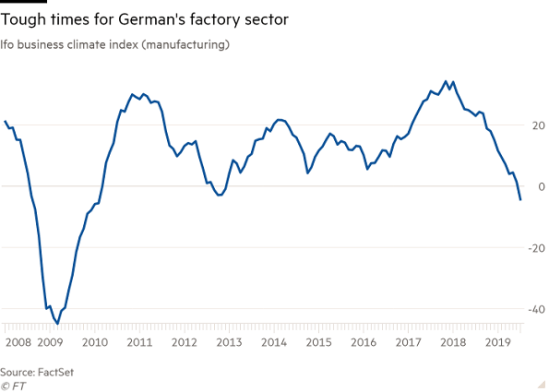
That means uncertainty. You know, like economic uncertainty?

Export

German exports fell by 1.3% in February compared with the month before, the Federal Statistics Office said on Monday. The figure represents the biggest drop in export revenue for a year…

Economists say that uncertainties surrounding Britain’s exit from the EU, the ongoing trade dispute between the US and China as well as weakening demand for industrial products are weighing on economies across the world.

“Die Ungewissheit aufgrund der vielen ungelösten Konflikte schlägt sich in den Auftragsbüchern nieder.”