This Guy Doesn’t Have A Chance

Of replacing Angela Merkel as the chairman of the conservative CDU, I mean.

Merz

1) Because Merkel doesn’t like him and forced him out of politics ten years ago, 2) he’s pro-business (and that’s a bad thing to be in German politics) and 3) he represents the conservative wing of a conservative party that stopped being conservative long ago. What’s the difference between the CDU and the SPD – or the Greens, for that matter?

I sure do wish this guy a lot of luck, though.

A former rival of Chancellor Angela Merkel who seeks to replace her at the helm of Germany’s conservative party said Wednesday he would aim to renew the party and establish close ties with Western democracies but wouldn’t push for a radical overturn of current policies.

Friedrich Merz, a corporate lawyer and former parliamentary floor leader of Ms. Merkel’s conservatives, said he could get along with the chancellor despite previous clashes that led to his gradual exit from politics nearly 10 years ago. A good working relationship with the chancellor would be crucial to ensure party backing for the ruling coalition’s political agenda.

“We need an awakening and renewal but not an overturn.”
To Rival Silicon Valley?

Good luck with that. Honest. It’s great that big industry finally wants to pump some money into Berlin again but keep your pants on already, Siemens.

Siemensstadt

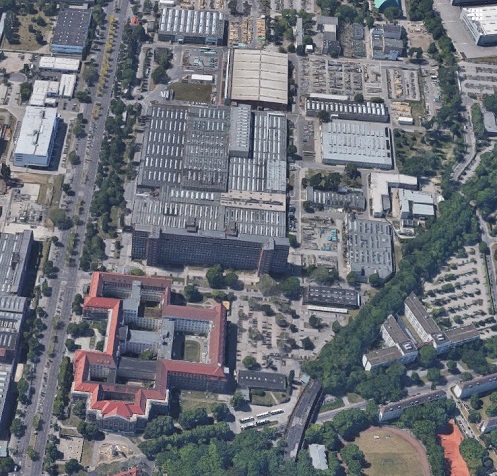
The German engineering giant has unveiled plans to build a huge innovation campus in Berlin, harking back to its early days in the German capital and aiming to rival Silicon Valley in the United States.

Investment in a new campus to be called Siemensstadt 2.0 (Siemens City 2.0) will come in at €600 million ($680 million) on offices and residential accommodation, as well as laboratories and production plants, according to an agreement signed by Berlin Mayor Michael Müller and Siemens executive member Cedrik Neike on Wednesday.

The plan is to transform the historic Siemens site in Berlin-Spandau into a location for research and startup centers by 2030.

Der Weltkonzern baut in Berlin für 600 Millionen Euro seinen Zukunfts-Campus. Mit 2000 Wohnungen, Forschungslabors, Geschäften, Schulen und eigenem S-Bahn-Anschluss

How Tasteless

How could British newspapers report such things? In this way, I mean. As if they really happened. Which, of course, they did. But still.

Rape

If a German newspaper printed this it would be… Well, it wouldn’t be a German newspaper

Five Afghan asylum seekers are arrested for allegedly raping a girl, 15, in Germany – as country is rocked by sex attack on student, 18, ‘by Syrian migrants’

If it’s not in the German news, it didn’t happen.

Berlin Is The Place

The place where you don’t want thriving companies offering gainful employment and increasing property value in your neighborhood.

Gentrification

I get it. It’s about gentrification again. But the problem here isn’t the evil capitalist rich swooping in to speculate and force the poor out of their neighborhoods. The problem is a classic case of “I’m from the government and I’m here to help.” The German government in general and the Berlin government in particular have been “helping” German renters for decades in ways that have discouraged Germans from owning property of their own (the vast majority of Berliners pay rent). Then when reality finally strikes (supply and demand = rising rents) the same politicians can’t help these renters anymore and leave them high and dry with rents they can no longer afford to pay. Ain’t nothing new.

Kreuzberg has long been one of the most affordable areas of Berlin, making it a haven for students, immigrants, artists and activists, a hub of culture, night life and left-wing politics. But in a pattern repeated in similar neighborhoods in many of the world’s wealthiest cities, affluent people have moved in, too, in recent years, bringing with them the social tensions of gentrification.

“They push out the people who were here before.”

Godot Has Just Left The Building

A snap election in Hesse this weekend? Yeah, maybe. But didn’t we just have one in Bavaria?

Godot

The real German problem is more subtle… She is broken, Señor. Germany, I mean. And ain’t nobody gonna fix her until she gets, like, really broken.

Waiting for Germany today is like waiting for Godot. Nothing will get fixed: neither the eurozone, nor climate, nor migration. Comfy but angst-ridden, Germans will keep having fake domestic crises, while the rest of Europe tries to keep a lid on real ones. Eventually, those real ones will erupt. And then a continent could accidentally get lost. At that point, Germans will finally get a proper crisis. Maybe it’s just as well that they kept rehearsing now.

Vor dem Knall – In Hessen findet am Sonntag nicht irgendeine Landtagswahl statt. Es wird ein politisches Erdbeben geben, die Auswirkungen wird vor allem Berlin spüren. Die Frage ist nur noch, ob es zuerst die SPD oder die CDU erreicht. Die Große Koalition steht vor dem Ende, das Land vor einer Zeitenwende

The Two-Party Is Over?

And it couldn’t have happened to a nicer bunch of folks. Or Volk, if you prefer.

SPD

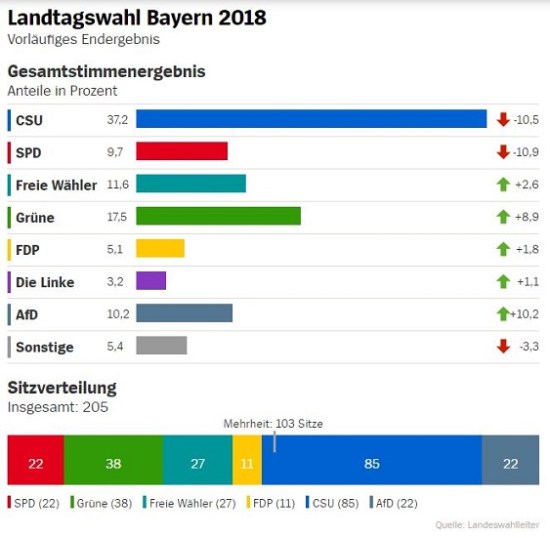
The German Social Democrats’ (SPD) existential crisis can no longer be treated as a typical party crisis. The party captured a mere 9.7% of the vote in regional elections in Bavaria this month, and it is trailing both the populist Alternative für Deutschland (AfD) and the Greens in national opinion polls. With another important regional election fast approaching in Hesse, polls indicate that the SPD will lose still more support, albeit not as dramatically as in Bavaria…

Most likely, the fall of the CDU/CSU-SPD duopoly will undermine German hegemony in Europe, even if no other country can replace Germany in that role. At the same time, the weakening of the SPD will diminish the socialist faction in the European Parliament, where a similar eclipse of two-party rule could be in the offing. Yet without the twin pillars of the European People’s Party and the Party of European Socialists, the parliament will be incapable of making even insignificant decisions. As Germany and the SPD go, so goes Europe.

European Data Security Just Got More Secure

So secure that not even your mailman, friends or family will be able to find you anymore.

Datenschutz

Europeans want secure data. So you can imagine how thrilled everybody is about this latest development.

The city of Vienna has determined that name tags in apartment houses are a violation of the EU’s GDPR (General Data Protection Regulation). After a renter complained about the lack of proper data security, some 220,000 renters will lose the name tags next to their doorbells.

In Wien verlieren etwa 220.000 Mieterinnen und Mieter die Namensschilder an ihren Türklingeln, weil ein Bewohner sich über mangelnden Datenschutz beklagt hatte.

Not Bad

The polling predictions made before the Bavarian election yesterday, I mean.

Polls

Whether the actual results are bad or not depends entirely upon your point of view.

The CSU’s drop was not quite as bad as predicted (although they will no longer be able to govern without a coalition partner), the SPD’s drop was breathtaking (the worst regional election result in their history) and the AfD did not get the votes that many had feared they would. This was probably due to the success of the regional “Free Voters” party (CSU-light) that will now most likely be the CSU’s coalition partner. The free market-friendly FDP just got in by the skin of their teeth with 5.1 percent of the vote (5 percent minimum needed). The Left didn’t make it in, as usual. The Greens made a huge leap forward but who cares? This is Bavaria and they don’t go for this utopian stuff so they’ll make a fine opposition party which is where they belong.

So it looks like Angie Merkel will live to resign another day, as usual.

Die CSU hat die absolute Mehrheit in Bayern verloren, sie kommt nach dem vorläufigen Endergebnis nur noch auf 37,2 Prozent. Die SPD erlebt ein Debakel. Wahlgewinner sind die Grünen, die Freien Wähler und die AfD.

Irresistible Filth?

I guess that’s one thing you could call it.

Filth

As previously reported, the Germans are having big problems meeting their ambitious CO2 emissions targets these days. One of the reasons for this dirty little secret – after having turned off most of their nuclear power plants due to a tsunami in Japan (don’t ask) – is their burning need to burn dirty, filthy, dreckig brown coal, aka lignite.

It is mined in vast, open pits that devour landscapes and villages, leaving Martian vistas of desolation roamed by gigantic excavators straight out of “Mad Max”.

Brown coal made up about 23% of the country’s energy supply last year, and black coal another 14%, according to the Economy Ministry. Renewable energy sources made up 33%—up from 6% in 2000.

Hey, whatever gets you through the dark as black coal night.

“The image of Germany as a country leading on the renewable energy transition is very, very wrong,”

Reality Can Be Like That

Germany’s green dreams run into climate change reality – Berlin’s commitment to stay nuclear free complicates Europe’s push to lower emissions.

Green

The contradictions in Germany’s energy policy are coming home to roost.

It’s struggling to balance efforts to combat climate change while at the same time shutting down its nuclear power plants.

Don’t sweat it, Germany. If you need any advice on how to improve things in the CO2 department just contact the folks in Washington.

“The rushed and improvised exit from nuclear power that some support is not our policy. Recent events prove that pretending otherwise is a pure illusion.”