German Of The Day: Fortschritt

That means progress.

Germany’s Anti-Digital Law Is a Case Study in Stunting Progress – Germany just passed a law that completely bans digital contracts and signatures. Whether you’re a coder who finds jobs online, an Amazon delivery guy or a Dilbert character, you’ll now get the fine print of your terms on paper — the dead-tree kind. And it’ll have your new boss’s signature in just-dried ink. If employers provide a digital contract instead, they’ll get fined up to 2,000 euros ($2,049) for each instant.
German Of The Day: “Schwelle zur Rezession”

That means cusp of recession, as in being on it.

Germany on cusp of recession, says ifo, after business sentiment falls – German business morale fell more than expected in July as high energy prices and impending gas shortages push Europe’s largest economy to the cusp of recession, a survey showed on Monday.

The Ifo institute said its business climax index was 88.6, its lowest level in more than two years. June had also seen an unexpected drop to a downwardly revised reading of 92.2.

German Of The Day: Wohlstand

That means prosperity.

Ukraine war: Germans fear the end of prosperity – The war in Ukraine and inflation have Germans concerned about their standard of living. Those who have the least are likely to suffer the most…

Inflation is running at nearly 8%, compared to the same time last year, according to Germany’s Federal Statistics Office. Consumer energy and food prices are up more than 38% and 11%, respectively.

A €9 Per Month Public Transport Ticket?

What a steal. From the taxpayers, as usual. But still.

Germany offers €9-a-month public transport ticket – Cut-price deal allows nationwide travel as Berlin acts to soften the impact of rising inflation and expensive fuel.

The €9 ticket opens up the entirety of Germany to many who couldn’t otherwise afford it. It’s now so easy to scramble up the Harz mountains, stroll through “Frau Holle Land” and drink a few beers on the Ruhr. You could even reenact Inglourius Basterds in the Elbe Sandstone Mountains or find out why Tom Hanks fell in love with Eisenhüttenstadt for yourself.

It’s Time To Drop Your Masks, Germans

And show us your real faces.

Faces plagued by real problems, for a change. Problems like finding new sources of energy that will keep your homes heated and your economy running (and breaking free from your dependency on Russian energy = 50%), skyrocketing inflation, dire economic forecasts and that little war thing going on in Ukraine just a few miles down the road, for instance. COVID-19? What’s COVID-19?

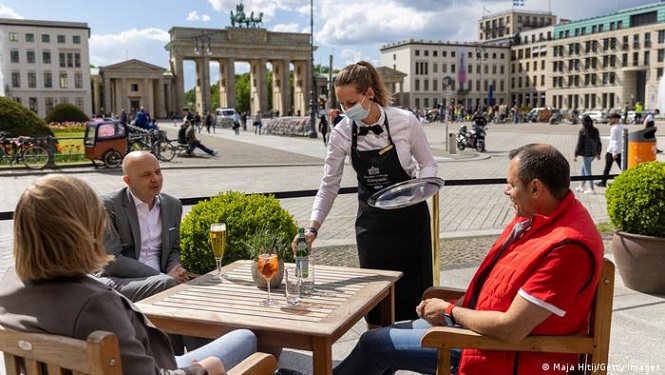
Starting Friday, a number of rules and restrictions went away in much of Germany. That means no more masks in most shops, and no more proof of vaccination or day-of test in restaurants. Though some public transportation systems, individual businesses and institutions will keep mask requirements in place, the move to drop the majority of mandates tracks with many of Germany’s neighbors.

Skyrocketing Inflation, Dismal Economic Growth, War Next Door, Pandemic, Sucky Weather…

Otherwise, though, things are looking up in Germany.

Germany inflation hits 30-year high at 7.3%, growth outlook dims – Inflation in Germany jumped to a record high since reunification in 1990. Growth expectations have been slashed amid fears the Ukraine conflict will hit Europe’s biggest economy hard.

But Look On The Bright Side

Germans may feel the least free of all Europeans when it comes to the pandemic…

But to compensate for this they pay the highest taxes, have the highest energy and water costs, earn some of the lowest wages, get the lowest retirement pay, fight through the worst bureaucracy, have the most difficult time acquiring property of all Europeans and there’s more of course but I’ll stop here because I’m running out of breath.

Germans ‘feel least free’ of all Europeans during pandemic – Nowhere in Europe have people felt more inhibited by 18 months of Covid-19 restrictions than in Germany, a new study by the European Council on Foreign Relations (ECFR) finds.

Just one in ten Germans currently ‘feel free’ in their everyday life, while almost half say that they ‘don’t feel free’, the study published on Wednesday found.

The results put Germany at the bottom of a table of Europeans in 12 EU member states who were asked about their level of freedom now compared to since the pre-pandemic days.

Always Look On The Bright Side Of The Worst Recession In Post-War History

A $256.15 quadrillion zillion stimulus package of their own money taken from them by their government and given back to them as a gift (to be paid back to the government by their grandchildren and great-grandchildren and so on should they ever have any) has lifted German spirits.

Berlin

Sort of. But just keep smiling through the Coronavirus stimulus party anyway, Germany.

German consumer morale improved less than expected heading into October, a survey showed on Wednesday, putting a damper on hopes that household spending in Europe’s largest economy will be strong enough to drive a quick recovery from the COVID-19 shock.

The GfK institute said its consumer sentiment index, based on a survey of around 2,000 Germans, edged up to -1.6 heading into October from an upwardly revised -1.7 in the previous month.

Can’t Reach The Current Planned Level Of Carbon Emission Reduction?

I know. Let’s introduce an even higher and more unrealistic new level of carbon emission reduction we can’t reach!

Uschi

Then everybody’s happy. Except those folks who still have to live in the real world.

German industry sceptical of EU’s new 2030 climate goals – The European Commission will present today (17 September) detailed proposals to reduce carbon emissions in the EU by 55% below 1990 levels by 2030. While German industry officially welcomes the new ambitions, it is also clearly sceptical.

The increase of the current target for 2030 by a further 15% would mean a roughly fivefold increase in the efforts of the 27 EU member states, BDI President Dieter Kempf emphasised at the beginning of his speech.

And according to BDI calculations, Germany alone would have to invest €2.3 trillion to achieve climate neutrality by 2050. “You can work out who of the other 26 countries can afford to do this. The level of ambition not only differs greatly within the EU, but also globally,” said Kempf.


Germany Would Be So Much Poorer Without Berlin

Not. Not according to this latest study.

Berlin

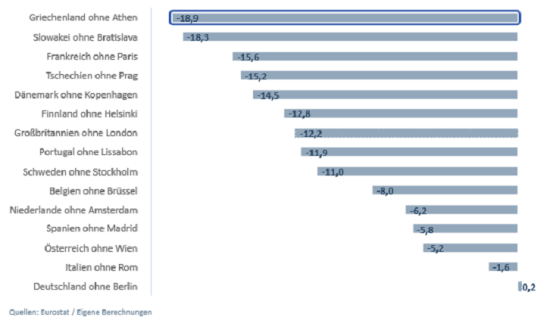
Normally, the per capita economic output (GDP) in capital cities in Europe is higher than in the rest of the given country. There is one big exception, however. Germany would be wealthier without Berlin.

Poor but sexy” is out. Now Berlin is just poor. Actually, it’s been that way for ages but nobody seems inclined to do anything about it. See the current red-redder-green city government.

Jeder Deutsche wäre ohne Berlin knapp 80 Euro reicher. Every German would be about 80 euros richer without it.