German Of The Day: Wutbürger

That means outraged citizens. And although they’ve always been around (Germans are always empört/outraged about something), Angela Merkel’s ongoing open-arms refugee policy seems to be generating more and more of them all the time.

Wutbürger

And whoopee! 2016 just happens to be a big regional election year. Unless things start to change real fast (ha, ha, ha), I wonder who’s going to be getting all these votes? Not.

Originally founded as a eurosceptic movement a few years ago, the party Alternative for Germany (AfD) came close to its demise – until it split in two. Now, it has experienced a surge in public opinion. Euroscepticism is barely mentioned any more; the new party is acting as an anti-refugee party. If elections were to take place today, the AfD would probably enter parliament with a double-digit election result.

German Of The Day: Heulsuse

A “howling Susie” is a crybaby here. You know, like that Palestinian refugee girl who just got granted a three-year residence permit for herself and her family for being one?

Cry

In a related story, hundreds of thousands of refugees all across Germany have suddenly broken out in a spontaneous public fit of sobbing, bawling and bewailing, the likes of which have never ever been seen or heard before in this country (Germans prefer to spontaneously moan, gripe, grumble and lament loudly in public).

Bei einer Veranstaltung mit Kanzlerin Angela Merkel (61, CDU) im Juli brach sie vor laufender Kamera in Tränen aus: Merkel hatte ihr erklärt, dass Deutschland Flüchtlinge zurückschicken müsse, wenn sie keinen Anspruch auf Bleiben hätten. Auch Reems Fall werde ganz normal geprüft und könne so enden.

Is Bild Without Bild Still Bild?

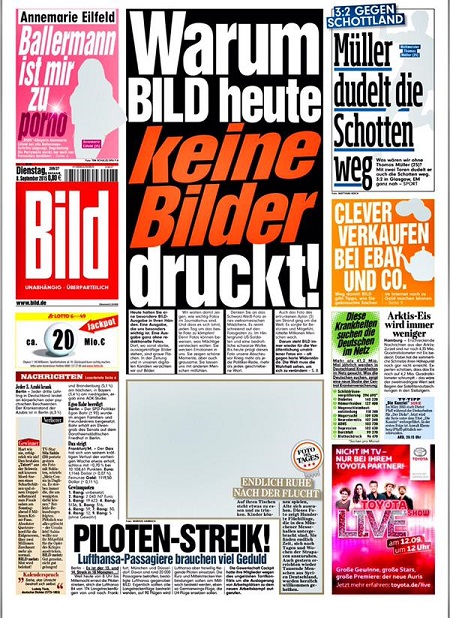
Germany’s best-selling newspaper has removed all pictures from its print edition and website in response to complaints about its decision to publish images of the three-year-old Syrian refugee who drowned trying to reach Greece.

Bild

The decision to remove pictures in print and online comes less than a week after the newspaper dedicated its whole back page to the distressing image of Alan lying face down on the beach in Bodrum, surrounded by a black background and a plea for action from Europe.

The Problem With European Immigration Policy…

Is that there is no European immigration policy.

Refugees

There is a mish-mash of national policies, a patchwork of systems and criteria which are contradictory, incoherent, fragmented. Italy is very far way from Finland, not only geographically, but when it comes to immigration and asylum. France and Germany have quite different historical approaches to integrating newcomers. Sweden and Denmark are neighbours with a close shared history, but their immigration policies are chalk and cheese.

The seven countries of central Europe and the Baltic are being asked to take fewer than 30,000. It should not be a problem for big international cities such as Warsaw, Prague and Budapest. But the east Europeans are retreating into parochialism, digging into their national bunkers while nursing resentment at what they perceive to be German bullying.

Hungary’s prime minister, Viktor Orbán, is the cheerleader of the “Europe is useless” chorus, but Robert Fico, the Slovakian premier, and President Milos Zeman in Prague are not far behind. Ewa Kopacz, the prime minister of Poland, sounds more moderate, but she looks likely to lose an election next month to the nationalist right. Her hands are tied.

I wouldn’t worry about any of this, however. Think Greece: Europe always manages to get together in the end, when stalling for time is no longer possible, to not solve a problem by doing almost just enough to put it off until it does not go away by itself.

“If this is Europe, you can keep it.”

Not Bright To Call Germany Dark

It is weder (neither) dark noch (nor) bright.

Personally, I like to think of it as being more of a Wehrmacht gray. No, wait. Leave that Wehrmacht part out. Gray like all cats are in the dark, I mean. When it’s not light out there in Dark Germany.

Refugees

And being that it’s always darkest before the dawn and there is no darkness but ignorance and out of darkness comes creation, well, let’s all lighten up and Schluss (enough) with these all of these dark thoughts already.

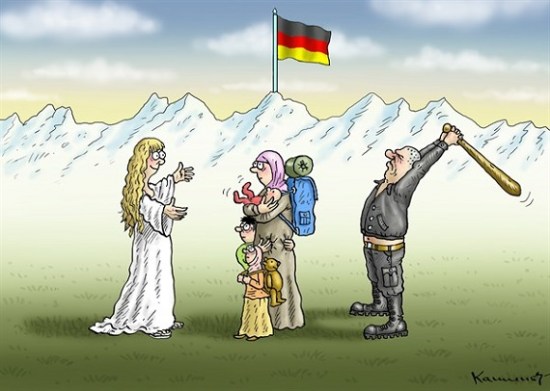
Which Germany will prevail? The Germany of racist chants from the roadside? The Germany of rioters and drunken rock-throwers? “Dark Germany,” as President Joachim Gauck calls it? Or will it be the new, bright Germany, represented by the young policeman with his roots in Afghanistan?

Racism Not Eastern German Problem

Hell no. It’s all over the place here. Although actually, what we’ve really got here is another good old case of classical German schizophrenia in action again.

Germans

The real issue isn’t the humanitarian one, however. Of course the refugees currently flooding Europe have to be helped and have to be helped in an equitable manner, i.e. each country takes on its fair share of the burden. The real issue is the unspoken one: They have to be stopped from coming here in the first place. The problems that are causing them to flee aren’t being addressed but Europe can’t solve them. Europe can’t even solve its own problems.

And the reason this issue is still unspoken is that keeping them from coming here implies doing something really unpleasant. You know, something really unpleasant like Americans and Israelis do? You know, like putting up a wall of some kind to keep them out. Set your clocks. This issue won’t remain unspoken for very much longer.

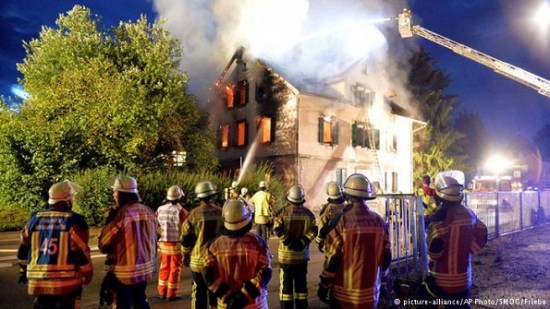
“At the moment, refugee shelters are burning night after night all across Germany. And the hot spots for far-right violence are spread in all directions.”

Today’s Headlines

Riots in Suhl refugee camp in Germany.
Refugee chaos in Macedonia.
UK sends cops to Calais to stop migrants from coming through the Chunnel.
Slovakia refuses to let in Muslim refugees.
Germany expecting 800,000 migrants this year.

Migrants
Maybe this is just me but I think the problem here could have something to do with all of the refugees coming to Europe right now. Has anyone called Brussels yet?

Maybe it’s time for the Europeans to consider putting up a wall down there in the Mediterranean Sea somewhere. And have Mexico pay for it.

Als Erstes muss eine Mauer gebaut werden, für die Mexiko zahlen muss.

Last Man Standing

Only she’s a girl.

Merkel

You have called Angela Merkel the modern-day empress of the eurozone. What do you mean?

The title empress reflects, in my view, two realities of present-day Europe. First, the Germans look so strong because the others look so weak. The British are withdrawing from Europe. The French are down but not out. They’re unable to rev up their economy – same thing for the Italians, same thing for the Spaniards. So, when you add it all up, who is the last man – or in this case, the last woman – standing?

The second reason is more concrete – the Germans have been in the vanguard of driving home fealty to the eurozone’s foundational treaties. These conventions enjoined member states, like Greece, not to overspend and over-borrow and, at the same time, to make their economies more efficient. Merkel and her finance minister are not austerity mongers as everybody is harping on about. They are committed to the original treaties’ stated rules that require eurozone members to reform their economies and become more competitive.

Zum ersten Mal seit 2005 könnte die Union einer Umfrage zufolge die absolute Mehrheit erreichen. Die Partei wäre mit 43 Prozent der Stimmen stärker als all anderen Parteien zusammen.

“The problem with socialism…”

is that you eventually run out of other people’s money.”

Socialism

Already on Saturday pictures of anxious savers queuing outside banks to withdraw money were circulating. A slow-motion bank run that had already drained €35 billion ($39 billion) of household and corporate deposits out of the Greek banking system between November 2014 and May 2015 threatens to get out of control. Greek banks have been able to cope with the haemorrhage of deposits only thanks to massive borrowing from the Bank of Greece, permitted by the European Central Bank (ECB) in Frankfurt. The ECB is now likely to call time on this and to prevent further increases in this “emergency liquidity assistance” (ELA). That will in turn force limits on cash withdrawals along with capital controls to prevent money leaving the country… Even if the ECB stays its hand this weekend, it will be forced to act early next week. Without a deal this weekend, the cash-strapped Greek government will be unable to repay the IMF €1.5 billion that is due at the end of this month.

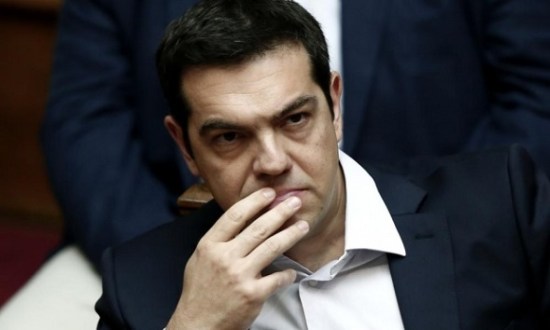
The climax to 10 days of fraught bargaining in Brussels and Luxembourg was the decision by Alexis Tsipras, the Greek prime minister, to call a plebiscite on the terms of Greece’s bailout, stunning the other eurozone governments. “I am very negatively surprised,” said Jeroen Dijsselbloem, the Dutch chair of the committee of eurozone finance ministers. “The situation [in Greece] will deteriorate very rapidly … How the Greek government will survive, I do not know.”

It’s Not Easy Being Optimist-In-Chief

When it comes to dealing with Europe, I mean. Optimism is suspekt (makes suspicious) here. There is always an angle to everything, you see.

Larry Page

For him (Larry Page), the real danger is opposing technological progress and greater efficiency. Such dangers lurk particularly in the Old World: “Especially in Europe, it appears easy to ignore the fundamental physics of a question in order to claim everything is just fine when things here cost twice as much as elsewhere. This attitude worries me greatly, because it hinders the work of entrepreneurs.”

But should not a society also have the right to say “No” to a superior technology? Certainly, agrees Mr. Page. But that’s not particularly clever. “If you make everything twice as expensive, you reduce people’s quality of life.” And do you really want to keep local entrepreneurs from making their contribution to the global economy? Naturally it’s great when citizens have the feeling they can decide. “I’m merely saying that when they make decisions contrary to a global system of capital, then they have to do that consciously and seriously. And I don’t believe anyone is doing that.”

“If I were a young entrepreneur today and I had the choice of starting my Internet firm in Germany or Silicon Valley, it wouldn’t be a hard choice. And regulation will only get worse in Europe. It will be very hard to build a company of global import there.”

Gerade die Europäer neigen in den Augen von Larry Page offenbar zu falscher Nostalgie. “In Europa scheint es leicht, die grundlegende Physik einer Frage zu ignorieren und zu behaupten, es ist schon in Ordnung, wenn Dinge hier doppelt so viel kosten wie anderswo”.