Or at least see him move in a robotic fashion.
Robot dogs take on routine tasks at Germany’s Merck – Pharmaceutical group employs services of Spot to carry out checks at incineration plants.
Or at least see him move in a robotic fashion.
Robot dogs take on routine tasks at Germany’s Merck – Pharmaceutical group employs services of Spot to carry out checks at incineration plants.
Too late for the later, I think.

Germany Promises Elon Musk Whatever He Needs For Tesla Berlin Plant – The factory, under construction, would be Tesla’s first European car plant, and could employ an estimated 12,000 people, making as many as 500,000 cars a year. The factory is slated to start production in summer 2021, an aggressive timetable for a car plant…
Locals have complained that trees were cut down for the factory and that it’s being built in a region with scarce water resources, but construction has progressed relatively smoothly so far.
“We are very proud of your car plant in Brandenburg and we wish you good luck with that. You’ll have every assistance you need.”
How could their economy be in relatively good shape? They were BAD (compared to head of the class Germany) because they didn’t do that COVID-19 lockdown thing. I don’t understand.

The 18 members of the DAX 30 index of Germany’s biggest firms that have already reported swung from a healthy profit in the second quarter of 2019 to a loss almost as big this year. For many companies, including Volkswagen, a giant carmaker, and BASF, the world’s biggest chemicals concern, results were even worse than analysts had expected. The income of the 27 Swedish firms in Stockholm’s OMX 30 that have reported so far fell by 49%, bad but much better than the DAX. If you include adjusted earnings of two opaque investment vehicles in the OMX, income actually rose…
In public, CEOs of big German companies generally praised their government’s tougher policies. Privately, though, some shared the fears expressed openly by the BVMW, the association of Mittelstand firms that represents 3.5m businesses with up to 250 employees. In an open letter in May the BVMW called on the government to lift the lockdown “before it is too late” and criticised it for lacking an exit strategy.
The German Automobile Empire.

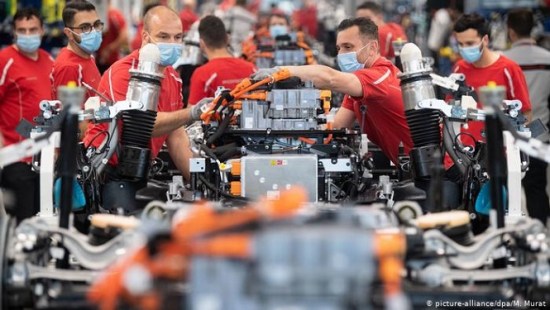
Could 400,000 car industry jobs in Germany be lost? – The car industry is in apparent decline in Germany. Some estimates predict that half its 800,000 jobs will be gone by 2030. The industry disagrees with that estimate, but the road ahead looks bumpy.
“The production of electric vehicles can be automated more easily. If there is no improvement in the competitive position of the German industry in the area of electromobility in the next few years, and if the need for imports of battery cells and electric vehicles continues to grow in light of the launch of electromobility, employment structures will be severely hit.”
No, not no to drugs. Just say no to energy. Electricity was yesterday.

No nuclear energy, no coal energy. Not much sun either for solar energy. There’s lots of wind in Germany, though. Hot air mostly but still.
Germany is first major economy to phase out coal and nuclear – German lawmakers have finalized the country’s long-awaited phase-out of coal as an energy source, backing a plan that environmental groups say isn’t ambitious enough and free marketeers criticize as a waste of taxpayers’ money.
Bills approved by both houses of parliament Friday envision shutting down the last coal-fired power plant by 2038 and spending some 40 billion euros ($45 billion) to help affected regions cope with the transition.
The plan is part of Germany’s ‘energy transition’ – an effort to wean Europe’s biggest economy off planet-warming fossil fuels and generate all of the country’s considerable energy needs from renewable sources. Achieving that goal is made harder than in comparable countries such as France and Britain because of Germany’s existing commitment to also phase out nuclear power by the end of 2022.
I didn’t leave it in my other wallet now, did I?

Remember when Germany used to have that squeaky-clean image? Yeah. Me neither. Now Wirecard has stepped up to the plate.
German payments firm Wirecard says missing €1.9bn may not exist – Company thought money was in two Asian banks but search hits dead end in Philippines.
“The management board of Wirecard assesses on the basis of further examination that there is a prevailing likelihood that the bank trust account balances in the amount of €1.9bn do not exist.”
It’s as if none of this Corona crap ever happened at all!
Maybe that’s because none of this Corona crap ever did happen. Not like it was supposed to happen, I mean. Not that anybody ever really knew how it was supposed to happen but everybody knows now that it simply didn’t happen that way. Folks sure got riled up though, didn’t they?
Germany poised for big economic recovery – The German economy is expected to shrink by more than 6% this year. But a new study found the country could be in for a big economic recovery next year.
In a best-case scenario, the economy could recover in about five months, the institute said. This would result in a more mild economic slump of just 3.9% in 2020.
But in a worst-case scenario, the recovery could also take as long as 16 months. The economy could then shrink by 9.3% this year, with growth of 9.5% forecast for 2021.
“In that case, the recovery would stretch into 2022.”
May was REALLY awful.

And we don’t even want to talk about June.
The mood among German exporters recovered somewhat in May after a “catastrophic” April, the first full month of coronavirus lockdown measures in Europe’s largest economy, the Ifo institute said on Tuesday.
“Virtually every sector still expects further declines, yet these will be less sharp than had been expected in the previous month,” the Munich think tank said in a monthly release.
The Ifo export indicator, based on a survey of around 2,300 manufacturing businesses, rose in May to -26.9 from -50.2. It is a net reading for respondents expecting an increase minus those who see a decline.
That means decline.

You know. Like the Decline and Fall of the Merkel Empire?
Biggest German industry slump in a decade revives recession fears – German industrial output suffered its biggest fall in December since the recession-hit year of 2009, a shock drop highlighting the weakness in manufacturing that risks dragging Europe’s largest economy into contraction again.
Deutsche Industrieproduktion bricht ein – “Spielball der Weltkonjunktur.”
Or it will be. Or it could be. Maybe.

Germany’s Second Economic Miracle Is Ending – The cognoscenti of international economics are once again agape, and not in a flattering way, at the budget surpluses Germany’s government keeps running, when instead it should be stimulating the economy with tax cuts and higher spending. The surplus revealed this week for 2019, at 13.5 billion euros ($15 billion), is the fifth in a row, and the biggest ever.
Many Germans still regard such numbers as signs of economic virtue and virility, as they keep slashing public debt and reveling in high employment numbers. Alas, these positive indicators are likely to be lagging, not leading. That’s because an unusual era is drawing to an end, one that was likened by Bert Ruerup, one of Germany’s top economists, to a “second economic miracle.” (The first was West Germany’s long postwar rally).
In the past 15 years — somewhat coincidentally, the reign of Angela Merkel as chancellor — Germany turned from the “sick man of Europe” to the continent’s export powerhouse and growth engine. In the next 15 years, Germany won’t necessarily become sick again. But, as Ruerup puts it, it could simply turn economically “gray,” with meager growth indefinitely.

