German companies’ hiring plans drop to four-year low, Ifo finds – German companies are less willing to hire new staff than at any point in more than four years, data from the Ifo institute showed on Monday, as weakness in Europe’s largest economy has left its mark on the country’s labour market.
Ifo’s employment barometer fell to 93.7 points in October from 94.0 points in September, the lowest level since July 2020.
some of the lowest salaries in Europe, the highest taxes in Europe (if not in the world), the highest social “contributions” (taxes) in Europe, some of the lowest retirement pensions in Europe (unless you’re a civil servant), the highest energy prices in Europe, the highest water and sewage costs in Europe, some of the highest real estate taxes and related bureaucratic costs in Europe, some of the highest rents and real estate prices in Europe and a catastrophic lack of available apartments. I’ll stop there. For now.
So don’t miss out on this opportunity, millennials!
Desperate for millennial talent, Germany launches ‘Opportunity Card’ giving migrants a year to look for a job – Between an aging population and an economy in seemingly perennial stagnation, Germany faces some major challenges. Could a visa aimed at attracting more young, hungry workers be the answer?
Germany is set to launch an “Opportunity Card” just in time for the summer, aimed at young foreign workers hoping either to eventually secure a long-term job or simply work in the country for a while.
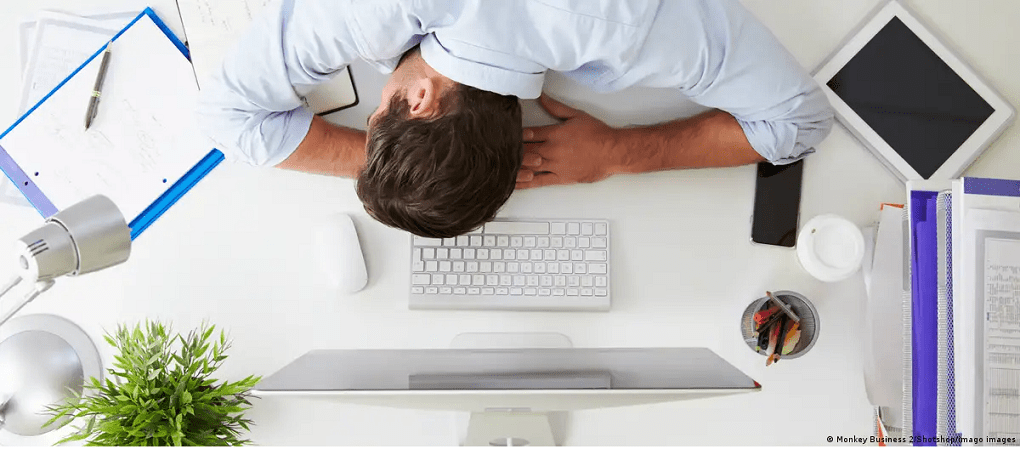
That means sleeping in the office is the most healthy kind of sleep.
Have the Germans become lazy at work?
Germans have long been known for their diligence, sense of duty, reliability and productivity. Recent data suggests that Germans are working fewer hours. But that doesn’t tell the whole story.
A glance at current OECD labor figures can be startling. In 2022, the average American worked over 1,800 hours per year, while the average German worked only 1,340 hours. However, labor market researcher Enzo Weber from the Institute for Employment Research (IAB) in Nuremberg, Germany, dismisses suggestions of the once-industrious Germans now only wanting to enjoy their sweet lives.
“Germany has a very high female labor force participation rate compared to most other countries,” Weber told DW, noting that the main difference to other countries was that about every second woman works part-time, which mathematically lowers the average annual working hours.
Germany targets Indian students to address labor shortages – Germany looks to tap into international student talent to keep its engineering and IT sectors afloat.
Germany is grappling with a critical labor shortage and aging population, with projections indicating a deficit of seven million skilled workers by 2035.
With some 700,000 vacancies currently unfilled, Germany’s economic growth potential has dropped to about 0.7% now from around 2% in the 1980s, and is set to fall further to 0.5% if the country fails to resolve this problem, German Economy Minister Robert Habeck has said, stressing the importance of migration in bridging this widening gap.
Engaging Germany’s Indian student population in the workforce may be part of the solution.
That’s why we desperately need a four-day work week.
To, uh, increase the hours worked each week? I don’t get it.
Germans work fewer hours over their lifetime than their European neighbours – In comparison to their European neighbours, people in Germany work fewer hours throughout their lifetime, a new study has revealed, but there is still a big appetite for a four-day week in the federal republic.
Germans work an average of 52.662 hours throughout their lives.
A new study from the Roman Herzog Institute has laid out the working habits of people in European countries. In comparison to their neighbours, Germans are on the clock for fewer hours throughout their lives, clocking in an estimated 52.662 hours of work, which means 39,3 years of their lives are solely occupied by work.
They’re just not as, well, robotic as their parents and grandparents used to be.
It’s time to replace them with the real thing.
As baby boomers retire, German businesses turn to robots – At machine parts producer S&D Blech, the head of the grinding unit is retiring. With Germany’s acute labour shortage leaving few candidates to take on the skilled but dirty and hazardous manual work, the company will replace him with a robot.
Other small and medium-sized companies are also turning to automation as the gradual exit from the workplace of Germany’s post-war “baby boom” generation tightens the labour squeeze.
Germany’s would-be spies seek licence to work from home – BND intelligence service is finding expectations of flexible working and taking a mobile to the office are affecting recruitment.
“Remote work is barely possible at the BND for security reasons, and not being able to take your cell phone to work is asking much from young people looking for a job.”
Yeah, I read about those once. Looks like it’s been quite a while since then, though.
Tesla’s Berlin Hub Can’t Hire Enough People, or Keep Them – The company’s staffing problems have been magnified in Germany, where it is unable to meet targets as more workers head for the exit.
“Some people are off sick longer than they’ve actually worked. There are people who I haven’t seen working for three weeks in six months. Many people are signed off sick because the motivation isn’t there.”
Energy crisis: Quarter of German companies ‘plan to cut jobs’ – In order to tackle rising energy prices, a quarter of German companies revealed in a new survey that they planned to cut jobs, among other cost saving measures.
Around 25 percent of German companies plan to axe jobs as a cost saving measure, according to a survey of 1,080 German firms led by the Munich-based Stiftung Familienunternehmen released on Monday.
Tesla Submits Application to Expand German Plant – Tesla has submitted an application to build on a further 100 hectares east of its plant in Germany, expanding the site’s area by a third, local newspaper rbb reported on Thursday, citing the local mayor.
The electric carmaker, which already has 300 hectares of land for its auto factory and battery plant under construction, planned to build a freight station, logistics areas and parking spaces on the additional space, Gruenheide mayor Arne Christiani told RBB.



 Observing Hermann