North, south. Inferiority, superiority. It’s all the same to me.
Germans export more to their European partners than they consume, benefiting from this asymmetrical situation even as they expect everyone else to be exporters and savers like them.
North, south. Inferiority, superiority. It’s all the same to me.
Germans export more to their European partners than they consume, benefiting from this asymmetrical situation even as they expect everyone else to be exporters and savers like them.
Is this the end of “the European way of life” as we know it?

European leaders have been muddling through instead of properly tackling the debt crisis. Now it threatens the very foundations of the European Union and could destroy a lifestyle that millions of Europeans take for granted.
Funny. I thought taking things for granted was what the European lifestyle was all about.
“We need fiscal discipline because we have a debt problem… No euro bonds as long as I live.”
German government debt keeps climbing relentlessly higher and reached an all-time high during the first three months of this year. The federal, state and local governments then reached a debt to the tune of 2 trillion euros.

That was 2.1 percent or 42.3 billion euros higher (deeper?) than in the previous year’s quarter, reported the Federal Office of Statistics in Wiesbaden on Monday.
Now if only Greece and Co. could learn to control their government spending like the Germans do. Oh, wait. They already have. Or do. Or whatever.
Deutschlands Staatsschulden auf Rekordhoch gestiegen
Is it termination time yet? For the booming German economy, I mean?
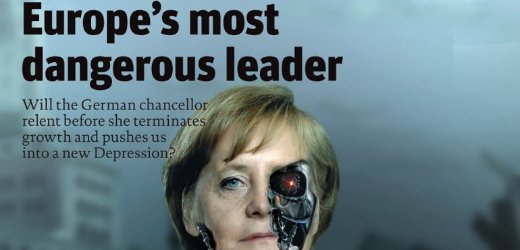
The Spiegel says: German manufacturing activity has hit a three-year low and export orders have also seen a big drop. This data suggests that the crisis is starting to hit the previously robust German economy.
Hasta la vista, baby? Maybe.
The ones that used to go to the euro zone, I mean. Wo sind sie geblieben?

German imports tumbled at their fastest rate in two years in April and exports fell, adding to evidence that Europe’s largest economy is beginning to feel the chill from the euro zone debt crisis.
Hey, I’m all for austerity, too, Germany. But when your European partners are too austere to buy your German products, what happens then?
That’s when Plan B kicks in (the German master plan is well thought out, you know, the diabolical #!?§#!s): Exports to non-EU markets are now on the rise.
“German companies feel that foreign demand isn’t as dynamic as it used to be as the global economy is entering a weaker phase. The weakness originates in the euro area, where the debt crisis can no longer be felt only through budget cuts and austerity but increasingly creates uncertainty about economic prospects, which is reflected in weaker investment.”
The Economist writes: If the euro collapses, then Germany will suffer hugely.
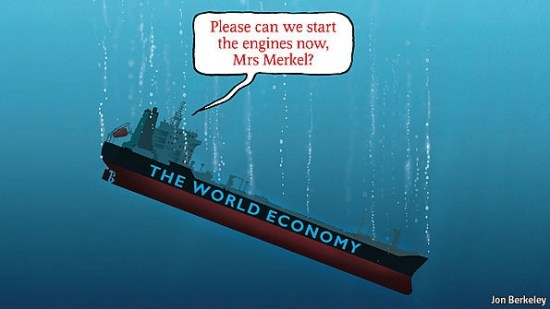
The downgrading of some of its banks this week was a portent of that. Moreover, the undoubted mistakes in Greece, Ireland, Portugal, Italy, Spain and the other debtor countries have been compounded over the past three years by errors in Europe’s creditor countries. The overwhelming focus on austerity; the succession of half-baked rescue plans; the refusal to lay out a clear path for the fiscal and banking integration that is needed for the single currency to survive: these too are reasons why the euro is so close to catastrophe. And since Germany has largely determined this response, most of the blame belongs in Berlin.
Throughout this crisis, Mrs Merkel has refused to come up with a plan bold enough to stun the markets into submission, in the same way that America’s TARP programme did. In short, even if her strategy has paid some dividends, its cost has been ruinous and it has run its course.
Europe Doesn’t Need the Euro? Another religious tract to study on Sundays.
All of this is kind of like religion, don’t you think? First you’ve got some prophets who come out of the wilderness (the political class preaching the virtues of the euro, come hell or high water), then what they say gets labeled as heresy by the faithful (by the “man on the street” who wants to keep his deutschmark), then the euro faith overcomes this persecution, establishes itself as the true universal teaching and becomes orthodoxy. Then the next voice out of the wilderness comes along and the game starts all over again, etcetera and so forth already.
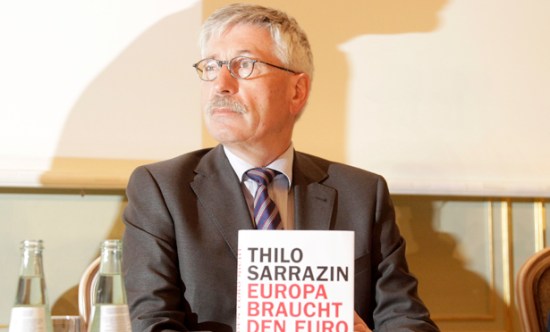
Don’t get me wrong, I don’t beleive that Thilo Sarrazin is a full-fledged prophet or anything (I just think he wants to make a buck, I mean euro). But he’s not a full-fledged heretic, either. And that’s something the euro high priests could never admit to.
The euro, in Sarrazin’s view, is just the old German deutschmark extended to a lot of countries with less robust currencies.
Germany, in other words, is being used as a guarantor of other countries’ debts.
“The German political class bet that the political union would follow shortly thereafter almost as a matter of natural law, because without that the common currency wouldn’t be stable. That bet has failed.”
Germans are hostage to their sense of not wanting to be responsible for Europe’s failure.
Germans are hostage to their sense of historical guilt.
“Pro-euro Germans are driven by that very German reflex, that we can only finally atone for the Holocaust and World War II when we have put all our interests and money into European hands.”
“Angela Merkel to like the friendly woman on the navigation system in my car.”
It’s a popular Sunday night ritual here in Germany: After Tatort is over, most folks stay tuned in to watch Günther Jauch’s talk show.

And another popular ritual here is to make sure to be empört (outraged, highly indignant) whenever you hear the name Tilo Sarrazin. The reason? This guy has the gall to 1) revel in being politically incorrect by saying out loud what roughtly 80 to 90 percent of the rest of the German population really (if not secretly) thinks and to 2) openly and shamelessly captialize on this by writing lucrative bestsellers about these horrid and despicable views.
His first Tabubruch (taboo breaking): “Germany Is Doing Away With Itself,” a book advocating a more restrictive immigration policy and the reduction of state welfare benefits.
His next big bestseller (to be plugged tonight): “Europe Does Not Need The Euro,” a book, well, the title says it all, doesn’t it?
Needless to say, the politically correct political caste is up in arms about tonight’s show already and is calling for a boycott and whatever else they call for in a situation like this and, well, let’s face it. Once you mix popular rituals like these together, live and in color, as the Germans like to say, I am convinced we’ll be getting Fernsehen vom Feinsten (TV at its best) tonight. All for all the wrong reasons, of course, but still.
“Mit Sarrazin sollte sich niemand mehr in eine Talkshow setzen.”
There’s Germany, it seems. And then there’s (practically) everybody else in Europe.
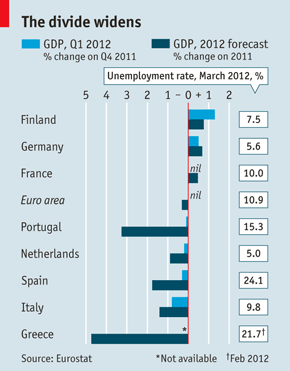
The Economist notes: The hope is that Germany, which produces over a quarter of euro-zone output, can pull along the rest. But the worry is that the latest bout of euro sickness may sap confidence even in Germany, aborting a broader recovery.
With unemployment at 6% compared with a 15-year high of 11% across the euro zone and over 20% in Spain and Greece, Germans feel less pressure to save in case they lose their jobs. And a more confident Germany helps everyone by spending more on imports. German inflation at 2.2% is now below average.
German resilience reflects several strengths. Although growth in the first quarter was helped by exports, the usual mainstay, it has increasingly been backed by domestic demand, which accounted for three-quarters of GDP growth in 2011. This reorientation has happened because Germany avoided the debt excesses (? hmmm, relatively speaking perhaps, but I’ve seen some other numbers here), both private and public, that inhibit growth elsewhere. With relatively low debt, German households and firms can borrow more. What is more, they can do it at rock-bottom rates. Paradoxically, Germany is benefiting from the euro crisis, as investors seek a haven. Yields on ten-year German government bonds have fallen below 1.5%.
Paradoxically, Germany is benefiting from the euro crisis, as investors seek a haven. Yields on ten-year German government bonds have fallen below 1.5%.
And yet, after having read all these impressive figures up there, there’s another German paradox I keep running into here all the time: Germans on the street aren’t nearly as confident as this article wants to imply, at least not when it comes to the euro and the euro-zone. How else do you explain the fact that nearly every second German now thinks that the introduction of the euro was a big honking mistake in the first place?
Die Euro-Einführung war ein Fehler, glauben knapp die Hälfte der Deutschen.
Undank ist der Welten Lohn (nothing is so hard as man’s ingratitude).

What were you expecting, Germany? The Greeks have politely but firmly said no to a recent offer made by 160 German tax collectors who were ready, willing and able to fly down to Greece and help their Greek tax collector buddies gather Greek taxes in a more efficient and Teutonic-like manner.
The Greeks may be broke, but they’re not crazy. Not even Germans can stand German tax collectors
Als Begründung müssen die “hart arbeitenden griechischen Beamten” herhalten.
 Observing Hermann