Kings of Kallstadt

President Trump Keeps Falsely Saying His Father Was Born In Germany.

It’s an honest mistake, I guess. If he never saw this German documentary called “Kings of Kallstadt,” I mean. His grandfather – as did H. J. Heinz of the famous ketchup company – both stemmed from this same small German town in the Rhineland. The film is in German, of course, but even if you don’t speak German it gets interesting around minute 48.

What’s also interesting about the film, I think, is that this takes place shortly before Donald Trump ran for President and the civil tone of the whole undertaking is breathtaking. Before all the poison that came out later, I mean. The film is a bit of an accident, in other words.

“He was born in a very wonderful place in Germany.”
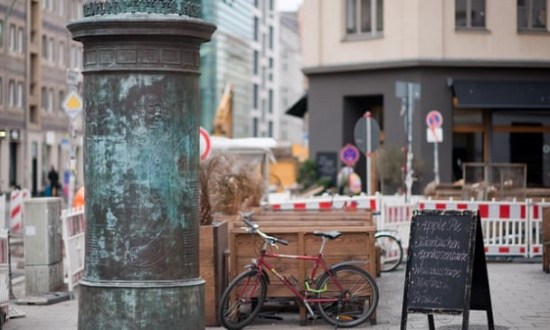
German Of The Day: Litfaßsäule

That means advertising column.

Pillar

Take a good look. They won’t be around much longer. They’re going to a better place – the same place the LPs, dial phones, typewriters and carrier pigeons went.

They have been an integral part of the city’s furniture for so long, Berliners admit to taking them for granted.

But concrete advertising pillars, known as Litfaßsäule – or Litfaß columns – after the man who invented them, around 3,000 of which dot the German capital, are under threat. A low-key, grassroots protest has sprung up in an effort to save them from destruction and sparked a trend involving writing messages on the pillars, as well as poems and heart felt tributes.

It takes two or three people to group hug a Litfaßsäule, and that has also become another way of highlighting the reluctance to let them go.

“I’m certainly still more drawn to a catchy poster on the Litfaßsäule, than I am to something that flashes up on my mobile phone which I’m likely to swipe away in annoyance.”

No Contradiction Here

Not if you’ve lived in Germany long enough there isn’t. Or you won’t notice it, I should say.

Zeit

Germans Invented Daylight Saving Time—Now They’re Going to Kill It – The European Parliament voted in favor of stopping the practice by 2021, following a poll last year from the EU in which 84% of the respondents voted in favor of reverting to one time year-round. The law must now be passed by national governments…

European Commission President Jean-Claude Juncker is a force behind the movement, having vowed to back the end of Daylight Saving Time in September last year, after the results of the poll were released. The survey proved it was the will of the people, he declared; “Clock-changing must stop.”

But in reality, it was mostly just the will of the Germans.

Out of 4.6 million responders to the poll, 3 million were German. (The country accounts for about one-sixth of the EU’s total population.)

“If we didn’t have the time change, and today someone would come up with the idea of introducing it, everybody would think that person was crazy.”

German Of The Day: Migrationshintergrund

That means migrant or immigration background.

Migrationshintergrund

You know, like almost half of the unemployed in Germany have Migrationshintergrund? 46 percent, to be exact, sort of (answering this question at the employment office is not mandatory so the number will actually be higher). Back in 2013 it was 36 percent. Kind of a high percentage, don’t you think? But the talking heads in government and media don’t worry about something like this turning into a larger problem than it already is because they have been told, officially like, that “they can do it.”

Die entsprechende Quote liegt demnach bei 46 Prozent. Ende 2013, vor Beginn der verstärkten Migration nach Deutschland, hatte der Wert noch bei 36 Prozent gelegen.

Angst, Angst, Angst…

Insurance, insurance, insurance.

Angst

How German angst created the welfare state – The state sets the tone. Your health insurance contributions are deducted automatically from your salary at a rate of 14.6 percent. You and your employer pay half each. Unemployment, pension and long-term care insurance are also taken out of your pay.

Liability insurance isn’t legally required, but people will raise an eyebrow if you don’t have any. Additional dental insurance, for procedures not covered by the statutory system, comes widely recommended. And if you have a pet, expect to be judged for not guarding against all eventualities…

See German Oddity 11. Germans don’t like surprises. That is probably why they have insurance for practically anything you can imagine. It’s crazy. They not only have vacation insurance, for example, they also have what-if-I-decide-to-cancel-my-vacation insurance. They have insurance for their insurance, you see. And if you were to ever tell a German that you didn’t have any Rechtschutzversicherung (legal costs insurance) they would gasp for breath and look at you like you just beamed down from Mars.

German Of The Day: Die fetten Jahre sind vorbei

That means the “fat” (good) years are over.

Fat

Merkel Doesn’t Want to Tell Germans the Good Times May Be Over – The leaders preparing to take over when Merkel steps aside are worried too. They say voters could be caught unawares by an economic shock in the middle of the political transition from Merkel’s rule. Two senior party officials this month voiced concerns that such a double whammy could shake up the political map ahead of the next election. They asked not to be identified questioning the chancellor’s approach.

One shouldn’t undermine the economic upswing by talking it down.

No Parallel Society Here

Not yet anyway.

Kindergarden

But if at first you don’t succeed, try and try again.

Germany: Muslim kindergarten loses appeal against closure – State officials had ordered “Al Nur” to close following revelations that inappropriate literature had been shared at the kindergarten. The day care center is the only Muslim kindergarten in Rhineland-Palatinate…

The state’s decision to revoke Al Nur kindergarten’s license was lawful because evidence showed links between the school’s administrators and the extremist Salafist ideology, an administrative court in the city of Mainz said. The court said the links made it difficult for children at Al Nur to integrate into German society and compromised their independence.

“Efforts by Arab Nil-Rhein, the association that runs the kindergarten, to distance itself from Salafist thought were not convincing.”

It’s In Their DNA Or Something

Self-abnegating Germans obsess about becoming more European than the other Europeans only to make the EU more German than anyone wants it to be.

EU

What makes me chuckle about the Brexiteers is how little they understand the German mindset. Here in Germany, the European Union is a religion. It is ingrained so heavily in the DNA of nearly every German citizen that any reasoned argument to counter its domination, or challenge its direction, is swiftly dismissed. The integrity of the EU – its unity, identity, money and rules – is central to German identity. That’s why they’ve maintained such a tough stance over Brexit.

And there is a clear reason why. As stated here, The EU is Germany writ large.’

The EU is a religion for Germans – no wonder Brexit is going so badly.

A Large City Every Year

The head of Germany’s Federal Office for Migration and Refugees, Hans-Eckhard Sommer, is in hot water now.

City

He claims that the amount of asylum seekers still being allowed to enter Germany is “too high” (162,000 last year) and compares this to “a large city coming to us every year.”

Worse still, he makes the ridiculous allegation that “the state can only handle so much” and then has the cheek to critisize the fact that over half of those seeking asylum (54 percent) still don’t have the decency to carry any identification papers with them.

What a monster or something. He should be relieved of his job immediately.

„EINE GROSSSTADT, DIE JÄHRLICH ZU UNS KOMMT”

Deutsche Sprache Schwere Sprache

German is a tough language to learn.

German

For example, nearly half of the migrants who took the German language course offered by Germany’s Federal Office for Migration and Refugees last year (93,500 from 202,000 participants), failed. That failure rate of 45% is up from 40% the previous year.

And this was after 600 teaching units forty-five minutes each. Are they stupid? Of course not. But maybe the people who think “integrating” them would be easy. This just shows you what a mammoth task the integration of such a large number of people will be, should it ever succeed at all. If they can’t even speak the language, how can anyone expect them to be integrated? But maybe nobody really does anymore.

Die Durchfallquote bei den Deutschprüfungen am Ende der Integrationskurse ist vergangenes Jahr auf 45 Prozent angewachsen. 2017 lag sie noch bei 40 Prozent. Das zuständige Ministerium will die Kursqualität anheben.