German Of The Day: Heimlicher Wortbruch

That means secret breach of promise.

Wortbruch

Mr Trump accused Berlin of falling short of its NATO commitments during a meeting with Polish President Andrzej Duda at the White House yesterday (June 12). The US President demanded that they increase their defence spending from one percent to two percent of gross domestic product (GDP).

NATO set a target for every member to spend two percent of GDP on defence by 2024.

But Berlin has only pledged to increase spending to 1.5 percent by that date.

Deutschlands heimlicher Wortbruch gegenüber der Nato.

And You Thought Paying Back Your Student Loan Was A Bitch

And I’m sure it was but…

Debt

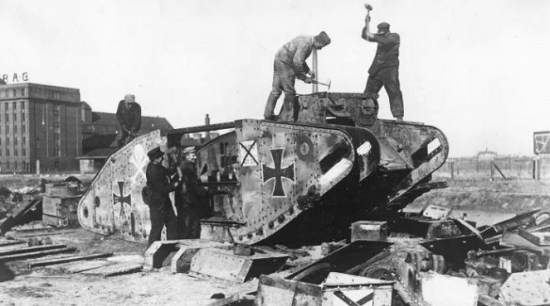
Germany’s World War I Debt Was So Crushing It Took 92 Years to Pay Off – After the Treaty of Versailles called for punishing reparations, economic collapse and another world war thwarted Germany’s ability to pay…

The Allies exacted reparations for World War II, too. They weren’t paid in actual money, but through industrial dismantling, the removal of intellectual property and forced labor for millions of German POWs. After the surrender, Germany was divided into four occupation zones, and in 1949 the country was split in two. Economic recovery, much less reparations payments, seemed unlikely.

By then, West Germany owed 30 billion Deutschmarks to 70 different countries, according to Deutsche Welle’s Andreas Becker, and was in desperate need of cash. But an unexpected ray of hope broke through when West Germany’s president, Konrad Adenauer, struck a deal with a variety of western nations in 1953. The London Debt Conference canceled half of Germany’s debt and extended payment deadlines. And because West Germany was required to pay only when it had a trade surplus, the agreement gave breathing room for economic expansion.

Soon, West Germany, bolstered by Marshall Plan aid and relieved of most of its reparations burden, was Europe’s fastest-growing economy. This “economic miracle” helped stabilize the economy, and the new plan used the potential of reparations payments to encourage countries to trade with West Germany.

Still, it took decades for Germany to pay off the rest of its reparations debt. At the London Conference, West Germany argued it shouldn’t be responsible for all of the debt the old Germany had incurred during World War I, and the parties agreed that part of its back interest wouldn’t become due until Germany reunified. Once that happened, Germany slowly chipped away at the last bit of debt. It made its last debt payment on October 3, 2010—the 20th anniversary of German reunification.

Adis A.?

Maybe he’s Aris A.’s brother.

Bataclan

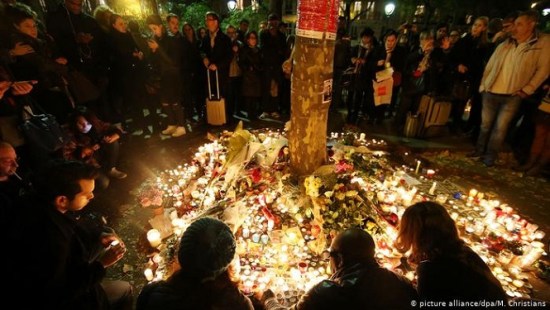
Bosnian arrested in Germany in connection with Paris Bataclan attacks – Dresden prosecutors say a Bosnian man linked to the 2015 attacks on the Bataclan nightclub in Paris, is under arrest in Germany’s state of Saxony-Anhalt. An extradition to Belgium is being considered.

Den Namen des Verdächtigen gab die Staatsanwaltschaft mit Adis A. an. Ob auch die internationale Suche wegen der Beteiligung am Terroranschlag mit Waffen zu tun hat, konnte zunächst kein Behördensprecher sagen.

The German (Political) Psyche In A Nutshell

Or everyday German schizophrenia in action, if you prefer – in this case with regard to  Germany’s famous/infamous green energy policy.

Energy

“Germany is not a trendsetter. Germany is a dependent tag behind. Gas will come from Russia in the future while we impose sanctions on the Russians at the same time. Electricity will come from nuclear reactors and coal-fired power stations in neighboring countries while we simultaneously disparage them for being environmental villeins. Security will be provided by the NATO partner USA who we permanently abuse in the most savage manner. Sadly, political Germany suffers from megalomania and ineptitude at the same time. If one wants something, one finds a way. If one doesn’t want something, one finds the reasons.”

Deutschland ist nicht Vorreiter. Deutschland ist abhängiger Hinterherhinker. Gas kommt künftig aus Russland, das gleichzeitig mit Sanktionen behängt wird. Strom kommt künftig aus den Atomreaktoren und Kohlekraftwerken der Nachbarländer, die gleichzeitig als Umweltsünder und Schrottreaktoren verunglimpft werden. Sicherheit kommt vom NATO-Partner USA, der permanent aufs Übelste beschimpft wird. Das politische Deutschland leidet leider an Größenwahn, gepaart mit Unfähigkeit. Wer etwas will, findet Wege. Wer etwas nicht will, findet Gründe.

Two Down, One To Go

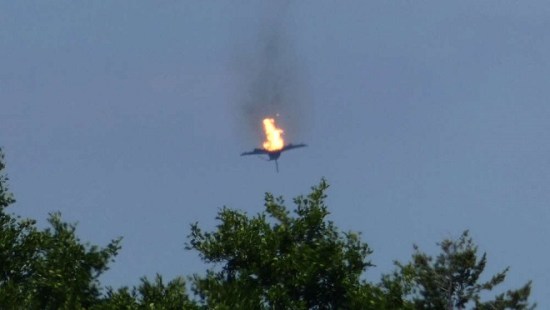
After yesterday’s tragic crash of two Eurofighters during a training mission over Northern Germany, the German Luftwaffe is down to one operational plane of that design.

Air Force

But they are really, really good planes, we are told. Again and again. Top of the line state of the art. But state of the art isn’t even good enough these days, especially when most of them don’t even fly. That’s why the Eurofighter is now to be replaced with the “Future Combat Air System.” This one won’t have to leave the ground, either, I assume, which will make things a lot easier. It will just beam to the future and do its future combat fighting there.

Nach Unglück: Hat die Luftwaffe wirklich nur noch einen einsatzfähigen „Eurofighter“?

What Harm Could 160 “Islamic State” Combatants Cause?

Hey, see no evil, hear no evil, speak no evil and no evil will come to you, right?

ISIS

Germany loses track of 160 ‘Islamic State’ supporters – About 1,000 Germans traveled to the Middle East to join the ‘Islamic State’ after 2013. A third of them have since returned to Germany. Some died on the battlefield, others are in prison, but many appear to be missing.

“In rare cases, these individuals could have succeeded in escaping and/or disappearing.” The ministry stressed it was unlikely IS followers would pass unnoticed in Germany, given “various measures (including wanted lists or entry bans), which make uncontrolled re-entry much more difficult.”

History Really Does Repeat Itself

The German navy does this regularly, I guess. Commit suicide, I mean.

Suicide

So I suppose you could call the one going on presently a ritual suicide, albeit slower than those of the past (look what’s been going on with the Bundeswehr for the past thirty or forty years or so and you’ll get my drift).

One hundred years ago, the German High Seas Fleet committed suicide. On June 21, 1919, the crews of seventy-four German warships attempted to scuttle their vessels in order to prevent the Allies from taking them. Over the course of a few hours, fifty-two modern warships sank. In the modern history of naval combat, there has never been an event as devastating as the self-destruction of the German fleet at Scapa Flow. The scuttling immediately became legendary, closing one chapter of German naval history and opening another…

Indeed, the Germans had prepped the ships for scuttling over the previous several months, removing doors and taking other steps to reduce watertight integrity. They waited for motive and opportunity. As the Paris Peace Conference dragged on, both the French and the Italians had made claims upon the fleet. As the deadline for signing the treaty approached, both the Germans and the British made their preparations, the latter to seize the ships and the former to scuttle them.

On June 21, a comedy of errors ensued. The signing of the treaty was postponed two days, although it is unclear how aware the German sailors were made of this fact. The British commander decided that the fabulous early summer weather offered a great opportunity for practice, and the bulk of the Grand Fleet left Scapa Flow for maneuvers on the morning of June 21. Only a few patrol and utility ships remained.

Admiral Ludwig von Reuter gave the order for scuttling, and every German ship obeyed. The British didn’t notice until around noon, when the battleship Friederich der Grosse began to list noticeably. At this point, the rest of the fleet raised the Imperial German Naval ensign, which the British had officially forbidden. At that point, the scuttling became a race between the water and the Royal Navy. The Grand Fleet, notified by radio of the sinking, began to return immediately. The few Royal Navy ships in attendance picked up survivors, but were unable to save very many of the sinking ships.

Who Makes This Stuff Up?

Oh, Al Jazeera makes this stuff up. Then it makes sense.

Germany

Germany welcomed refugees. Now it’s reaping the economic benefits – German companies need more skilled workers. Refugees are helping to fill the gap.

This is not the German reality. When Angela Merkel opened the floodgates in 2015, talk was soon everywhere (where talk like this was expected to be – see state television) that precisely this would happen; highly skilled engineers, doctors and other specialists from Syria would “fill the gap” in a booming German economy short on workers. This simply did not happen. The small number of specialists who did make it here were generally stymied by German bureaucracy or simply do not have the skills German companies expected them to have. Who did come? Armies of unskilled workers who are now a big burden on the German social system.

It’s not the Syrians’ fault that Germany does everything bass ackwards here, though. The Germans needed skilled workers so they let the unskilled in. They don’t even bother to introduce a comprehensive immigration law so they can decide who enters their country or not – haven’t gotten around to it to this very day. And on and on it goes. Al Jazeera’s fantasy Germany makes for good stories, I guess, but it has nothing to do with the real Germany. Not that anybody is interested. Just sayin’.