The Symptoms Of The Times

Withdrawal, I am told, can refer to any sort of separation, but is most commonly used to describe the group of symptoms that occurs upon the abrupt discontinuation/separation or a decrease in dosage of the intake of medications and recreational drugs.

In order to experience the symptoms of withdrawal, one must have first developed a physical/mental dependence (often referred to as chemical dependency).

„Notenbankfinanzierung kann süchtig machen.“

The End With Horror

No horror here. Or terror, if you prefer. How does that German proverb go? Lieber ein Ende mit Schrecken als ein Schrecken ohne Ende?

That is, better an end with horror than a horror without end. And that’s where we’re at with Greece now, finally.

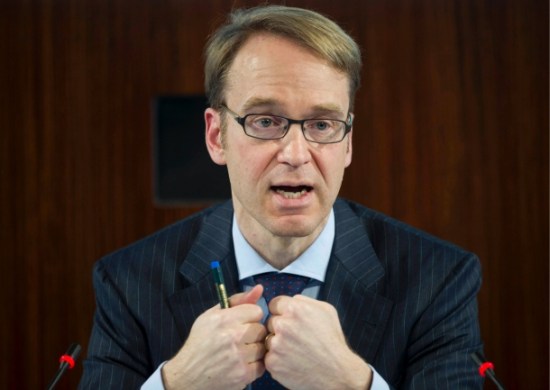
German Vice Chancellor Philipp Roesler said he’s “very skeptical” that European leaders will be able to rescue Greece and the prospect of the country’s exit from the euro had “lost its terror.”

Get it over with already, people, and move on.

Our Debt Still Doesn’t Stink

German government debt keeps climbing relentlessly higher and reached an all-time high during the first three months of this year. The federal, state and local governments then reached a debt to the tune of 2 trillion euros.

That was 2.1 percent or 42.3 billion euros higher (deeper?) than  in the previous year’s quarter, reported the Federal Office of Statistics in Wiesbaden on Monday.

Now if only Greece and Co. could learn to control their government spending like the Germans do. Oh, wait. They already have. Or do. Or whatever.

Deutschlands Staatsschulden auf Rekordhoch gestiegen

Bonds, German Bonds

That’s the thing about a crisis: There’s always a winner, too. Take the euro crises, for instance. And the demand for German bonds these days.

Demand for German bonds, seen as the safest haven in the euro zone, has pushed Berlin’s borrowing costs so low that some investors are effectively paying Germany for the privilege of lending it money.

Damn. This gives German bondage a whole new meaning.

Low interest rates on German bonds are translating into billions in savings. Now economists have calculated that the country should be able to balance its budget by next year — something that is likely to increase criticism of Germany’s crisis management.

…The perception that Germany is benefiting financially from the crisis while imposing strict austerity measures on countries in southern Europe is unlikely to win many friends for Chancellor Angela Merkel, who is already highly unpopular in countries such as Greece.

Speaking Of Presidents… You Call This Being “Increasingly Disillusioned” With Obama?

Well, there’s disillusion and there’s disillusion.

A new survey indicates that German disillusionment with the US president is “widespread.” Wow, like what a surprise or something. Even the Germans catch on eventually.

But wait, please look a little closer. The real news story has to do with the numbers behind this so-called disillusionment. “Disillusionment with Obama” over here means:

Nevertheless, they (the Germans) still have overwhelming confidence in Obama’s overall international leadership. In fact, at 87 percent, Germans are the most supportive in Europe… And nine out of 10 Germans want to see Obama re-elected.

Huh? OK. Unbelievable as usual. It never ceases to amaze me. In a nation so openly sensitive to the concept of Gleichschaltung (enforced political conformity, as in the Third Reich kind), how can you get more gleichgeschaltet than that?

In retrospect, hopes for an Obama presidency were unrealistically high, especially among Europeans.

Heretics Verboten!

Europe Doesn’t Need the Euro? Another religious tract to study on Sundays.

All of this is kind of like religion, don’t you think? First you’ve got some prophets who come out of the wilderness (the political class preaching the virtues of the euro, come hell or high water), then what they say gets labeled as heresy by the faithful (by the “man on the street” who wants to keep his deutschmark), then the euro faith overcomes this persecution, establishes itself as the true universal teaching and becomes orthodoxy. Then the next voice out of the wilderness comes along and the game starts all over again, etcetera and so forth already.

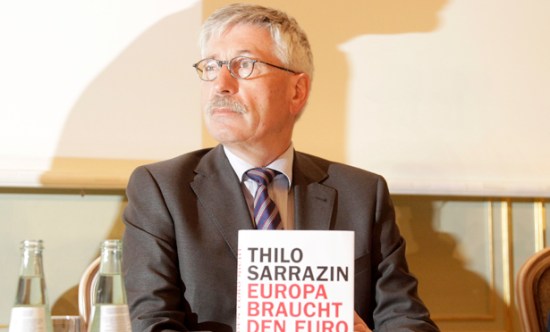
Don’t get me wrong, I don’t beleive that Thilo Sarrazin is a full-fledged prophet or anything (I just think he wants to make a buck, I mean euro). But he’s not a full-fledged heretic, either. And that’s something the euro high priests could never admit to.

The euro, in Sarrazin’s view, is just the old German deutschmark extended to a lot of countries with less robust currencies.

Germany, in other words, is being used as a guarantor of other countries’ debts.

“The German political class bet that the political union would follow shortly thereafter almost as a matter of natural law, because without that the common currency wouldn’t be stable. That bet has failed.”

Germans are hostage to their sense of not wanting to be responsible for Europe’s failure.

Germans are hostage to their sense of historical guilt.

“Pro-euro Germans are driven by that very German reflex, that we can only finally atone for the Holocaust and World War II when we have put all our interests and money into European hands.”

“Angela Merkel to like the friendly woman on the navigation system in my car.”

The Great European Divide

There’s Germany, it seems. And then there’s (practically) everybody else in Europe.
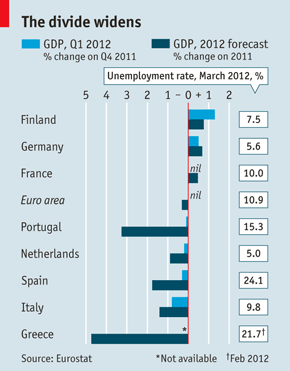
The Economist notes: The hope is that Germany, which produces over a quarter of euro-zone output, can pull along the rest. But the worry is that the latest bout of euro sickness may sap confidence even in Germany, aborting a broader recovery.

With unemployment at 6% compared with a 15-year high of 11% across the euro zone and over 20% in Spain and Greece, Germans feel less pressure to save in case they lose their jobs. And a more confident Germany helps everyone by spending more on imports. German inflation at 2.2% is now below average.

German resilience reflects several strengths. Although growth in the first quarter was helped by exports, the usual mainstay, it has increasingly been backed by domestic demand, which accounted for three-quarters of GDP growth in 2011. This reorientation has happened because Germany avoided the debt excesses (? hmmm, relatively speaking perhaps, but I’ve seen some other numbers here), both private and public, that inhibit growth elsewhere. With relatively low debt, German households and firms can borrow more. What is more, they can do it at rock-bottom rates. Paradoxically, Germany is benefiting from the euro crisis, as investors seek a haven. Yields on ten-year German government bonds have fallen below 1.5%.

Paradoxically, Germany is benefiting from the euro crisis, as investors seek a haven. Yields on ten-year German government bonds have fallen below 1.5%.

And yet, after having read all these impressive figures up there, there’s another German paradox I keep running into here all the time: Germans on the street aren’t nearly as confident as this article wants to imply, at least not when it comes to the euro and the euro-zone. How else do you explain the fact that nearly every second German now thinks that the introduction of the euro was a big honking mistake in the first place?

Die Euro-Einführung war ein Fehler, glauben knapp die Hälfte der Deutschen.

Vorratsdatenspeicherung

Is that a German word, or what?

And it looks like it’s a word that’s going to cost Germany millions in fines for not being willing to go along with the guidelines concerning it as determined by the EU.

I mean, we all know that Vorratsdatenspeicherung is a touchy subject and all. Some countries do their Vorratsdatenspeicherung this way, other countries do their Vorratsdatenspeicherung that way. But any way you cut the Vorratsdatenspeicherung cake, Vorratsdatenspeicherung is Vorratsdatenspeicherung and I, for one, find it irresponsible of Germany to just ignore the EU’s Vorratsdatenspeicherung guidelines like that, just because they’re Germany, I mean. All Europeans are in the same Vorratsdatenspeicherung boat, after all.

Who do they think they are, anyway?

You should be ashamed of yourself, Germany. Put that in your Vorratsdatenspeicherung pipe and smoke it.

“Was wir auf den ersten Blick sagen können ist, dass Deutschland anscheinend keinen Fortschritt bei der Umsetzung der EU-Richtlinie zur Vorratsdatenspeicherung gemacht hat und weiterhin EU-Recht verletzt.”

PS: Vorratsdatenspeicherung means data retention (the EU wants to retain data for six months, Germany doesn’t).

German Tourists Avoiding Greece This Year For Some Reason

German tourists may gladly zip off to some of the most dangerous places on earth you can imagine, but not even they are crazy enough to be heading down to Greece any time soon.

“The Germans aren’t coming here this year but there’s no reason for them to be afraid,” one Greek guy said. “Honest,” he should have added.

“We don’t have a problem with the German people, only their government,” another guy added, who forgot to say “Really.”

“That’s just the way Germans are: if there’s trouble in some country, then Germans just don’t go there on their holidays.”

Germans Now Allowed To Shoot At Pirates

On land, even. No, not these pirates. These pirates down here.

Well, they won’t actually be shooting at the pirates per se (that would be bad), but more like at their equipment and stuff. You know, at the loot and the booty on the beaches? This will make the pirates run away and never come back again or at least become good or something.

It is all part of the EU’s anti-pirate Operation Atalanta off the Somali coast so it’s OK for Germans to do this, really.

The German opposition continues to criticise the operation as risky overreach for the forces and has vowed to vote against it.