That’s how it’s always been in today’s Germany. Search here (in the upper left) for “beautiful German weapon sale” to get just a few examples.
Thanks to Putin, Business Is Booming for Germany’s Defense Contractors – As governments rearm in response to Russia’s invasion of Ukraine, the German arms industry is a prime beneficiary, and that’s making some of the public uncomfortable.
85 percent of Germans dissatisfied with the education system, survey reveals – A staggering 85 percent of people are dissatisfied with schools and educational policy in Germany, according to a recent representative survey by the Forsa Institute. 85 percent of survey respondents said that they believed the German education system did not sufficiently equip children and young adults for leaving school.
Pupils’ delayed learning caused by school closures during the coronavirus pandemic was among the biggest concerns for respondents. Recent data from Destatis revealed that the number of children repeating an academic year increased by 67 percent between 2021 to 2022; the academic year 2021 / 22 saw 155.800 pupils retake a year. The survey results also come as Germany reckons with a debilitating teacher shortage, with between 32.000 and 40.000 posts unfilled.
Don’t thank us. It’s just what we do. Or don’t do, in this case.
German minister expects Bundeswehr shortages beyond 2030.
German Defense Minister Boris Pistorius has said the country’s military, the Bundeswehr, will not be able to bridge gaps in funding and supplies by 2030.
“We all know that the existing gaps cannot be completely closed by 2030… It will take years. Everyone is aware of that…”
Chancellor Olaf Scholz announced a special fund to raise €100 billion for the Bundeswehr last year, although this has not yet been put to use. The government last week also earmarked €12 billion over the next nine years to supply Ukraine with newly produced weapons and ammunition rather than from German stockpiles.
Strike over pay paralyzes rail, air travel in Germany – Trains, planes and public transit systems stood still across much of Germany on Monday as labor unions called a major one-day strike over salaries in an effort to win inflation-busting raises for their members.
The 24-hour walkout — one of the biggest in decades — also affected cargo transport by rail and ship, as workers at the country’s ports and waterways joined the strike.
Didn’t they just have, like, forty years or something of “feminist foreign policy” under Angela Merkel? And wasn’t Urusla von der Leyen a big German Exportschlager (top export) in the EU feminist foreign policy department?
Look where that got them. But hey, this Annalena Baerbock really strikes me as someone who can finally get this feminist foreign policy stuff down pat. Something tells me that feminist foreign policy is now going to bring peace to Ukraine overnight. All you have to do is ask for it! A man would have never thought of doing this.
Germany announces new “feminist foreign policy” – Germany’s centre-left government on Wednesday announced new feminist guidelines to shape its diplomacy and development work including the creation of a new role for an “ambassador for feminist foreign policy”.
Germany will lobby to ensure women’s concerns are more in focus worldwide, that women are better represented and that the country’s generous development funds are allocated more to projects that tackle gender inequality, according to the guidelines.
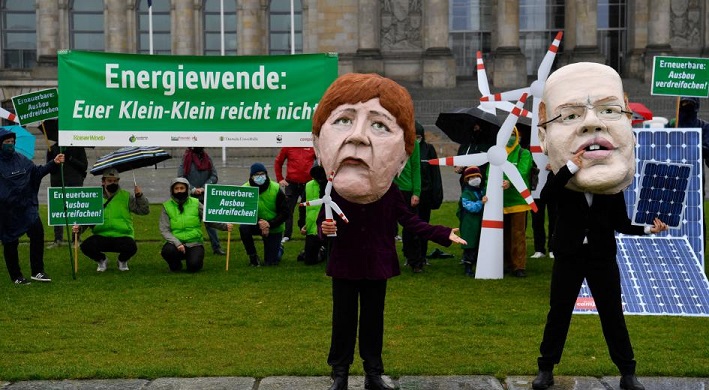
Do they mean the Energiewende (the Green renewable “energy turnaround”)?
Oh. They’re only talking about Wirecard. Yeah. That one was pretty cool too. Peanuts compared to the Energiewende fraud, though. But still.
The tech company Wirecard was embraced by the German élite. But a reporter discovered that behind the façade of innovation were lies and links to Russian intelligence.
Olaf Scholz has not delivered on his sweeping vision for a more modern, more active German military.
And anybody who thinks will ever live up to their promises about defense spending is a fool.
Chancellor Olaf Scholz summarized his country’s approach to the war in Ukraine. “Despite all the pressure to take action,” he said, “caution must take priority over hasty decisions, unity over solo actions.” The line provided Scholz’s most explicit defense to date of Germany’s cycle of denial and delay.
A year ago, Scholz announced a special investment fund of more than 100 billion euros to strengthen the German military, but less than a third of those euros have been assigned to contracts. Defense Minister Boris Pistorius recently aired concerns that Germany’s stockpiles have been depleted by its generous transfers to Ukraine. These comments strain common sense when most of the “special funds” remained unspent until December, when lawmakers finally approved the first procurements. This month, Scholz also abandoned plans to establish a National Security Council, a body that would have been well suited to manage an expanded role in the defense of Europe.
Ukraine updates: Germans see arming Ukraine as involvement.
A poll conducted by Germany’s DPA news agency suggests many Germans disapprove of arming Ukraine in its war against Russia. Meanwhile, Russia’s Medvedev denied the country was running out of missiles.
Fifty-one percent of the respondents thought arming Ukraine meant being part of the war, an argument that Russia has been pushing. Meanwhile, 37% disagreed with the statement.
Germany has approved some €2.6 billion ($2.75 billion) worth of weapons and armaments since the start of the war.
Forty percent of those polled considered the amount of weapons support from Germany to be too much, 22% thought it was too little, and 23% thought it was just the right amount.
Those windmill thingies are kind of like trees so deal with it, conservationists. You can’t have both. Boy, these Greens sure have come a long way, haven’t they?
Germany’s wind energy: Conservationists fear for forests – Germany is counting on wind energy to help replace fossil fuels. But critics say massive investment in the sector is ignoring a different environmental crisis.
By 2032, the government wants to have 2% of land area allocated for onshore wind power. This means installing between 1,000 and 1,500 new turbines a year, or four to five a day by 2030, as German Chancellor Olaf Scholz recently said.
Germany needs wind energy to meet its goal of becoming carbon neutral by 2045, a target it’s currently in danger of missing, according to multiple studies. The country also missed its emissions reduction targets the last two years in a row, according to think tank Agora Energiewende.
“If Germany fails to meet its climate targets, we will not be able to demand that others meet theirs,” Germany’s Economy and Climate Minister Robert Habeck said in February.
That means deportations. German deportations. Deportations that don’t work, in other words. Migrants deported for criminal offences just turn around and come right back to Germany again. Why, how criminal or something. That they’re able to do so, I mean.
Thousands of deported migrants reenter Germany – Nearly 6,500 people deported from Germany sneaked back to the country over the past three years, police told Bild newspaper.
Citing federal police statistics, the newspaper said 6,495 foreigners had returned or tried to return over the past three years.
During that period, the number of returnees increased by 74%.
“These numbers reveal the enormous gaps in Interior Minister Nancy Faeser‘s security policy.”