Beautiful German arson attack of the week.

Because somebody has to notice they’re happening.
„Von der Spurenlage her sieht es nach Brandbeschleuniger aus.“
Beautiful German arson attack of the week.
Because somebody has to notice they’re happening.
„Von der Spurenlage her sieht es nach Brandbeschleuniger aus.“
That means there is dirt stuck (to you) somewhere or you have dirt under your carpet – as in having done something wrong or illegal.

You know, like Volkswagen has/does in US-Amerika? The company inserted a device into almost 500,000 cars meant to trick emissions testing, the EPA says. Volkswagen is not denying this.
So the next time Germans begin those tiring lectures about doing more for the Umwelt (another German word meaning environment), remember to make sure and check if their emissions are make-believe or not.
There are almost 500,000 vehicles on American roads with the devices installed, according to the EPA. Volkswagen must now pay to repair the emissions systems in affected cars. The government may also fine the company as much as $18 billion.
Sergeant Pepper taught the band to play. No, wait. That was the Rolling Stones. And they were destroying Berlin’s Waldbühne.
After World War II, the Olympic grounds were within the British occupation sector of Berlin. They were released for public use beginning in 1948, and the amphitheater was used for film showings, including for the Berlinale, and beginning in 1960 for boxing matches. Use for concerts began in the 1960s, but when the Rolling Stones performed there on 15 September 1965, the theater was severely damaged. Fans stormed the stage, and after the band left after a set of only 20 to 25 minutes, fought police, who attempted to control them with rubber truncheons and fire hoses, and destroyed the seating, fire hydrants and other furnishings. 270,000 DM in damage was done, in a riot that fulfilled the dire prophecies of some Berlin newspapers about rock concerts and was the first inter-generational battle of the 1960s in Germany. A reporter from Bild wrote of the concert, “I know Hell.” The arena had to be completely renovated and was then little used until 1978.
Facebook should do more to crack down on German hate speech and xenophobia about refugees online? Sure, why not? But maybe Germans should do more to crack down on the Germans doing the hating, too. Just a thought.

Germany expects to see a record number of asylum seekers this year, most from war-torn countries like Syria and Afghanistan. The country expects to see 800,000 refugees through this year, and has pledged to accept more than any other European government, though its response has stoked some xenophobic riots. Last month, Germany’s ministry of justice criticized Facebook for not doing more to police hate speech, alleging that the social network reacts faster to remove sexual imagery than it does racist messages. German Justice Minister Heiko Maas announced the creation of the online task force after meeting with Facebook in Berlin on Monday.
Sooner or later reality gets up in your face.

Germany has introduced temporary controls on its border with Austria to cope with the influx of migrants, the interior minister has said.
Politically this is a shrewd move by Thomas de Maiziere. His announcement comes just a day before he travels to Brussels to meet other EU interior ministers to discuss the migrant crisis. The measure will help him put pressure on other European countries to do their bit. It highlights just how much Germany is struggling to cope.
The move could also serve as a useful threat; after all, Mr de Maiziere said Germany was controlling the border with Austria “first”, the implication being more could follow. The possibility that Germany might suddenly decide to control its other borders could well help jolt EU partners into action.
Germany’s best-selling newspaper has removed all pictures from its print edition and website in response to complaints about its decision to publish images of the three-year-old Syrian refugee who drowned trying to reach Greece.
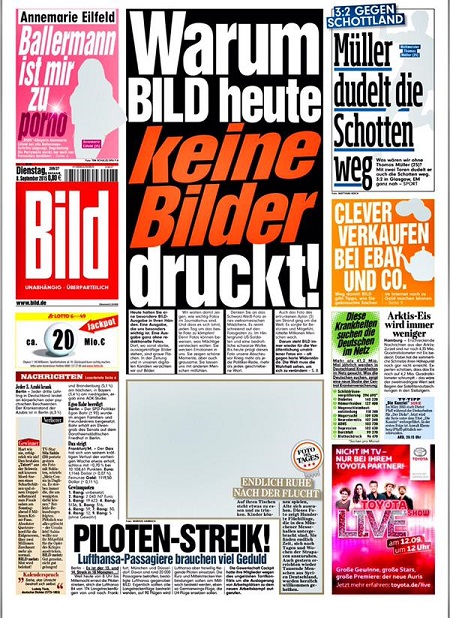
The decision to remove pictures in print and online comes less than a week after the newspaper dedicated its whole back page to the distressing image of Alan lying face down on the beach in Bodrum, surrounded by a black background and a plea for action from Europe.
It might not be as severe as bummed-out disorder or as sexy as burn-out syndrome, but bore-out looks like the kind of imaginary disease that might just be right up my alley.

Germans just can’t wait to get it, either. Although they’ll still have to.
Whereas in US-Amerika bore-out might describe a a situation in which an employee’s zest for work has been extinguished by an unchallenging rather than an unmanageable workload, German bore-out has been specially redesigned to affect early retirees and others like them who have spent their entire working lives looking forward to doing just that (retiring early or otherwise) and are now bored to tears.
Sadly, there is no known cure for bore-out. Other than to stop being bored, of course. And to stop being boring while you’re at it.
„Täglich Zeitung lesen.“
Beautiful German arson attacks of the week.

Because somebody has to notice they’re happening.
Die Polizei schließt bei dem Brand einer Asylbewerber-Unterkunft mit fünf Verletzten im baden-württembergischen Rottenburg Brandstiftung nicht aus.
Is that there is no European immigration policy.

There is a mish-mash of national policies, a patchwork of systems and criteria which are contradictory, incoherent, fragmented. Italy is very far way from Finland, not only geographically, but when it comes to immigration and asylum. France and Germany have quite different historical approaches to integrating newcomers. Sweden and Denmark are neighbours with a close shared history, but their immigration policies are chalk and cheese.
The seven countries of central Europe and the Baltic are being asked to take fewer than 30,000. It should not be a problem for big international cities such as Warsaw, Prague and Budapest. But the east Europeans are retreating into parochialism, digging into their national bunkers while nursing resentment at what they perceive to be German bullying.
Hungary’s prime minister, Viktor Orbán, is the cheerleader of the “Europe is useless” chorus, but Robert Fico, the Slovakian premier, and President Milos Zeman in Prague are not far behind. Ewa Kopacz, the prime minister of Poland, sounds more moderate, but she looks likely to lose an election next month to the nationalist right. Her hands are tied.
I wouldn’t worry about any of this, however. Think Greece: Europe always manages to get together in the end, when stalling for time is no longer possible, to not solve a problem by doing almost just enough to put it off until it does not go away by itself.
“If this is Europe, you can keep it.”
 Observing Hermann