Whatever Is Not Expressly Allowed

Is verboten. In Germany. If you’re Facebook, Google, Amazon, WhatsApp, Instagram, Twitter and Co., that is.
Facebook

Recognize a pattern here? They’re all American companies and they’re all “free” to use. The Germans, of all people, surely must have figured out by now that nothing is ever for free. But they haven’t.

GERMAN REGULATORS JUST OUTLAWED FACEBOOK’S WHOLE AD BUSINESS – FACEBOOK’S MASSIVELY LUCRATIVE advertising model relies on tracking its one billion users—as well as the billions on WhatsApp and Instagram—across the web and smartphone apps, collecting data on which sites and apps they visit, where they shop, what they like, and combining all that information into comprehensive user profiles. Facebook has maintained that collecting all this data allows the company to serve ads that are more relevant to users’ interests. Privacy advocates have argued that the company isn’t transparent enough about what data it has and what it does with it. As a result, most people don’t understand the massive trade-off they are making with their information when they sign up for the “free” site.

“We disagree with their conclusions and intend to appeal so that people in Germany continue to benefit fully from all our services.”

Forget About Jane’s Addiction

Germany has the real problem.

Nord Stream 2

And France is going to help the Germans score… Right?

Nord Stream 2 pipeline row highlights Germany’s energy dependence on Russia – Almost a third of the new Nord Stream gas pipeline has been laid across the Baltic Sea. There is, however, growing opposition to the pipeline — and Brussels is having difficulty figuring out how to deal with the project…

Germany is pressuring other European capitals to block an EU proposal to regulate Russia’s Nord Stream 2 pipeline ahead of a key meeting on Friday, diplomatic sources said, but may fail to convince France, threatening the project’s construction.

Germany Reassures NATO Partners It Will Continue To Miss Defense Spending Goals

Worried that the German government’s tax revenues are likely to decrease in coming years due to a slowing economy, German defense officials were quick to explain to their NATO partners that this will have absolutely no effect on the country’s continued failure to increase defense expenditures.

Defens

“Whether tax revenues increase or not is really not the issue here,” these officials stressed. “We have absolutely no intention of raising our defense spending under any circumstances. We do this to ensure that our NATO partners will be able to plan effectively for future increased defense spending on their part and thus continue to protect us as they have done so in the past, pretty much free of charge. For us, anyway. But still.”

“We have time until the end of March. Let us negotiate.”

German Of The Day: Milliardenloch

That means a billion-euro hole. You know, as in the ones that will be appearing in the coming German federal budgets?

Loch

The money has been rolling in to Berlin for years but it looks like those days are about to end. Germany’s current finance minister, Olaf Scholz (SPD), warns that the government will be missing some 25 billion euros by 2023. No new expenditures possible, folks. Not unless there are cuts somewhere else. Right. Good luck with that, pal. You’re with the SPD, for crying out loud (that stands for Spend other People’s Dough).

And it sure would be a shocker if Germany now used this as an excuse not to live up to its defense spending commitments, wouldn’t it? See how this works, folks?

Nach Jahren sprudelnder Steuereinnahmen droht dem Bund wegen der abflauenden Konjunktur ein 25-Milliarden-Loch im Haushalt bis 2023.

Well, This Is A Fine Super-State You’ve Got Us Into

Brexit has been going on a long time before Brexit ever came along. For good reason.

Brexit

Germany planted the seeds of destruction…

Although the form of the British exit from the EU is often presented as a reductionist binary choice — “a no-deal exit” or “a deal the U.K. and the EU can live with” — London has in effect restated the fundamental question of what is a European project: A Europe of sovereign nation states, or a federal European super-state.

Brexit is a revolt against a German-run European super-state.

Germans Recycle Their Plastic, Right?

And this makes them feel good about themselves. They do it for the environment, you see. Their environment, it turns out. Because when all their plastic finally gets processed in their big plastic recycle machine thingy or whatever the hell it is, most of it has somehow ended up in… Souutheast Asia. It’s magic.

Plastic

Officially, the country’s recycling rate is 36 percent. But critics say this number is far from the ugly truth. A new packaging law even states that by 2022, 63 percent of all plastic waste should be recycled. But Peter Kurth, director of the Association of German Disposal-, Water- and Resource-Economy (BDE), said he considers this number utopian…

What cannot be economically recycled usually finds its way to the incinerator, for example in plants in the chemical or cement industries, Kurth said, where burning plastic becomes a substitute fuel for oil and gas. But there is more plastic waste than all cement and chemical plants in Germany need. Kurth said what is not sold to customers in Germany is sold to Asia.

“While Germans are world champions of trash separation, not everything they toss into the yellow bin reserved for plastic packaging gets recycled. It is often incinerated. Statistics show that only 15 percent will actually be reused.”

“Germany” To Protect Consumers From Rising Electricity Prices?

The rising electricity prices that “Germany” caused in the first place, you mean?

Consumers

Well, not quite. The “German taxpayer” will have to protect consumers from these rising prices, as usual. It’s a brilliant business plan that only governments like “Germany” can think up. The consumer/taxpayer pays twice, see? It’s not like anybody has to ask them.

Germany is planning to protect consumers and manufacturers from the impact of abandoning cheap coal-fired power, which Berlin is looking to ditch for environmental reasons, according to a government body’s draft paper.

The Coal Commission, which is tasked with organizing the exit from coal, said in a 133-page draft document seen by Reuters that companies and private households should be spared from heavy price increases.

“The necessary funds must be made available by the state to finance the recommended measures.”

United Kingdom

Beautiful German weapon sale of the week – only it’s actually more like a purchase this time.

BAE

Because somebody has to admire them.

Wait a minute. Aren’t these the same Germans who tell us that Brexit is going to be the end of the world as we know it?

Brexit boost as Germans invest £30million in UK tank maker – A GERMAN defence giant yesterday defied Brexit doomsayers by pumping £30million into a British armoured vehicle business.

But This Isn’t Supposed To Happen

Germans don’t like electric cars. So nobody else is supposed to like them, either.

Tesla

The customers are supposed to buy, you know, German diesel automobiles, for instance.

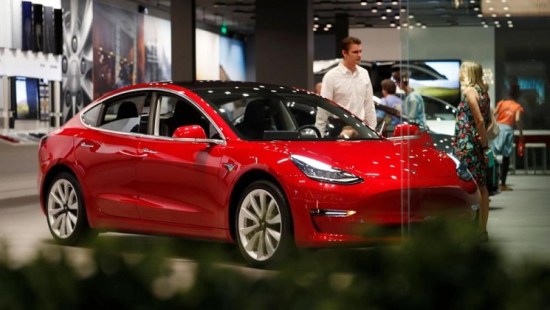
And now this. Tesla was dead. Everybody read about it. At least over here in Germany, they did. Again and again. And they liked what they read, too. But now, Tesla’s Model 3 appears to be a big hit in US-Amerika. And Tesla’s moving on to China. And this wasn’t supposed to happen. This is very upsetting for the German automobile industry. Very upsetting indeed. Now German automobile industrialists are on the defensive and will have to play catch-up and start pushing electric car production even harder even though they’re already printing mountains of money with their old technology now and why the hell would anybody want to buy a freakin’ stupid electric car like that anyway?

TESLA-BOSS SCHOCKIERT DIE KONKURRENZ MIT REKORD – Krisenkarre Model 3 plötzlich Bestseller.

German Of The Day: Auftragsschwund

That means a decrease in orders.

Auftragsschwund

Did the boom just go boom?

Orders slid 1 percent from October, and posted a year-on-year decline of 4.3 percent, the biggest in more than six years. The monthly decline was partly due to aircraft orders, which had jumped in October, as well as weakness in the euro area.

While there are questions over the outlook for the German economy, the euro area’s biggest, the Bundesbank has long expressed confidence that it will overcome the slump seen in mid-2018. Responding to the factory data on Monday, Commerzbank said the decline “should not be over interpreted.”

“Wir blicken abwärts.”