German of the day: “nicht zufriedenstellend”

That means not satisfactory or unsatisfactory.

Year number two. Germany is on a roll.

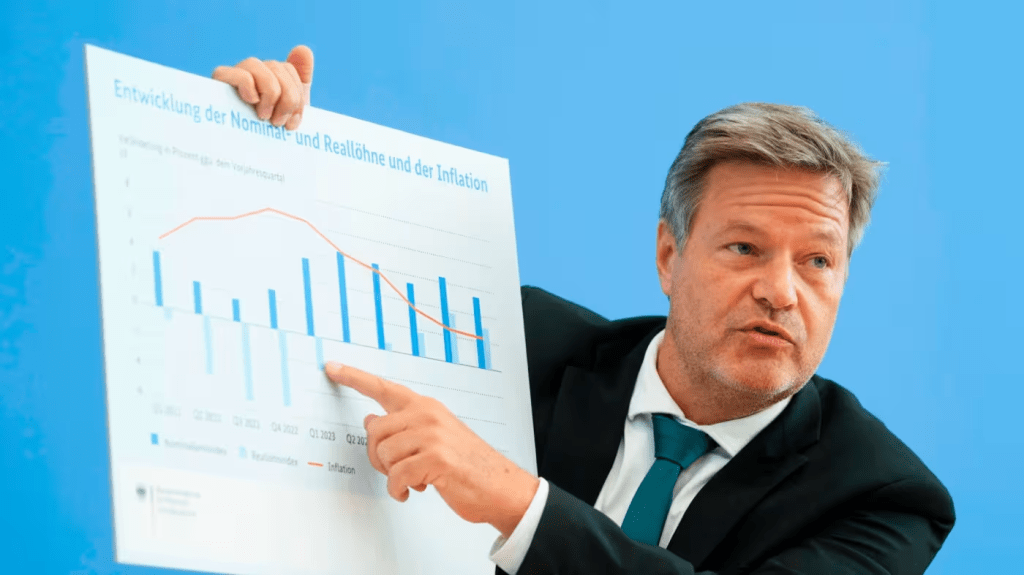
Germany expects economy to shrink after cutting 2024 forecast – Government predicts rebound in 2025 after 0.2% decline this year.

Germany is facing its first two-year recession since the early 2000s, as the government downgraded its growth forecast for 2024, predicting a contraction of 0.2 per cent.

“The situation is not satisfactory,” Robert Habeck, economy minister, said on Wednesday.

German of the day: Auf Eis legen

That means to put on ice. As in put on hold.

Intel postpones construction of chip factory in Magdeburg – Haseloff against abandonment of the project.

The chip company Intel has put its plans to build a factory in Magdeburg on hold. According to company boss Gelsinger, construction will probably be delayed by two years due to cost-cutting measures. A total of 3,000 direct jobs were to be created on Magdeburg’s Eulenberg. Saxony-Anhalt’s state government assures that the semiconductor plant will nevertheless go ahead.

Or not.

Last one out turn off the lights

Oh, sorry. Green energy already turned the lights off for you.

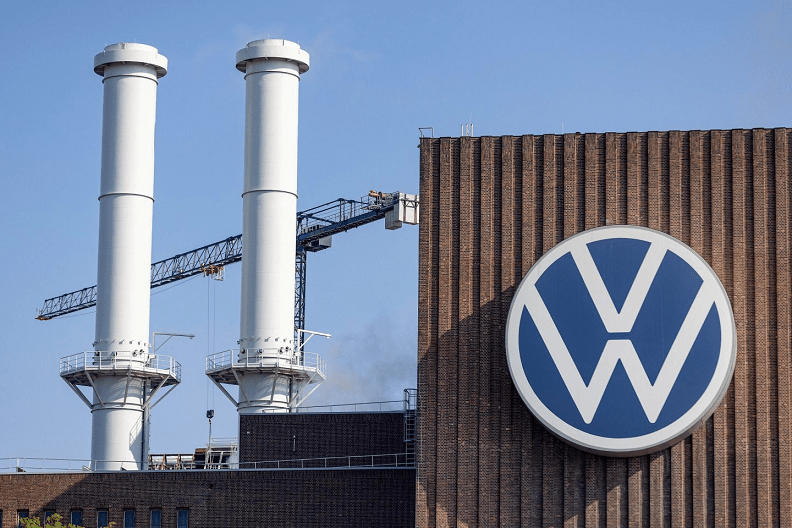
Germany in crisis: Intel and Volkswagen mull a multibillion-dollar withdrawal from the country.

For the first time in its 87-year history, Volkswagen is considering shutting down plants in Germany, where it employs around 300,000 people, as the company ramps up efforts to save €10 billion in costs…

Reuters reports that Intel will consider pausing or halting plans for its €30 billion ($33 billion) factory in the east German city of Magdeburg as the semiconductor manufacturer looks for cost savings. Germany had committed €9.9 billion ($10.9 billion) to the project when it was announced in June last year.

Not so quiet on the Western Front

The Chip War Western Front.

EU approves German state aid for $11 billion TSMC chip plant – Taiwan’s TSMC (2330.TW), opens new tab on Tuesday launched a major new computer chip plant in Dresden, Germany, expected to be a key supplier to European industry and carmakers after the EU Commission approved 5 billion euros ($5.5 billion) worth of state aid.

The large aid award for the project, which will cost 10 billion in all, is the biggest approved so far under the EU Chips Act, and the first in Germany.

It is also the first project in Europe under TSMC, the world’s largest contract chipmaker, and is expected to improve Europe’s resiliency if a chip shortage of the type experienced during the COVID pandemic happens again.

Let’s diversify!

Just like we did with our dependency on Russian gas a few years back.

It’s called diversification through more dangerous entanglement.

German investment in China soars despite Berlin’s diversification drive – Politicians warn of rising geopolitical tensions but country’s carmakers stick with Chinese manufacturing.

German direct investment into China has risen sharply this year, in a sign that companies in Europe’s largest economy are ignoring pleas from their government to diversify into other, less geopolitically risky markets.

A self-inflicted hostage-taking situation?

Why is it that big German automakers are worried about Chinese retaliation?

Because they voluntarily put themselves in the position to be retaliated against. Think Germany’s voluntary dependency on Russian gas recently. That didn’t work out very well either. But for whatever reason, this is what Germans do.

Germany launches 11th-hour bid to avert trade war with China – Germany wants the EU to set tariffs on electric vehicles at a low level to avoid severe retaliation from Beijing…

Germany’s position was “problematic,” he said: While big German automakers still entertain good ties with Beijing, that’s not necessarily the case for smaller businesses, meaning “the German economy as a whole has an interest in a more assertive policy towards China.”

German of the day: Büroschlaf ist am gesündesten

That means sleeping in the office is the most healthy kind of sleep.

Have the Germans become lazy at work?

Germans have long been known for their diligence, sense of duty, reliability and productivity. Recent data suggests that Germans are working fewer hours. But that doesn’t tell the whole story.

A glance at current OECD labor figures can be startling. In 2022, the average American worked over 1,800 hours per year, while the average German worked only 1,340 hours. However, labor market researcher Enzo Weber from the Institute for Employment Research (IAB) in Nuremberg, Germany, dismisses suggestions of the once-industrious Germans now only wanting to enjoy their sweet lives.

“Germany has a very high female labor force participation rate compared to most other countries,” Weber told DW, noting that the main difference to other countries was that about every second woman works part-time, which mathematically lowers the average annual working hours.

These antisemitic protestors are getting out of control

Now they’re attacking Tesla. Itself.

Protesters attempt to storm Germany’s Tesla factory – Hundreds of climate protesters have clashed with police in Germany after attempting to storm the Tesla factory near Berlin.

Several people were injured, including three police officers, during Friday’s demonstration against the proposed expansion of the electric car giant’s only European plant.

The Empire of Evil overtakes the Empire of Evil

As Germany’s top trading partner.

US overtakes China as Germany’s top trading partner – The United States overtook China as Germany’s most important trading partner in the first quarter of this year, according to Reuters’ calculations based on official data from the German statistics office.

Germany’s trade with the United States – exports and imports combined – totalled 63 billion euros ($68 billion) from January to March, while the figure for China was just under 60 billion euros, the data showed.