German of the day: Eskalationsfalle

That means escalation trap.

Berlin calls for strengthening defenses without falling into Putin’s “escalation trap” – The German Minister of Defense, Boris Pistorius, said Sunday that Germany must strengthen its defense capabilities, particularly against drones, while avoiding falling into what he called “the escalation trap” set by the Russian president Vladimir Putin.

During a defense exercise in Hamburg, the minister stressed the need for Berlin to invest in anti-drone and electronic jamming systems, as incursions into European airspace have increased since the start of the war in Ukraine.

“We must build strong defenses, but without responding precipitously to every provocation. This is exactly what Putin wants: a spiral of reactions that would lead to a direct confrontation,” Pistorius warned.
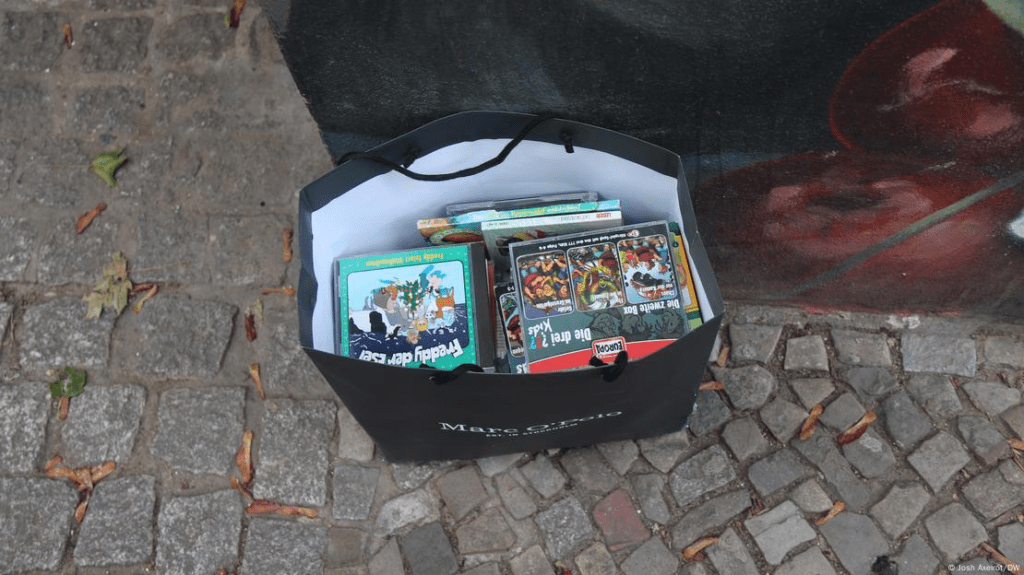
Giving things away on the street must be verboten!

Or at least strictly regulated. Then verboten.

Anything in Berlin that is not expressly permitted must be forbidden.

Berlin to crack down on a beloved giveaway tradition – One resident’s trash is another’s treasure has long been part of Berlin’s culture, but the German capital has had enough and plans to raise fines. Will they work?

Between old sofas and broken fridges, boxes of baby clothes and crates of cassettes, hidden treasures dot Berlin’s streets. In one such collection of unwanted stuff, Berlin musician Eno Thiemann discovered a new favorite author.

The Haruki Murakami books were left outside with the label “zu verschenken.” Meaning “to gift”, it’s a tradition that has long seen Berliners leave their repurposable goods on window ledges and in front of houses for others to take. And take, they do. Often within a matter of minutes.

“I was very pleased when I came back in 2013 to see that there’s some kind of culture,” said Thiemann, who had left Berlin three decades earlier before the practice took off. “Most people don’t just throw the trash out — it’s a nice thing to do and it’s enriching the neighborhood.”

But as Berlin plans to fine people for putting items on the street, this informal circular economy could become a thing of the past. The city’s environment department argues that while the idea behind leaving things out for others to take is “good and desirable,” it has “led to excesses that are not in line with the original intention.”

German of the day: Drohnenschwarm

That means drone swarm.

Test reactions and agitate – According to security authorities, the recent drone flights in Schleswig-Holstein are not so much for espionage as for other purposes. The perpetrators presumably also want to send a warning...

Last week, drones flew over a power plant in Kiel, the university hospital, the Thyssenkrupp marine division’s factory premises, the state parliament in Kiel, and other buildings.

13,000 jobs here, 4,000 jobs there…

Progress marches on.

Industrial giant Bosch shocks Germany with plans to cut 13,000 jobs – The Bosch group, one of Germany’s leading industrial players, has announced a far-reaching job cut programme. On 25 September the company said it would cut an additional 13,000 positions by 2030.

Germany’s Lufthansa To Cut 4,000 Jobs By 2030, Targetting Admin – Lufthansa set new financial targets for 2028-2030, including an adjusted operating margin of eight to 10 percent.

Deregulate through more regulation

It’s the German way.

If you want to properly deregulate, create a new deregulation bureaucracy first. We don’t want anybody to get fired or anything.

Germany’s new deregulation chief vows to be more subtle than Elon Musk – State modernisation minister Karsten Wildberger promises to bring about digital age in country clinging to fax machines.

Germans feel less gloomy?

Despite economic clouds?

Depends on who you ask. And how you look at it. My experience has been that Germans are the happiest when they’re the gloomiest.

Germans Feel a Little Less Gloomy Despite Economic Clouds – The pickup in consumer mood contrasts with a worsening outlook among German business.

You should have slashed the UNRWA budget first

But it’s a good start, I guess.

Germany slashes aid and development budget – Germany has cut its budget for international development by 8% and emergency aid has been halved. Aid agencies warn of drastic consequences.

The governing coalition of the conservatives (CDU/CSU) and the Social Democrats (SPD) has slashed the budget of the Federal Ministry for Economic Cooperation and Development (BMZ) by 8% to just under €10 billion ($11.47 billion).

Development Minister Reen Alabali Radovan (SPD) is clear about the impact of the cut: “My budget is down by around €910 million compared to the previous year. In view of increasing crises, Germany is investing far less in international cooperation than is actually urgently needed.”

Growth driver now just backseat driver…

Who doesn’t know what he’s driving at.

Germany was billed as Europe’s growth driver. Now economists are saying: Not so fast – Huge investment pledges and major fiscal changes had bolstered hopes that Germany could give the euro zone economy a much-needed boost, but economists are starting to question if — and when — that will happen.

“The actual spending is slower than many of the more excitable pundits had expected. In Germany, it takes time to spend money.”

Super safe!

Germany is as safe as it can be (all things considered). So move along! Nothing to see here!

Crime statistics: How safe is life in Germany?

Cases of drug trafficking, knife crime and violence on the streets are frequently reported in the German media. But is crime on the rise? And how does Germany compare internationally?

“The new Germany” is “a shame, a travesty,” says Kurt Caz.

In a video, the South African-German travel blogger presents Frankfurt’s notorious Bahnhofsviertel neighborhood near the city’s main train station as the new normal, which has been “completely taken over by crime, illegal migrants and drugs.”