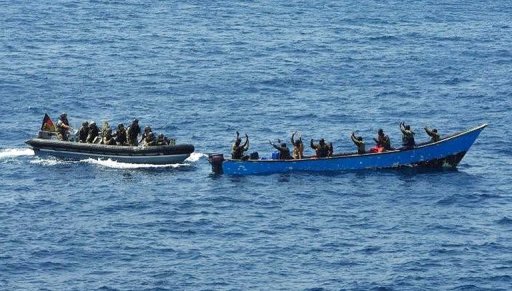
Well, they won’t actually be shooting at the pirates per se (that would be bad), but more like at their equipment and stuff. You know, at the loot and the booty on the beaches? This will make the pirates run away and never come back again or at least become good or something.
It is all part of the EU’s anti-pirate Operation Atalanta off the Somali coast so it’s OK for Germans to do this, really.
The German opposition continues to criticise the operation as risky overreach for the forces and has vowed to vote against it.
The project to set up a European rating agency to challenge the dominance of American firms is at risk of collapsing, the German business daily Financial Times Deutschland reported on Monday. International consulting firm Roland Berger can’t find enough investors for its plan.
Hey, you-know-what happens. But don’t worry about it, Europe. It’s not like anybody is going to be rating you on this or anything. When in doubt (and you always are), just keep on bitching and moaning instead.
Ihnen wird nicht nur wegen Fehlbewertungen eine Mitschuld an der Finanzkrise gegeben. Auch ihre Rolle bei der Beurteilung der dramatischen Rettungsbemühungen und -konzepte für hochverschuldete Euro-Länder wie Griechenland, Portugal und Irland ist umstritten. Das Urteil der Ratingagenturen prägt letztlich vielfach die Marktreaktionen auf solche Bemühungen.
The German government didn’t reach even half of its planned savings in the federal budget in 2011. Only 42 percent of the spending cuts named by Merkel’s coalition government, comprised of the conservative Christian Democrats and the business-friendly Free Democratic Party, were actually not implemented…
The government is also falling behind on its targets for this year. Of the originally planned €19.1 billion in savings, less than half has been implemented…
This lapse (in reaching savings targets) is particularly embarrassing for the German government because the news comes just after 25 European Union member states agreed in early March to an international fiscal pact obliging them to adhere to greater fiscal discipline…
The aim of the pact is to make EU countries maintain binding austerity measures that leaders hope will contain the debt crisis and prevent countries like Greecefrom being able to pile up massive debts again.
And countries like Germany will show them how to do it, see? Next year, maybe. Or the year after that. Hard to say for sure.
“It (the pact) is a milestone in the history of the European Union.”
I call it Hurt Feelings Burnout Syndrome (HFBS). With an emphasis on the BS. Oh man, I had to laugh out loud while reading the latest on the poor, misunderstood German front.
It appears that many German intellectuals are very concerned about how their European neighbors think of them (Germany) these days. Needless to say, it isn’t very highly at all. And some have come to the stunning conclusion that they are so disliked at the moment because, now get this, they are so big and strong. Imagine that.
Germany is the USA of Europe – only with a different history.
You don’t need to puzzle for very long about the question of why so much Nazi name-calling is going on at the moment: For the first time since 1945, Germany has appeared in full strength again. Not because anybody wanted it, but because the European debt crisis has made the most economically powerful country the most politically powerful one, as well. Germany is now intervening in the internal affairs of others in a big way.
Slowly but surely, the country is taking over a role for Europe that the USA has played for the rest of the world for so long, as being the country that uses (and sometimes misuses) its power, the country that is to blame for everything, the country that is supposed to save everything and is reviled for the way it does it. What has America not been accused of? The CIA has always been behind everything and American imperialism has always been the motivation.
How moving. Or something. And the rest of the story? Now folks are calling Germans Nazis again (as if they had ever stopped). Boo-hoo-hoo already. Come on, Germany. Wake up and smell the coffee. You’re the big kid on the block. Run with it. Enjoy. It comes with the turf.
And in a related story (I find), it turns out that Germans are also now “burning out” like flies (it’s hard to carry on when nobody likes you, I guess). This imaginary disease (yet another American import – are we having irony yet?) is currently running rampant among Germany’s workforce, with nearly 1 out of 10 sick days in Germany in 2010 being attributed to it (tendency rising). Another connection to US-Amerika? Oh my God. No wonder so many Germans are getting sick. Please note: The high-brow daily Frankfurter Allgemeine Zeitung questioned why burnout was being written so much about in Germany, while in France, which is economically a lot worse off, “it’s hardly a preoccupation at all.”
Remember: HFBS is incurable, but there are many effective treatments. One of them is shutting the #!?#! up.
Man braucht wirklich nicht lange an der Frage rumzurätseln, warum die Nazi-Vergleiche im Moment so oft gezogen werden: Zum ersten Mal seit 1945 tritt Deutschland wieder mit voller Macht auf, nicht weil man das gewollt hätte, sondern weil die europäische Schuldenkrise das ökonomisch stärkste auch zum politisch mächtigsten Land gemacht hat. Deutschland greift nun tief ein in die inneren Angelegenheiten Dritter.
Allmählich bekommt das Land für Europa eine ähnliche Funktion, wie sie die USA lange Zeit für die ganze Welt hatten. Als jene Macht, die ihre Kraft gebrauchte, manchmal missbrauchte, die an allem schuld war, die alles retten sollte und sich dafür beschimpfen lassen musste, wie sie es tat. Was wurde den Amerikanern nicht alles Übles angedichtet, immer steckte die CIA hinter allem Bösen, stets wurden die Amerikaner des Imperialismus geziehen.
PS: I hate to admit it, Germany, but I guess we’ve got more in common than we would like to admit (thanks for the idea, Old Phat Stu).
God punishes us, I mean you, by giving you what you want.
The 1960s saw demonstrations across West Germany against the Vietnam war and the 1980s brought large protests outside some U.S. bases against plans to deploy new medium-range nuclear missiles. U.S. forces have always been viewed by some, especially on the political left, with hostility, as occupiers.
“We Germans fought for the Russians to go, now we are fighting for the Americans to stay.”
The title reads: Greeks and Italians Work Harder Than Americans.
One common reaction to the European debt crisis has been to blame the victim: If only those Greeks/Italians would work harder, like us Americans/Germans, then they wouldn’t be in this pickle, the thinking goes.
Except it’s not, how do you say, true: Greeks and Italians actually work more than Americans and Germans.
And when they’re not doing that they’re hurting each other’s feelings – by calling each another too European. Yikes. Talk about hitting below the belt (but somebody’s got to do it).
It’s a scandal or something. And I’m shocked, I guess (I really thought they would have more powerful stuff than this). But some of these are pretty good, actually:
“Obama wants to turn the US into a European welfare state.”
“I don’t believe in Europe. I believe in America.”
“I don’t think Europe is working in Europe. I know it won’t work here.”
“You want to see America after the Obama administration is through, just read up on Greece.”
“Obama has a European social democratic vision.”
“American elites are guided by their desire to emulate the European elites. As a result, anti-religious values and principles are coming to dominate the academic, news media and judicial class in America.”
“The president said he wants to fundamentally transform America. I kind of like America. I’m not looking for it to be fundamentally transformed into something else. I don’t want it to become like Europe.”
Recently, RC Hammond, the spokesman for Newt Gingrich’s campaign, commented on Mitt Romney’s alleged support for a value added tax. “The fact that he’s willing to look at European Socialism shows just how far out of the conservative mainstream he is.”
This must be the scoop of the century. Are Woodward and Bernstein back? Did the CIA finally do something right? Where on earth do Spiegel journalists uncover such unexpected and volatile information?
Always remember, folks: If it’s not in the Spiegel, it didn’t happen.
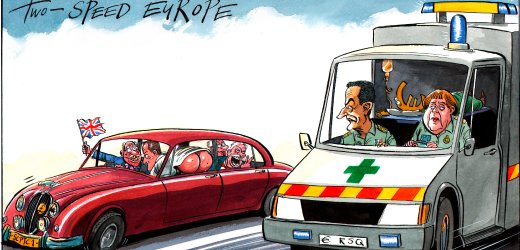
Women and children first! No offense there, Nicolas.
It looks like Germany and France may have had enough of broke weeny Europeans (other than themselves) already and now appear to be planning a secret and very “exlusive stability pact” just for the crème de la crème of ze Europe. You know, for that handful of European countries that can still pay their debts, maybe. But don’t tell anybody yet. This is still a secret, like I said.
Deutschland und Frankreich sind nicht mehr gewillt, auf eine Einigung aller EU-Länder zu warten. Notfalls wären sie bereit, mit einigen Ländern voranzugehen und so innerhalb der Währungszone eine Art Klub der Super-Europäer zu gründen, deren Mitglieder sich strengen Sparauflagen unterwerfen.
So, is it time for the sweet poison or the silver bullet? Germany (or one German) is the last man standing and it’s time to pay up or shut up.
Can Germany (and Germany’s “independent” Bundesbank President Jens Weidmann) jump over its/his shadow and allow the European Central Bank to become the lender of last resort in Europe’s never-ending efforts to prop up the euro?
Pump up the volume already. Half a dozen bailout packages and half a trillion euros later, Greece is closer to leaving the euro zone than ever before and Italy now seems bound for bankruptcy, too. Who’s next? And where’s the money? It looks like Europe’s arsenal is down to one last taboo here: Let the ECB vouch for all of the outstanding debt of the debtor nations, “permanently, to an unlimited extent and in violation of all applicable laws.” Germany, for some strange (and wonderful) reason, is still against doing this.
You know the deal, my fellow Americans. It’s the easy way out: “Print money and drown the debt crisis in a sea of liquidity.” Look what its done for us – so far.
Hey look, I don’t know much about economics (nor do at least half of the world’s economists, for that matter), but I do know that if President Barack Obama, President Nicolas Sarkozy and European Commission President José Manuel Barroso are all urging the Germans to abandon their resistance to the ECB plan, it’s probably best for the rest of us out there if this Weidmann guy sticks to his guns. I wouldn’t bet money on him doing so, though. And I certainly wouldn’t bet using the euro.
He mechanically recited the traditional mantras of the Bundesbank: “independence,” “a culture of stability” and “credibility.”




 Observing Hermann