Bad German Historian Woman Points Out Trümmerfrau Myth

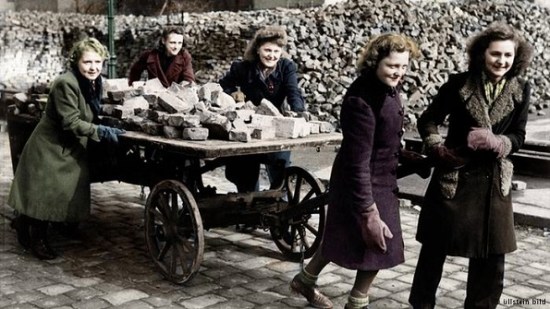
… Every time another memorial goes up in the “rubble woman’s” honor, German politicians look to what former German Chancellor Helmut Kohl said in Munich in 2005. The rubble-clearing women in the aftermath of WWII are “a symbol of the German people’s wish to rebuild and of their powers of survival,” he said, adding that the Munich monument “commemorates the large number of women who volunteered to clear the ruins.”

Wrong, says historian Leonie Treber. Neither was there a great number of women, nor did most of them volunteer to clear the rubble, the researcher says. “The Trümmerfrau is a German legend.”
Rubble Women

Yet it wasn’t just the women who were reserved when it came to clearing the war debris; men weren’t crazy about the task, either. In the eyes of the Germans, it was anything but honorable for people to show their “willingness to rebuild.” In fact, most Germans regarded clearing rubble as punishment – and for a reason.

During the war, the Nazis made soldiers, the Hitler Youth, forced laborers, prisoners of war and concentration camp prisoners clear the bombed cities after Allied air raids. In 1945, after the end of the war, prisoners of war and former members of the NSDAP Nazi party took their place. When that turned out to be insufficient, the population was asked to help – on a voluntary basis in the West, but usually against their will in the Soviet occupation zone.

Let There Be Wall

I mean Lichtgrenze.

The LICHTGRENZE is the light installation along the former path of the wall through the city center. It will trace the division of the city over a stretch of approximately 12 kilometers and with thousands of illuminated balloons as an impressive installation in Berlin from 8 to 9 November, 2014. At once emotional, poetic, and serious, this installation remembers the recent historical event, the fall of the Berlin Wall on November 9, 1989.

I Had No Idea Germany Used To Be This Fat

But that’s why places like the British Museum have exhibitions like this, I guess.

Map

Germany – memories of a nation. A 600-year history in objects. You know, objects like these:

VW

Uh, why don’t they have exhibitions like this here in Berlin?

This exhibition will examine elements of German history from the past 600 years in the context of the fall of the Berlin Wall 25 years ago.

Accidents Do Happen

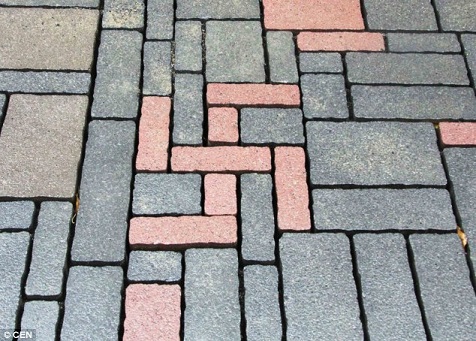
A German construction company has apologized to the city of Goslar after laying bricks in the shape of a swastika at a new shopping center there (this is the town that finally got up enough civil courage to revoke Adolf Hitler of his honorary citizenship last year, after all).

Swastika

The builders claim that the shape of the bricks was purely accidental but when trying to contact the particular worker responsible to ask him about some other shapes discovered at the shopping center (the Nazi party eagle, several pairs of SS bolts and a big “I Love Adolf” mosaic)  he could no longer be found for questioning.

“We have no leads, we are keeping our options open and investigating. We are speaking to the building firm responsible for the new footpath. They claim it was not deliberate but just an innocent mistake, and have already changed it.”

The Red Parts Is Where All Them There German-Americans Live

Germans

California still looks like a pretty safe bet.

It’s time to break out the bratwurst as the United States celebrates German-American Day on Oct. 6.

Commemorating the founding of Germantown, Pa. in 1683, the holiday celebrates America’s largest ancestry group, with 49 million people claiming part or full German heritage.

Dumm Gelaufen

Hard luck – for this not-tricky-enough maneuver by a group of German Dornier 17 bombers near Kent in the summer of 1940. For this one plane in particular, I should say (very interesting video). But, in a way, it turned out to be good luck for all of us now.

Dornier 17

The plane in question is believed to have crashed on 26 August 1940, brought down by an RAF fighter called the Boulton-Paul Defiant.

The stricken bomber flew south, rapidly losing power and height. The pilot tried to bring his plane down on the water. But when his wingtip touched the surface, he lost control and the plane apparently flipped, coming to rest on its back. The pilot and observer survived; the other two crew members died.

“This aircraft is going to be the only one of its type in existence in the world. There are little bits and pieces – the RAF Museum have a tail section, for one. But this aircraft is complete and therefore its price from a historical viewpoint is invaluable.”

The Time Tunnel

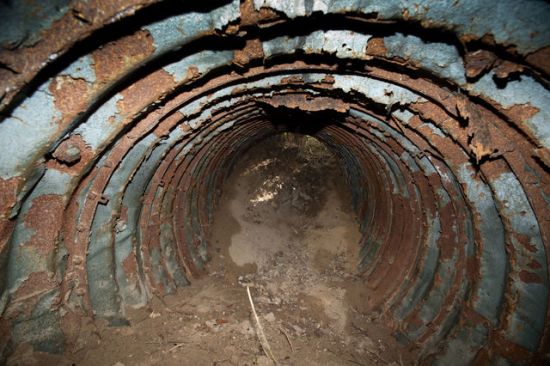
A section of an ingenious tunnel built by U.S. and British spies to intercept Russian phone conversations in Cold War Berlin has been found after 56 years in a forest 150 kilometers from the German capital.

The 450-meter-long tunnel, built in 1955, led from Rudow in West Berlin to Alt-Glienicke in Soviet-occupied East Berlin. By tapping into the enemy’s underground cables, Allied intelligence agents recorded 440,000 phone calls, gaining a clearer picture of Red Army maneuvers in eastern Germany at a time when nuclear war seemed an imminent threat.

German Historian Unclear As To What Happened Between 1939 and 1945

Completely clueless as to what happened in Germany and environs during what appears to have been a rather turbulant period roughly between 1939 and 1945, a young German historian has written a book in which he asks his readers to ask their grandparents if they might possibly know.

“Whatever it was, it must have been a pretty big deal,” the historian said. “And as my studies now indicate, immediately after this whatever it was event, conversations about it between parents and children appear to have been nearly impossible as it was, well, hell if I know. That’s part of the mystery. And that’s why I’ve written this book.”

Time is running out. The answer to how a cultured, civilized nation did something “I dunno” (text slightly altered here) lies in the minds of the dying generation that took part, many of whom are ready and willing to talk at the end of their lives.

Endless War And Violence?

And it’s the worse that it’s ever been. And it’s only getting worse, right?

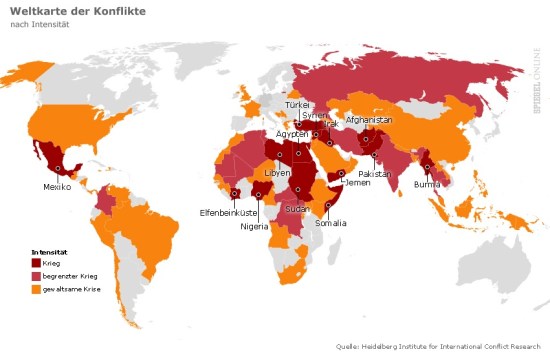
And if you ask this Heidelberg research group who just put out their “Conflict Barometer,” they will tell you that more wars took place worldwide in 2011 than at any time since 1945 (and 2012 doesn’t look all too promising, either).

But what does that mean?

If you really want to put our dreadful, horrible and unspeakably violent age into true historical perspective, do yourself a favor and take a look at what this guy has to say about it.

Thanks for the letting me stumble on to/over this, ¡No Pasarán!

In ihrem “Konflikt-Barometer” zählen Heidelberger Forscher so viele Kriege wie seit 1945 nicht mehr.