It’s Good To Be In A Crisis

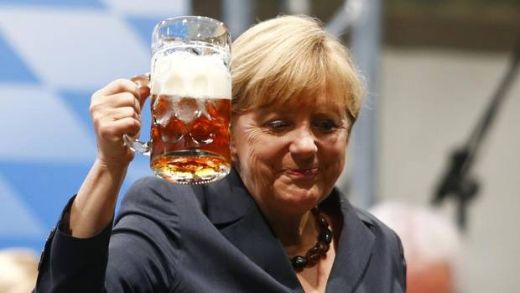
Money is like water (or maybe like beer). It has to go somewhere. And 40 billion euros just made its way to Germany.
Crisis

While fear has driven money away from Greece and Spain and co, making the government cost of repaying debt in these countries seem prohibitive, in Germany it has been quite different. Fear has boosted Germany coffers…

One thing is for sure, putting it in Greek bonds is risky. Spanish, Italian and Portuguese bonds don’t seem much safer either. But German bonds, in contrast, feel as safe as a safe house in a land with no crime. In fact so safe are German government bonds or bunds, perceived to be, that there have been times when the yields on some of them have been negative.

So actually, Germany has done rather well out of fear created by the euro crisis – or should that be the other way around – a euro crisis created by fear?

Indignant Response Pure Hypocrisy?

Here? In Germany?

Merkel

An interview with historian Josef Foschepoth published in the online edition of the Süddeutsche Zeitung makes clear that US intelligence agencies have a free hand to do what they like in Germany, with the knowledge and blessing of the federal government.

The historian regards the indignant response of the German government regarding the spying activities of American and British intelligence services unmasked by Edward Snowden as pure hypocrisy. For a Western intelligence agency, such as the National Security Agency (NSA), there are in principle no limits in Germany.

“The NSA can do everything in Germany. Not only because of the legal situation, but above all because of the intensive collaboration between the services, which was always desired and always politically acceptable.”

Sure Is Cold In Here

Cold

The issues at stake are not trivial ones. At the core of the Franco-German conflict is no less a matter than the question of how Europe can shake off the current crisis. Merkel is convinced this can only be achieved by implementing reforms — austerity, liberalization of the labor market and restructuring of social welfare systems.

But Hollande is unwilling to let Germany impose its model on France. He fears the European recession will only worsen if Berlin succeeds in implementing its austerity plans.

Even in the euro crisis, Germany is reluctant to be seen as sole leader. It badly needs a French economic revival to have a plausible partner at the top again.

“This is why, ultimately, it does not matter whether they like each other—that has not been the case for years.”

Germans Tired Of Being Cast As The Euro Zone’s Scapegoats

But once they take a nap and rest a little bit, they won’t be so tired anymore.

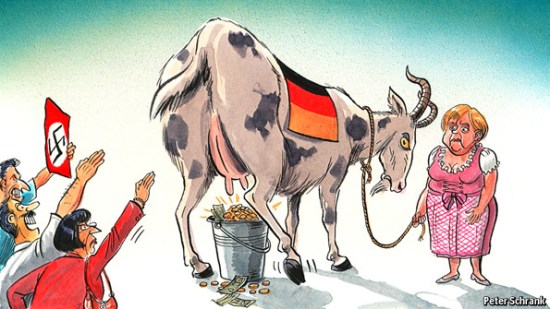
Scapegoats

Sometimes Germany was too weak, sometimes too strong. Or, as Henry Kissinger, a former American secretary of state, put it, referring to Germany just after unification in 1871, it was “too big for Europe, but too small for the world”. Today, Mr Simms (Cambridge University) argues, “it sits uneasily at the heart of an EU that was conceived largely to constrain German power but which has served instead to increase it, and whose design flaws have unintentionally deprived many other Europeans of sovereignty.”

The question is whether Germany can use its power by unapologetically leading. Given Germany’s past, its political culture militates against even trying.

“It’s nice to go to a conference of ‘young leaders’, but you don’t want a conference of ‘junge Führer’.”

Pope Latest Victim In Never-Ending German Plagiarism Scandal(s)

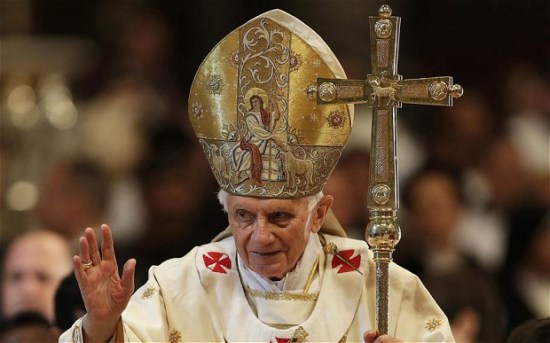
Pope Benedict XVI shocked the world by resigning today following allegations in Berlin that his entire bibliography had been plagiarized.

Pope

This is now the four-hundred-and-forty-seventh time in the past two years that a high-ranking German politician and/or Pope has been forced to quit over accusations of cheating on doctoral dissertations and/or religious meditations.

“Wow. We’ve had ministers resign here right and left, like freakin’ flies,” one source near Chancellor Angela Merkel’s government said. “But a Pope? Holy Moley!”

“I’ve accepted his resignation heavy-heartedly,” Ms. Merkel is said to have said.

More Godwin’s Law In Action

And it’s particularly popular with Germans, for some strange reason: “In other words, Godwin observed that, given enough time, in any online discussion—regardless of topic or scope—someone inevitably makes a comparison to Hitler or the Nazis.”

Hitler or what?

OK, technically this wasn’t online, but the latest unnecessary comparison to Hitler came from a certain Andreas Köhler, head of a German doctor lobby group here (die Kassenärztliche Bundesvereinigung).

“Julius Caesar, Charlemagne, Napoleon, Adolf Hitler, Angela Merkel – the list of leaders is very long when it comes to those who have tried to unite Europe. And these attempts have always failed because no one can imagine living together in one and the same European house.”

Uh, is the doctor in?

Ein KBV-Sprecher sagte der dpa, aus der rein internen Feier seien Sätze ohne weiteren Zusammenhang nach außen gelangt.

Prioritäten Setzen

You know, to prioritize?

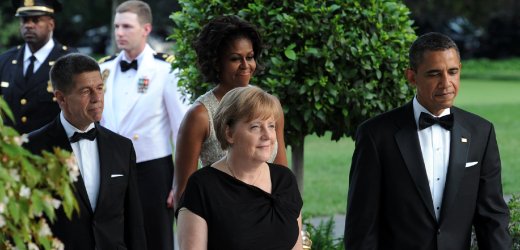
The refocusing of U.S. attention on Asia that marked Mr. Obama’s first term had already provoked much soul-searching among Germans about the relevance of the trans-Atlantic ties that for decades defined their existence.

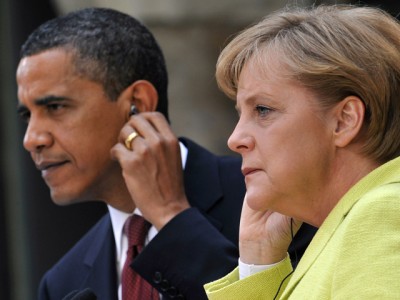
The failure to announce any early state visit to Germany is still perceived in Berlin as a snub, and has helped fuel the urban legend that Mr. Obama has not forgiven Ms. Merkel for refusing to let him speak as a senator before the city’s heavily symbolic Brandenburg Gate landmark.

“Berlin is not only a place of German history, but of American history. It is the city where the Americans twice triumphed over evil, first the Nazis and then the Communists.”

Merkozy This Is Not

How about Hollmerk?

The two capitals (Berlin and Paris) always begin from very different positions, whether there is a socialist or conservative administration in Paris.

The concern in Berlin is over what is seen as the absence of a clear strategy on eurozone reform from the new French government. There is a deep suspicion that France is happy to have a weaker euro, higher inflation, and a looser monetary policy than Germany.

Mr Hollande’s refusal to incorporate the recent “fiscal compact” into the French constitution is one reason that Germany is now pushing for every country to sign a bilateral budget “contract” with the European Commission, that can be enforced by a powerful budget commissar… But Paris regards Ms Merkel as being overly focused on building deeper European political integration in a way that ignores deep-seated reticence in France reflected in the 2005 referendum defeat of the then-planned EU constitution.