The Problem With European Immigration Policy…

Is that there is no European immigration policy.

Refugees

There is a mish-mash of national policies, a patchwork of systems and criteria which are contradictory, incoherent, fragmented. Italy is very far way from Finland, not only geographically, but when it comes to immigration and asylum. France and Germany have quite different historical approaches to integrating newcomers. Sweden and Denmark are neighbours with a close shared history, but their immigration policies are chalk and cheese.

The seven countries of central Europe and the Baltic are being asked to take fewer than 30,000. It should not be a problem for big international cities such as Warsaw, Prague and Budapest. But the east Europeans are retreating into parochialism, digging into their national bunkers while nursing resentment at what they perceive to be German bullying.

Hungary’s prime minister, Viktor Orbán, is the cheerleader of the “Europe is useless” chorus, but Robert Fico, the Slovakian premier, and President Milos Zeman in Prague are not far behind. Ewa Kopacz, the prime minister of Poland, sounds more moderate, but she looks likely to lose an election next month to the nationalist right. Her hands are tied.

I wouldn’t worry about any of this, however. Think Greece: Europe always manages to get together in the end, when stalling for time is no longer possible, to not solve a problem by doing almost just enough to put it off until it does not go away by itself.

“If this is Europe, you can keep it.”

Who Would Want To Stay In My Crappy Country?

Hungarian Prime Minister Viktor Orban has brushed off calls for Hungary to reconsider its rejection of a fairer redistribution system for refugees across all countries belonging to the European Union by explaining how nobody in their right mind would want to set foot much less spend the night in a rotten country like his. He then named a few other trashy European nations no self-respecting war refugee would want anything to do with, suggesting he could name a whole lot more where those came from.

Orban

The problem is not European, it’s German. Nobody would like to stay in Hungary, neither Slovakia, Poland or Estonia. All of them would like to go to Germany,” the well-meaning prime minister said.

Der hässliche Populismus Viktor Orbáns kann nicht über die eigentliche Ursache der Flüchtlingskrise hinwegtäuschen: Die EU hat das Thema Migration völlig unterschätzt.

Coffee From Togo To Be Heavily Taxed

At last count, Germans who purchase coffee from Togo toss some 3 billion of the disposable cups used to temporarily carry it in each and every year.

Togo

Predictably outraged by this, German green shirts have predictably outraged German coffee vendors by suggesting that a 20-cent tax be placed on this luxury drink to encourage coffee Togo connoisseurs to bring along their reusable and occasionally re-washable coffee Togo coffee cups with them, preferably hanging on the environmentally friendly coffee Togo belt loop hangers attached to their biodegradable pants.

Should this prove to be too impractical for some customers, the ecological crusaders suggest, vendors should offer them a discount option (taxpayer subsidized) of drinking the invigorating beverage directly from their trembling cupped hands.

“Nehmen Sie sich ein wenig Zeit und trinken Ihren Kaffee vor Ort – aus einer Tasse.”

Not Bright To Call Germany Dark

It is weder (neither) dark noch (nor) bright.

Personally, I like to think of it as being more of a Wehrmacht gray. No, wait. Leave that Wehrmacht part out. Gray like all cats are in the dark, I mean. When it’s not light out there in Dark Germany.

Refugees

And being that it’s always darkest before the dawn and there is no darkness but ignorance and out of darkness comes creation, well, let’s all lighten up and Schluss (enough) with these all of these dark thoughts already.

Which Germany will prevail? The Germany of racist chants from the roadside? The Germany of rioters and drunken rock-throwers? “Dark Germany,” as President Joachim Gauck calls it? Or will it be the new, bright Germany, represented by the young policeman with his roots in Afghanistan?

Racism Not Eastern German Problem

Hell no. It’s all over the place here. Although actually, what we’ve really got here is another good old case of classical German schizophrenia in action again.

Germans

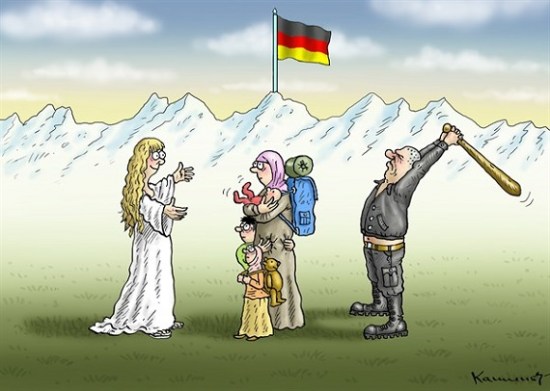
The real issue isn’t the humanitarian one, however. Of course the refugees currently flooding Europe have to be helped and have to be helped in an equitable manner, i.e. each country takes on its fair share of the burden. The real issue is the unspoken one: They have to be stopped from coming here in the first place. The problems that are causing them to flee aren’t being addressed but Europe can’t solve them. Europe can’t even solve its own problems.

And the reason this issue is still unspoken is that keeping them from coming here implies doing something really unpleasant. You know, something really unpleasant like Americans and Israelis do? You know, like putting up a wall of some kind to keep them out. Set your clocks. This issue won’t remain unspoken for very much longer.

“At the moment, refugee shelters are burning night after night all across Germany. And the hot spots for far-right violence are spread in all directions.”

The Mother Of All Refugee Shelters?

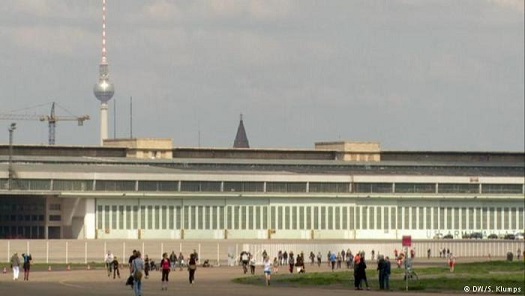
Tempelhof airport, the iconic structure that once oversaw the Berlin air lift in the 1950s, may be re-invented as a refugee shelter. The overstretched city administration did not deny it was considering the option.

Refugee

Berlin may have finally found a use for Tempelhof airport, the vast, iconic building that ceased operation in 2008, but has only been put to temporary use since. The city administration is considering turning the iconic structure – scene of the Berlin air lift during the Cold War and once described by architect Sir Norman Foster as the “mother of all airports” – into one of the biggest refugee shelters in Europe.

Weird Science

More German environmental backwardness in action. Or would it be better to call it genetic illiteracy?

So much for Europe’s efforts to put the junk science surrounding genetically modified (GMO) food to rest. Berlin this week signaled it will prohibit cultivation of GMO crops in Germany, even if the crops have been approved by EU scientific bodies and despite an attempt by Brussels to legalize them.

Science

Sure enough, neither environmentalists nor German politicians have come up with a justification for Berlin’s looming ban other than, well, because. Supporters cheer the move as an expression of “food democracy” in a country where opposition to GMOs is widespread and the government faced intense pressure to ban them…

Back in reality, EU scientific and food-safety authorities have repeatedly cleared various GMO crops for human and animal consumption. The process often takes months to complete, and in 95% of cases EU regulators ask producers for more evidence before greenlighting GMOs, so it’s hardly a rubber stamp.

German Of The Day: König Kunde

That sounds a bit like King Kong but actually means king customer or the customer is king, if you prefer. And it’s nice to be the king, as you well know.

Uncle Sam

For decades, France was the single biggest importer of German goods. But that’s changed now. The United States has taken the pole position among clients for “Made in Germany” goods for the first time.

Seit dem Jahr 1961 kauft kein Land so viele deutsche Produkte wie Frankreich. Das hat sich nun geändert. Und auch damit zu tun, dass Amerika wieder mehr auf die Industrie setzt.

PS: But thank goodness Germany still has its trade with ten foot tall China, too.


Angry, Drunk Germans Everywhere

Angry, drunk and unemployed German wasps are invading Essex?

Wasps

Stuff happens. Angry, drunk and unemployed German wasps have become a real plague here in Germany these days, too. Only they call them neo-Nazis here.

Neo-Nazism remains a fringe political movement in Germany, and these attacks should not be taken as a sign that it is becoming part of the mainstream. But the events in Heidenau are a disturbing reminder that neo-Nazi groups’ message of xenophobia and hate seems to be finding an increasingly receptive audience among ordinary Germans.