That means, more or less: “Well, what do you know? It’s possible after all.”
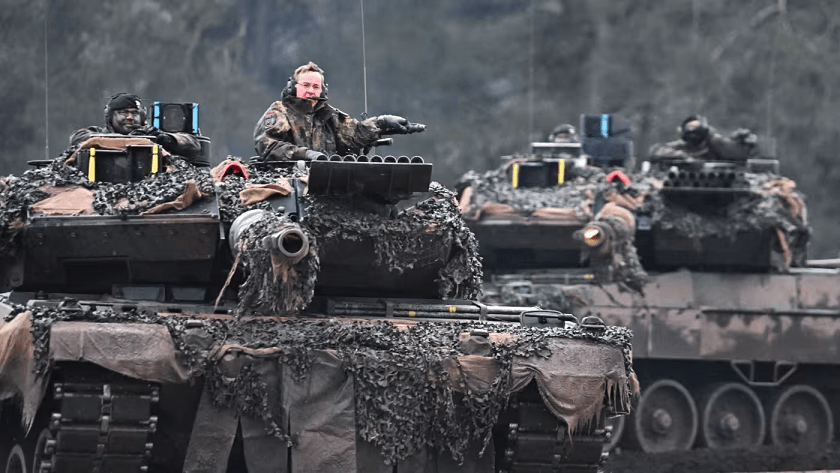
Germany hits 2% NATO spending target for first time since end of Cold War – Germany has met a NATO alliance target to spend 2% of its gross domestic product on defence for the first time since the early 1990s, a defence ministry spokesperson said on Wednesday, as spending ramped up after Russia’s invasion of Ukraine in 2022.
The German government is allocating the equivalent of 71.8 billion euros ($76.8 billion) for defence spending in the current year through regular and special budget outlays. However, the sum of its total defence spending is classified.
They reflect the widespread nervousness caused by the somewhat older new measures created to increase this widespread nervousness, a widespread nervousness that was increased by other new measures before them that much, much older new measures created in the first place.
You know the routine. Ritual, actually. “Right-wing extremism” is on the rise in Germany. It’s always been on the rise, of course. It’s been on the rise for decades and decades yet it never seems to rise quite high enough to satisfy those worrying about its rising. These are, at the moment, those politicians in the established parties being threatened by the AfD, a party that actually claims to be interested in addressing the migrant madness German voters want them to address, something these established parties refuse to do. They’re plotting to ban the AfD, in other words, because they are incapable of addressing the problems the electorate wants them to address.
Germany bolsters gun curbs, financial policing to rein in far right – German Interior Minister Nancy Faeser on Tuesday unveiled measures ranging from stronger financial policing and earlier detection of so-called botnets to tightened firearms controls to tackle a far-right surge that has spooked the country.
The measures reflect widespread nervousness that the far-right Alternative for Germany party could end up the largest party in several state parliaments later this year, propelled by a gloomy economy and overburdened public services.
Germany’s economy is on shaky ground and glimmers of hope are few and far between – Good news has been sparse for the German economy. And the latest economic data has not done much to change this.
A few key 2023 data points, namely factory orders, exports and industrial production, were out last week and indicated a weak end to the year that saw questions about Germany being the “sick man of Europe” resurface.
Co-head of the Berlinale justifies the cancellation with high pressure – The managing director of the Berlinale, Mariette Rissenbeek, has defended the decision to exclude AfD politicians from the opening gala. In the face of widespread criticism, it was “a very difficult gesture to say: ‘You are welcome!
AfD parliamentary group leader Brinker criticizes Berlinale decision as “exclusion.”
German Air Warfare Frigate Heading For Red Sea In Anticipation Of EU Operation ASPIDES – Frigate “Hessen” underway from Wilhelmshaven in what may be the most challenging deployment for a German warship in decades.
Beer, bratwurst and conspiracy: Inside a meeting of Germany’s far-right AfD – … They came for an evening of conversation with the Alternative fur Deutschland (AfD), Germany’s leading far-right party.
To one camp, this meeting represented a call for political change; to the other, a risk to German democracy. That vehement disagreement is one being played out across the nation as it heads towards regional elections in September.
After far-right gains in several European countries, most notably in the Netherlands and Italy, Germany may follow suit.
PS: Sign in the photograph: “How many more Hitler documentaries do you need?”
But not as bad as “greatest real estate crisis since the financial crisis.”
The fun just never seems to end these days.
German bank alerts the market on exposure to commercial real estate – The troubles in the US commercial property market, which have already hit banks in New York and Japan, moved to Europe this week, elevating fears about broader contagion.
The latest victim was Germany’s Deutsche Pfandbriefbank AG, which saw its bonds slump on concern about its exposure to the sector. It responded by issuing an unscheduled statement Wednesday that it had increased provisions because of the “persistent weakness of the real estate markets.”
It described the current turmoil as the “greatest real estate crisis since the financial crisis.”
Without you not being here – about 20 sick days a year.
A study says that in 2023, 5.5 percent of German employees were absent every day due to illness. Sickness-related absences caused 26 billion euros of damage in 2023. Without them, Germany would not be in recession.
“At least for 2023, Germany will be the ‘sick man’ in the truest sense of the word, whose economic performance will be significantly more affected by the wave of illness than in other countries.”
Just look at all the “ban Trump” moves in The Banana Republic.
“Germans seeking to ban democracy to save democracy.” They’re planning the banning of the AfD. Why? Because their ranks keep growing with disguntled voters from the established parties that refuse to give these voters what they want. An end to the migrant madness, for example. The Germans have this saying: “Wer nicht hören will, muss fühlen.” That means “he who will not hear must feel.” It’s clear that the established parties’ necessary pain threshold has not yet been reached but try to avoid this pain they must.
“The best argument against democracy is a five-minute conversation with the average voter.”
German industrial output drops unexpectedly in November – German industrial production fell unexpectedly in November by 0.7% compared to the previous month, the federal statistics office said on Tuesday.
As reported earlier, this only confirms that the Green plan to shut down Germany in order to save the planet is running like clockwork.