Is Bild Without Bild Still Bild?
Germany’s best-selling newspaper has removed all pictures from its print edition and website in response to complaints about its decision to publish images of the three-year-old Syrian refugee who drowned trying to reach Greece.
The decision to remove pictures in print and online comes less than a week after the newspaper dedicated its whole back page to the distressing image of Alan lying face down on the beach in Bodrum, surrounded by a black background and a plea for action from Europe.
Finally: An Imaginary Illness For The Rest Of Us
It might not be as severe as bummed-out disorder or as sexy as burn-out syndrome, but bore-out looks like the kind of imaginary disease that might just be right up my alley.
Germans just can’t wait to get it, either. Although they’ll still have to.
Whereas in US-Amerika bore-out might describe a a situation in which an employee’s zest for work has been extinguished by an unchallenging rather than an unmanageable workload, German bore-out has been specially redesigned to affect early retirees and others like them who have spent their entire working lives looking forward to doing just that (retiring early or otherwise) and are now bored to tears.
Sadly, there is no known cure for bore-out. Other than to stop being bored, of course. And to stop being boring while you’re at it.
„Täglich Zeitung lesen.“
Rottenburg AND Ebeleben
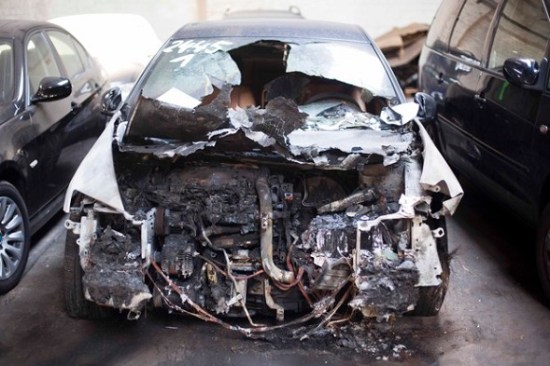
Beautiful German arson attacks of the week.
Because somebody has to notice they’re happening.
Die Polizei schließt bei dem Brand einer Asylbewerber-Unterkunft mit fünf Verletzten im baden-württembergischen Rottenburg Brandstiftung nicht aus.
The Problem With European Immigration Policy…
Is that there is no European immigration policy.
There is a mish-mash of national policies, a patchwork of systems and criteria which are contradictory, incoherent, fragmented. Italy is very far way from Finland, not only geographically, but when it comes to immigration and asylum. France and Germany have quite different historical approaches to integrating newcomers. Sweden and Denmark are neighbours with a close shared history, but their immigration policies are chalk and cheese.
The seven countries of central Europe and the Baltic are being asked to take fewer than 30,000. It should not be a problem for big international cities such as Warsaw, Prague and Budapest. But the east Europeans are retreating into parochialism, digging into their national bunkers while nursing resentment at what they perceive to be German bullying.
Hungary’s prime minister, Viktor Orbán, is the cheerleader of the “Europe is useless” chorus, but Robert Fico, the Slovakian premier, and President Milos Zeman in Prague are not far behind. Ewa Kopacz, the prime minister of Poland, sounds more moderate, but she looks likely to lose an election next month to the nationalist right. Her hands are tied.
I wouldn’t worry about any of this, however. Think Greece: Europe always manages to get together in the end, when stalling for time is no longer possible, to not solve a problem by doing almost just enough to put it off until it does not go away by itself.
“If this is Europe, you can keep it.”
The Little Red Book: Of Little-Read Jokes about the Enlightened Left
Why do liberals love eating donuts so much?
Also available at Amazon, Apple iTunes, Barnes & Noble, createspace, etc. Enjoy!
Katharina M.
Who Would Want To Stay In My Crappy Country?
Hungarian Prime Minister Viktor Orban has brushed off calls for Hungary to reconsider its rejection of a fairer redistribution system for refugees across all countries belonging to the European Union by explaining how nobody in their right mind would want to set foot much less spend the night in a rotten country like his. He then named a few other trashy European nations no self-respecting war refugee would want anything to do with, suggesting he could name a whole lot more where those came from.
“The problem is not European, it’s German. Nobody would like to stay in Hungary, neither Slovakia, Poland or Estonia. All of them would like to go to Germany,” the well-meaning prime minister said.
Der hässliche Populismus Viktor Orbáns kann nicht über die eigentliche Ursache der Flüchtlingskrise hinwegtäuschen: Die EU hat das Thema Migration völlig unterschätzt.
Coffee From Togo To Be Heavily Taxed
At last count, Germans who purchase coffee from Togo toss some 3 billion of the disposable cups used to temporarily carry it in each and every year.
Predictably outraged by this, German green shirts have predictably outraged German coffee vendors by suggesting that a 20-cent tax be placed on this luxury drink to encourage coffee Togo connoisseurs to bring along their reusable and occasionally re-washable coffee Togo coffee cups with them, preferably hanging on the environmentally friendly coffee Togo belt loop hangers attached to their biodegradable pants.
Should this prove to be too impractical for some customers, the ecological crusaders suggest, vendors should offer them a discount option (taxpayer subsidized) of drinking the invigorating beverage directly from their trembling cupped hands.
“Nehmen Sie sich ein wenig Zeit und trinken Ihren Kaffee vor Ort – aus einer Tasse.”
Not Bright To Call Germany Dark
It is weder (neither) dark noch (nor) bright.
Personally, I like to think of it as being more of a Wehrmacht gray. No, wait. Leave that Wehrmacht part out. Gray like all cats are in the dark, I mean. When it’s not light out there in Dark Germany.
And being that it’s always darkest before the dawn and there is no darkness but ignorance and out of darkness comes creation, well, let’s all lighten up and Schluss (enough) with these all of these dark thoughts already.
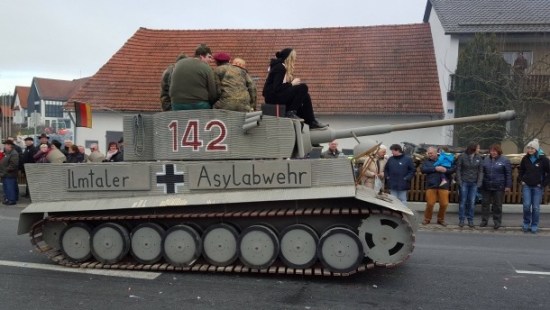
Which Germany will prevail? The Germany of racist chants from the roadside? The Germany of rioters and drunken rock-throwers? “Dark Germany,” as President Joachim Gauck calls it? Or will it be the new, bright Germany, represented by the young policeman with his roots in Afghanistan?