EADS-BAE SSA OK?

BAE Systems has warned it will walk away from its proposed €35bn tie-up with EADS if the deal waters down its special relationship with the Pentagon.

This SSA, specifies that BAE’s senior leadership in the US is made up of Americans, among other things, and has allowed the UK’s biggest defence company to work on many lucrative US national security projects.

“The [US] military would rather have a BAE than a combined BAE-EADS. BAE has been very successful in managing its US relationship. EADS is not in the same bucket, and a combined EADS-BAE is going to be treated a lot more like EADS than BAE.”

The Symptoms Of The Times

Withdrawal, I am told, can refer to any sort of separation, but is most commonly used to describe the group of symptoms that occurs upon the abrupt discontinuation/separation or a decrease in dosage of the intake of medications and recreational drugs.

In order to experience the symptoms of withdrawal, one must have first developed a physical/mental dependence (often referred to as chemical dependency).

„Notenbankfinanzierung kann süchtig machen.“

So Much For That Shootout

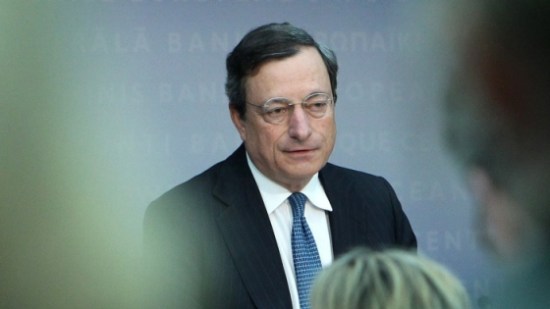
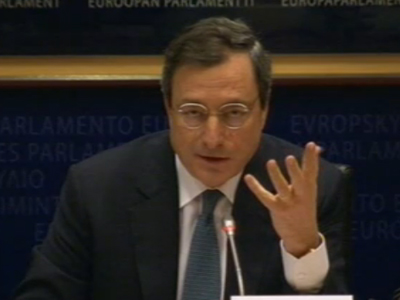
I still don’t know who Gary Cooper was here, but Mario Draghi just went from “I will do whatever it takes to preserve the euro” (and buy up Spanish and Italian bonds) to “the ECB may consider” doing so at a later date.

Needless to say, the markets were not amused. Cherchez la femme, I’d say (and it ain’t Grace Kelly).

What’s the hold up? Germany, perhaps. During a press conference afterwards, ECB vice-president Vítor Constâncio noted that only one member of the ECB was adamantly opposed to bond purchases. This seems to be a reference to Germany’s Bundesbank, which had vigorously opposed a central-bank bailout of Spain and Italy. And even though the Bundesbank doesn’t have a direct veto over ECB actions, it seems Germany, as the richest country in the euro zone, still has plenty of sway.

“For all the criticism of Merkel, she distinguishes herself from politicians on both sides of the Atlantic in that she has a plan.”

It’s High Noon

But which one is Gary Cooper?

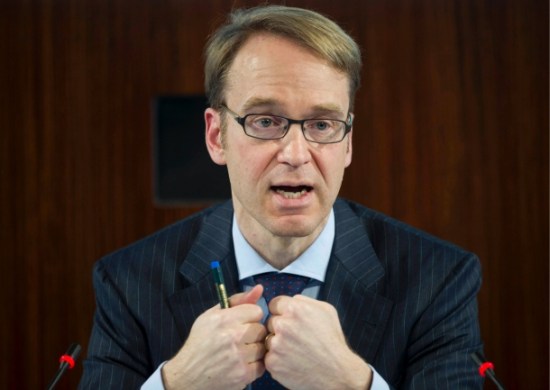
Big spending Mario Draghi, the European Central Bank boss who is shooting for the outright central-bank purchase of European sovereign debt, or lonely Bundesbank chief Jens Weidmann (and pretty much the rest of conservative Germany) who is gunning to resist such a move as it would “dilute debt-laden governments’ incentive to reform, and lumber the central bank with too many risks and responsibilities, endangering its independence and credibility.”

And more importantly, who is Grace Kelly here and where is she when we need her?

“I will do whatever it takes to preserve the euro.”

The Great European Divide

There’s Germany, it seems. And then there’s (practically) everybody else in Europe.
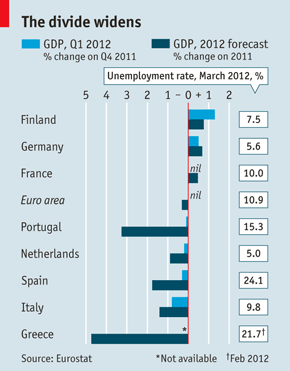
The Economist notes: The hope is that Germany, which produces over a quarter of euro-zone output, can pull along the rest. But the worry is that the latest bout of euro sickness may sap confidence even in Germany, aborting a broader recovery.

With unemployment at 6% compared with a 15-year high of 11% across the euro zone and over 20% in Spain and Greece, Germans feel less pressure to save in case they lose their jobs. And a more confident Germany helps everyone by spending more on imports. German inflation at 2.2% is now below average.

German resilience reflects several strengths. Although growth in the first quarter was helped by exports, the usual mainstay, it has increasingly been backed by domestic demand, which accounted for three-quarters of GDP growth in 2011. This reorientation has happened because Germany avoided the debt excesses (? hmmm, relatively speaking perhaps, but I’ve seen some other numbers here), both private and public, that inhibit growth elsewhere. With relatively low debt, German households and firms can borrow more. What is more, they can do it at rock-bottom rates. Paradoxically, Germany is benefiting from the euro crisis, as investors seek a haven. Yields on ten-year German government bonds have fallen below 1.5%.

Paradoxically, Germany is benefiting from the euro crisis, as investors seek a haven. Yields on ten-year German government bonds have fallen below 1.5%.

And yet, after having read all these impressive figures up there, there’s another German paradox I keep running into here all the time: Germans on the street aren’t nearly as confident as this article wants to imply, at least not when it comes to the euro and the euro-zone. How else do you explain the fact that nearly every second German now thinks that the introduction of the euro was a big honking mistake in the first place?

Die Euro-Einführung war ein Fehler, glauben knapp die Hälfte der Deutschen.
Germany Drains Spain’s Brains

In a ghoulish plan to intensify their already ironclad grip of an anemic Europe, depraved German industrialists have now begun luring unsuspecting southern European engineers to Germany by offering them well-paid jobs which will allow them (the depraved Germans) to drain their brains at leasure.

To make matters worse, if that were possible, another grisly gimmick has also been introduced in which so-called “blue cards” (green had already been taken) are being offered to skilled non-EU workers, as well. Although ostinsibly intended to “make the immigration process” easier, this “blue card” babble is clearly just another cynical euphemism for more German brain draining activity.

The gruesome brain-sucking capitalist bastards.

In December, a planeload of 100 Spanish engineers flew to nearby Stuttgart for a weekend of job interviews. Within a month, about a third of them had been hired. And some German companies have been making connections over the Internet, simply plucking Spanish, Portuguese, Greek and Italian professionals from sites like LinkedIn.

Vorratsdatenspeicherung

Is that a German word, or what?

And it looks like it’s a word that’s going to cost Germany millions in fines for not being willing to go along with the guidelines concerning it as determined by the EU.

I mean, we all know that Vorratsdatenspeicherung is a touchy subject and all. Some countries do their Vorratsdatenspeicherung this way, other countries do their Vorratsdatenspeicherung that way. But any way you cut the Vorratsdatenspeicherung cake, Vorratsdatenspeicherung is Vorratsdatenspeicherung and I, for one, find it irresponsible of Germany to just ignore the EU’s Vorratsdatenspeicherung guidelines like that, just because they’re Germany, I mean. All Europeans are in the same Vorratsdatenspeicherung boat, after all.

Who do they think they are, anyway?

You should be ashamed of yourself, Germany. Put that in your Vorratsdatenspeicherung pipe and smoke it.

“Was wir auf den ersten Blick sagen können ist, dass Deutschland anscheinend keinen Fortschritt bei der Umsetzung der EU-Richtlinie zur Vorratsdatenspeicherung gemacht hat und weiterhin EU-Recht verletzt.”

PS: Vorratsdatenspeicherung means data retention (the EU wants to retain data for six months, Germany doesn’t).

Germans Now Allowed To Shoot At Pirates

On land, even. No, not these pirates. These pirates down here.

Well, they won’t actually be shooting at the pirates per se (that would be bad), but more like at their equipment and stuff. You know, at the loot and the booty on the beaches? This will make the pirates run away and never come back again or at least become good or something.

It is all part of the EU’s anti-pirate Operation Atalanta off the Somali coast so it’s OK for Germans to do this, really.

The German opposition continues to criticise the operation as risky overreach for the forces and has vowed to vote against it.

German Austerity Still Quite A Rarity

Despite all the talk to the contrarity.

The German government didn’t reach even half of its planned savings in the federal budget in 2011. Only 42 percent of the spending cuts named by Merkel’s coalition government, comprised of the conservative Christian Democrats and the business-friendly Free Democratic Party, were actually not implemented…

The government is also falling behind on its targets for this year. Of the originally planned €19.1 billion in savings, less than half has been implemented…

This lapse (in reaching savings targets) is particularly embarrassing for the German government because the news comes just after 25 European Union member states agreed in early March to an international fiscal pact obliging them to adhere to greater fiscal discipline…

The aim of the pact is to make EU countries maintain binding austerity measures that leaders hope will contain the debt crisis and prevent countries like Greece from being able to pile up massive debts again.

And countries like Germany will show them how to do it, see? Next year, maybe. Or the year after that. Hard to say for sure.

 “It (the pact) is a milestone in the history of the European Union.”

We’re Helping Greece To Help Ourselves

It’s undeniable that Germany has great interest in helping Greece. Why just look at the great interest they’re getting back by doing so.

Despite all the perpetual bitching and moaning about having to foot the bailout bill for their bankrupt buddies in the bottomless pit, German tax payers raked in some 380 million euros on Greek aid interest payments in 2011 and are likely to pull in a whole lot more this year. It’s good to be the king, I mean lender.

Geez. With generosity like this, who needs extortion?

Im Rahmen des ersten Griechenland-Hilfspakets hat die Bundesrepublik dem Euro-Partner Darlehen von insgesamt 15,17 Milliarden Euro gewährt, um das Land vor der Pleite zu retten. Der Zinssatz habe zwischen 3,423 und 4,528 Prozent gelegen.