Huge funeral attendance

At Germany’s automobile industry burial.

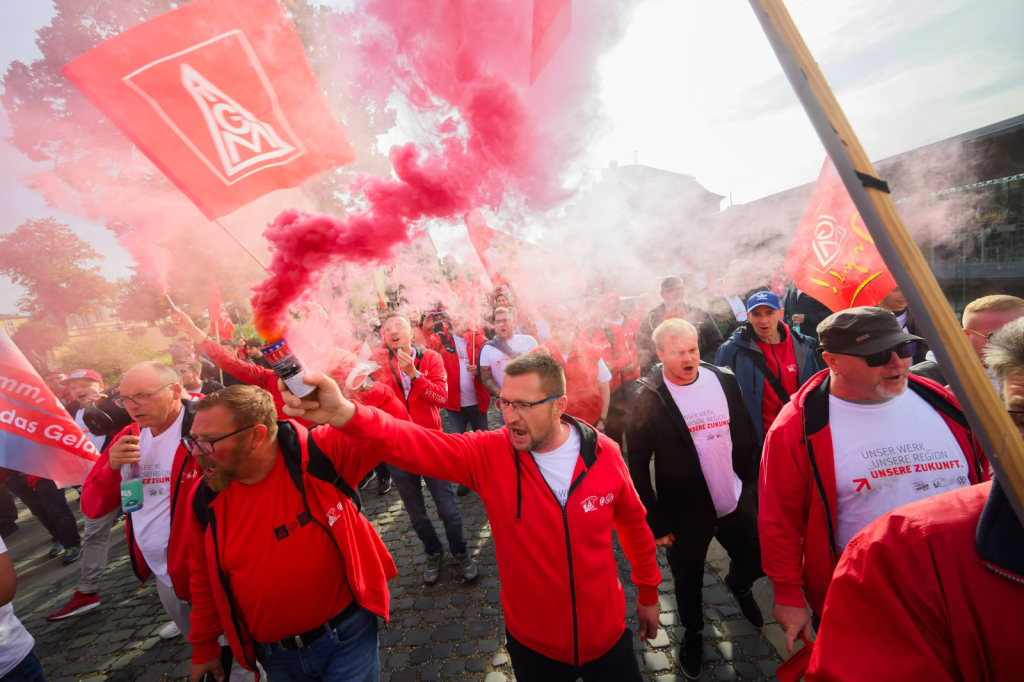
Volkswagen AG workers in Germany will pause production on Monday to join rallies about the automaker’s plans for unprecedented factory closures in the country.

Labor leaders plan to inform employees at 11 German sites about the latest on negotiations with the company. The events kick off a contentious week for Europe’s biggest carmaker, which is expected to post declining sales and profit when it reports third-quarter results on Wednesday…

The automaker has had a rough few weeks since it issued its second profit warning in three months in late September. While its premium brands including Audi and Porsche have been the carmaker’s biggest source of profit in recent years, they’re now struggling. Porsche AG on Friday said it’s weighing cost cuts and reviewing its model lineup after a demand slump in China hit its profits.

“Everything that could go wrong went wrong, or is going wrong”

Other than that though, alles ist in Ordnung (everything’s OK).

Germany’s lost decade: How the Fortune 500 Europe giant is flirting with long-term irrelevance – There is an elephant in the room of the 2024 edition of the Fortune 500 Europe. It’s not a crisis-riddled company or scandal-hit CEO. Rather, it’s the whole German economy.

For most of the 21st century, economists and neighboring countries have looked to Germany with admiration and envy as it managed to weather economic storms with relative ease, capitalizing on trade with growing economies and expanding the power of its industrial giants in the process.

However, a shifting world order has pulled the carpet out from underneath Germany. The industrial quirks that once helped it outgrow its European peers are fast becoming a burden, and crisis after crisis has exposed a lack of planning at the top of government.

“Declining connectivity” in Germany?

I wonder why.

It costs over four thousand euros for a commercial aircraft to leave a German airport. In other European countries it costs as little as 500 euros. Some say this has to do with German regulation and “green kerosene” madness but I’m sure there must be a more… reasonable explanation.

Lufthansa CEO concerned more airlines will cut German routes – After airlines such as Eurowings and Ryanair have cut back their connections in Germany due to excessive fees and costs, Lufthansa CEO Carsten Spohr fears a negative impact on Germany as a place to do business.

German of the day: “nicht zufriedenstellend”

That means not satisfactory or unsatisfactory.

Year number two. Germany is on a roll.

Germany expects economy to shrink after cutting 2024 forecast – Government predicts rebound in 2025 after 0.2% decline this year.

Germany is facing its first two-year recession since the early 2000s, as the government downgraded its growth forecast for 2024, predicting a contraction of 0.2 per cent.

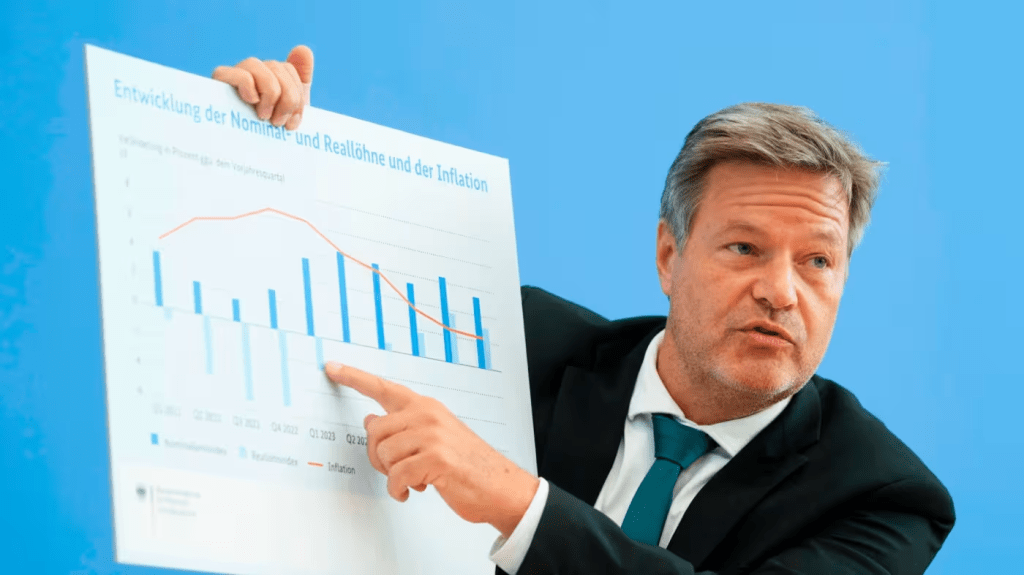
“The situation is not satisfactory,” Robert Habeck, economy minister, said on Wednesday.

Car science isn’t rocket science, people

Nobody wants Volkswagen’s electric cars.

The fewest German drivers do, anyway.

Driving on empty: The German government has few options to help an ailing car industry – Economy Minister Robert Habeck will meet with carmakers — but he has few weapons to stave off a car industry crisis.

Threats of historic job cuts and plant closures at German car giant Volkswagen and plunging earnings elsewhere in the industry are prompting Federal Economy Minister Robert Habeck to hold crisis talks on Monday.

But strained federal finances, fights with China over car tariffs and looming EU environmental regulations leave Habeck with few tools to help an industry which is the country’s economic backbone.

German arms exporters suddenly worried about “humanitarian law”

Silly me. I thought that was the only kind of law there was.

Germany has stopped approving war weapons exports to Israel, source says – Germany has put a hold on new exports of weapons of war to Israel while it deals with legal challenges, according to a Reuters analysis of data and a source close to the Economy Ministry.

A source close to the ministry cited a senior government official as saying it had stopped work on approving export licences for arms to Israel due to legal and political pressure from legal cases arguing that such exports from Germany breached humanitarian law.

German of the day: Auf Eis legen

That means to put on ice. As in put on hold.

Intel postpones construction of chip factory in Magdeburg – Haseloff against abandonment of the project.

The chip company Intel has put its plans to build a factory in Magdeburg on hold. According to company boss Gelsinger, construction will probably be delayed by two years due to cost-cutting measures. A total of 3,000 direct jobs were to be created on Magdeburg’s Eulenberg. Saxony-Anhalt’s state government assures that the semiconductor plant will nevertheless go ahead.

Or not.

Let’s diversify!

Just like we did with our dependency on Russian gas a few years back.

It’s called diversification through more dangerous entanglement.

German investment in China soars despite Berlin’s diversification drive – Politicians warn of rising geopolitical tensions but country’s carmakers stick with Chinese manufacturing.

German direct investment into China has risen sharply this year, in a sign that companies in Europe’s largest economy are ignoring pleas from their government to diversify into other, less geopolitically risky markets.

The urge to urge

Urged once again. Due to the urgency, I guess.

Well, I’m sure this urge will finally do the trick.

German chancellor urges Chinese industry bosses to play fair in EU market – Olaf Scholz says European cars should have equal access to Chinese customers.

“The only thing that always needs to be clear is that the competition is fair,” he said during a discussion with students at Tongji University in Shanghai. “That means there can be no dumping, no overproduction and that intellectual property rights are not violated,” he said.

German of the day: Unwahrscheinlich

That means unlikely. As in “a recovery of German industry to the level before the war in Ukraine is unlikely.”

Go Green, go… lean.

Germany set to permanently pay for reliance on Russian gas—as power chief says ‘significant structural demand destruction’ means it will never fully recover from energy crisis.

German industry got rich, thanks partly to its close energy trading relationship with political and economic rival Russia. The past few years have shown just how misguided that relationship was, as Russia invaded Ukraine and cut off Germany’s cheap, vital gas supply.

Now, one of Germany’s leading renewable-power bosses has suggested it’s a mistake the country could rue forever, as the fallout from the energy crisis is set to permanently damage its industry.