German Offshore Wind Farms More Deadly Than Fukushima

Nobody promised the Germans a rose garden when the so-called “energy turnaround” turned around the corner here last year.

So that’s why the three deaths and 80 serious accidents that have taken place so far while building Germany’s so badly needed offshore wind farms are being registered here with such stoic equanimity (or are being ignored altogether). Progress must march on or something. Keine Widerrede (no talking back)!

Do me a favor and wake me once this energy turnaround nonsense has finally turned around (as in over) and died itself.

Der Leiter des Havariekommandos in Cuxhaven, Hans-Werner Monsees, forderte gegenüber FOCUS ein „besseres und dichteres Rettungssystem“. Sonst drohe die Zahl der Toten und Schwerverletzten weiter zu steigen – in den nächsten Jahren werden bis zu 7000 Windräder vor der deutschen Küste installiert.

1 Percent?

That’s right. E-books only account for 1 percent of all book sales in Germany.

Why is this? Let us count the ways…

Germans believe they cannot read as well on digital reading devices. This is because they have never held a digital reading device in their hands, much less tried to read from one, but still.

Germans are convinced that they are “better” at reading from paper (I don’t make this stuff up, people).

Like savages who believe that a camera captures your soul, Germans believe that an e-book reader captures the souls of the books it, uh, holds captive (OK, that part I did make up).

But the biggest reason of all Germans don’t like e-books and e-book readers is that Germans don’t like technology. Technology that isn’t German, I mean.

“In Germany we’re still at 1 percent, but that’s already an increase of 77 percent from the previous year.”

PS: Of course low e-book sales in Germany might also have to do with the fact that German book prices are set by the German culture mafia (by the publishers!? = you pay the same artificially high price everywhere) so they get to set the e-book prices, too (you can pay up to $25 for one). And although printed books are exempt from Germany’s 19 percent value added tax, e-books aren’t. Not that the system is rigged or anything. I’m just saying.

Hallo, ist da jemand?

Is there anybody out there?

I like old Helmut Schmidt, and we’re talking old (93). I like that he goes out of his way to smoke in front of everybody, especially there where you’re not supposed to. I also think it’s cool that he doesn’t have a cell phone and prefers writing something called “letters” with something called “paper and ink.”  And I don’t even mind that he thinks the Internet is “menacing.” I mean, why should he be the only one in Germany who doesn’t think that way?

I do wish, however, that he would take that big leap and finally leave the SPD while he still has the time to do so. I don’t think he ever belonged there in the first place. But maybe that’s just me.

„Ich telefoniere überhaupt nur noch selten. Wahrscheinlich habe ich das auch früher nie wirklich gern getan. Ich habe immer die Schriftform bevorzugt, und zwar die briefliche Schriftform.“

German Computer Clouds Don’t Stink

I mean float. At least not across the German border, they don’t.

Germans being pathalogically hypersensitive whenever it comes to data protection issues, whether they be actual issues or not, Deutsche Telekom has cleverly exploited these wildly popular fears during this year’s CeBIT technology fair by suggesting to “the 3.6 million prosperous German small and medium sized firms who have not yet taken the leap to storing their data using cloud computing” that their “German cloud” can offer them the safety and security that those leaky and toxic foreign clouds could never offer them – even if those foreign clouds wanted to offer them safety and security in the first place which, of course, they don’t.

Telekom’s cloud – some 30 datacenters spread across Germany – is, well, spread across Germany, so nothing can ever possibly go wrong, one Telekom spokesman tells us. “And we are not playing on peoples’ fears, either” another spokesman added. “It’s just that when servers are situated outside of Germany there is a risk that companies will use your data for commercial purposes or, worse, they will be spied on by the secret services.”

Let’s all sing together: Paranoia strikes deep. Into your life it will creep. It starts when you’re always afraid. You step out of line, the man come and take you away…

This will be “a cloud computer model for the German market and in the German language.” Made for Germans. By Germans. In Germany.

Germans Still Scared Of The Internetz

Actually, it’s only the older, digital immigrant kind of Germans who are still scared of the Veb. You know, around 85 to 90 percent of the population?

And these are the folks who want politicians to introduce ever more stringent anti-Internet legislation (more is more here) and get all hysterical about data privacy for data that nobody’s interested in and ran Google Street View out of town and would never think of ever putting their faces (or anything else) on Facebook, provided they could even find the dad dern thing, and think that flash mobs are real mobsters with machine guns and stuff like that and on and on and on. And, oh yeah, these are also the folks who vote here. So there we have it. Old dogs, nix tricks. Tricks are for kids.

Sogenannte Digital Outsiders hält die Angst, die Kontrolle über ihre persönliche Daten zu verlieren, davon ab, überhaupt online zu gehen. Sie fürchten zudem, mit einem versehentlichen falschen Tastendruck das Internet zu löschen.

Cut The Loses And Run

The German government is about to cut solar subsidies by 30%.

Despite the massive investment, solar power accounts for only about 0.3% of Germany’s total energy. This is one of the key reasons why Germans now pay the second-highest price for electricity in the developed world (exceeded only by Denmark, which aims to be the “world wind-energy champion”).

According to Der Spiegel, even members of Chancellor Angela Merkel’s staff are now describing the policy as a massive money pit. Philipp Rösler, Germany’s Minister of Economics and Technology, has called the spiralling solar subsidies a “threat to the economy.”

Let The Protests Begin

Now that the command center for NATO’s missile shield program will be based here in Germany, it’s time for the German Left (that’s the middle of the road here, by the way) to start telling us why this is an awful bad horrible idea.

My guess is that that we will find out that there are actually no such things as rogue states like Iran (only morally challenged ones), that a missle shield like this is absolutely positively technically impossible to implement, and that putting one into operation (even though it is absolutely positively technically impossible to implement) would hurt Russia’s feelings.

There’s not much happening on the Peace Front either these days, you see. And spring is just around the corner. And folks do get easily bored, you know?

The United States insists that the missile shield aims to counter missile threats from Iran, but Russia has voiced concerns that it would target its own strategic deterrent.

It’s Us Against Them

Us as in US, I mean.

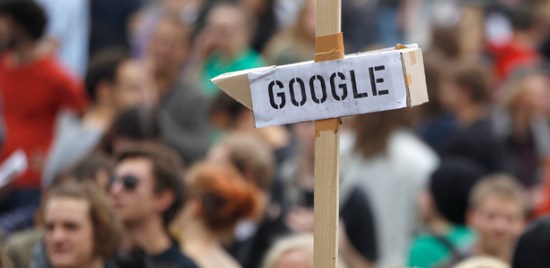
German authorities are trying to limit what the American tech companies can do, but the Silicon Valley giants are fighting back (the key word is American here, folks).

Give the Germans what they want, I say. But what DO they want, anyway (this is one of my favorite German schizophrenia thangs).

It’s worth noting that Facebook and Google are actually quite popular in the country — the BBC reported in September that “a quarter of the German population are active Facebook users and Google has 95% of the country’s search market.”

Like Get Out Of My Gesicht Already

Are we having another Street View yet? German faces on Facebook? Niemals (never)!

When it comes to Facebook’s biometric facial recognition technology “Tag Suggestions”, or just about any other kind of dad-gern-new-fangled sinister and EVIL US-Amerikanische Internet technology out there for that matter, Germans verstehen kein spaß (just can’t take a joke). And when you mix up a little “out of principle” in the fixins’, this latest tasty data protection Skandal is ready-to-serve.

To opt-in or opt-out, that is the question (German paranoiacs prefer the opt-in opt) and Hamburg’s data protection commissioner is now preparing legal action against Facebook and will soon fine the company over its use of said technology because, well, he can.

“Facebook has repeatedly come under fire in Germany, where privacy is a particularly sensitive issue for historical reasons.” Historical reasons? Nonsense. This is clearly a mental health issue.

“We believe that any legal action is completely unnecessary as the tag suggest feature on Facebook is fully compliant with EU data protection laws.”