Mark Your Calendars And Place Your Bets

I had no idea Auflösungserscheinungen (signs of disintegration) could occur this quickly with “progressive” political parties, not even in Germany. But disintegrating they are, two of them, right before our very eyes.

Let’s make a bet:

In three years at the latest, the Left Party will have completely lost whatever very, very little relevance they are said to have once had (still have?).

In two years time, no one will be reporting about the Pirate Party at all anymore. Not even Der Spiegel.

If I lose the bet, I’ll admit that I was wrong and you can buy me a cup of coffee. If I’m right, I won’t have to admit I was wrong and you can still buy me the cup of coffee.

“Ich bin müde, ausgepowert, erschöpft.”

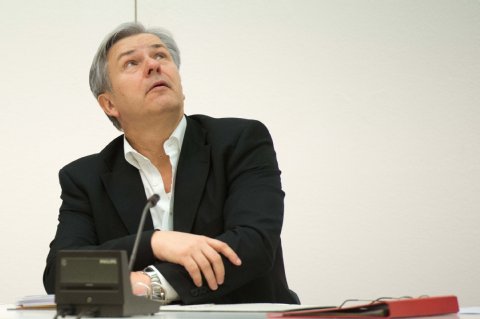
PS: Little Big Man Oskar Lafontaine just shot himself in the foot for the last time (I hope) and the Left Party is now mutating back to roll over and die on either side of its natural East-West divide, with the Communists of the East literally dying off like flies and the Möchtegern (wannabe) Communists of the West having lost interest and now wandering off for the latest next great cause (see Pirate Party). The Pirate Party has already long reached its fraternity house gag zenith and just will not function, “transparancy” or not, because it refuses to develop a platform more suitable for the inhabitants of Planet Earth, much less a structure of any kind, and the people supposedly running the show throw in the towels quicker than they can learn how to use them (they don’t bathe regulary, get it?). That guy up there (and the guy right after him) quite from exhaustion after a couple of days of something that used to be called “work,” just like that.

I wish I could make stuff like this up but I can’t.

If It Wasn’t For Schadenfreude I Wouldn’t Have No Freude At All

This just in: The German joy gene is broken. Holy freakin’ Makrele (mackerel)! Who would have ever thought that?

But here we have it. The latest German joy gene task force survey says: 46 percent of Germans reveal that they are increasingly unable to enjoy anything, 55 percent of younger Germans even claim to feel they have lost their ability to feel good at all and 81 percent of those surveyed said that the only time they experience pleasure is when they have managed to “achieve something” first. You know, like when “a motorcyclist reported experiencing delight when he blew exhaust fumes in the direction of a convertible driver as he accelerated at a green light.”

Wow. I would have never thought that Germans were self-denying overachievers completely incapable of enjoying themselves (unless it’s schadenfreude) and weighed down by their penchant for perfectionism and their inability to relax, you?

Meanwhile, chances to create a sense of well-being lurk everywhere — a glass of wine, a relaxing bubble bath, or a nice restaurant with delicious food. These, of all things, also rankle the Germans. “This glut of offerings pressures people into thinking, ‘I must enjoy everything’.”

It’s Good To Be The German

In case you didn’t know it, Germans are sitting on a big honking tremendous pile of money.

The Bundesbank thinks that German private households are in posession of ein paar tausend Milliarden or “a few thousand billion” euros (stick with that, believe me: Billion is Milliarde in German, trillion is Billion). They’ve got more set aside now then ever before, in other words; some 4.7 trillion euros.

And the punch line is that they seem to have invested most of it at those awful horrible dreadful banks they like to despise so much (they make big banks even bigger, you might say). Investments in real estate haven’t even been calculated here, by the way. Rereading this is starting to make my stomach hurt.

Privatleute vertrauen Vermögen den Banken an.

Energy Revolution Not Taking Place Quite Yet

German energy turnaround revolutionaries everywhere are turning around more than usual these days, burning more energy than planned trying to answer all the dumb questions those dumb energy reactionaries are always asking them.

Dumb questions like:
How come the energy turnaround isn’t making any progress?
How come the taxpayers continue to foot the bill?
How come all these renewable energy companies are going broke now that the subsidies are being cut?
How come made in Germany renewable energy technology is now being made in China these days (and German subsidies are actually helping the Chinese)?
How come Germany isn’t in the position to create the power-transmission lines needed to connect these new energy sources to the German power grid?
How come the energy-storage facilities needed for these new technologies are so extremely expensive and, well, just aren’t being built?
How was that again? How come Germany is in the process of turning off all its nuclear power plants?
How come the construction of dozens of new coal-burning power plants will therefore be necessary?

And how could ideology get the upper hand on reality (yet again) in a nation full of such sober, experienced thinkers?

And on and on and on these dumb questioners go. These reactionary types just don’t get it, you see. They don’t have visions like us revolutionary folks do. And they don’t hear the voices, either.

Germany Stalled on the Expressway to a Green Future

Hertha Down, Bayern Out

The German Football Federation has rejected Hertha Berlin‘s request to have their relegation play-off fixture with Fortuna Dusseldorf replayed due to fan unrest.

Home groan: How Bayern’s night of destiny became a nightmare.

FC Bayern have lost their last five matches to Borussia Dortmund, the DFB Pokal and the last two championships to Die Borussen and will need to recover quickly ahead of next season.

The Great European Divide

There’s Germany, it seems. And then there’s (practically) everybody else in Europe.

The Economist notes: The hope is that Germany, which produces over a quarter of euro-zone output, can pull along the rest. But the worry is that the latest bout of euro sickness may sap confidence even in Germany, aborting a broader recovery.

With unemployment at 6% compared with a 15-year high of 11% across the euro zone and over 20% in Spain and Greece, Germans feel less pressure to save in case they lose their jobs. And a more confident Germany helps everyone by spending more on imports. German inflation at 2.2% is now below average.

German resilience reflects several strengths. Although growth in the first quarter was helped by exports, the usual mainstay, it has increasingly been backed by domestic demand, which accounted for three-quarters of GDP growth in 2011. This reorientation has happened because Germany avoided the debt excesses (? hmmm, relatively speaking perhaps, but I’ve seen some other numbers here), both private and public, that inhibit growth elsewhere. With relatively low debt, German households and firms can borrow more. What is more, they can do it at rock-bottom rates. Paradoxically, Germany is benefiting from the euro crisis, as investors seek a haven. Yields on ten-year German government bonds have fallen below 1.5%.

Paradoxically, Germany is benefiting from the euro crisis, as investors seek a haven. Yields on ten-year German government bonds have fallen below 1.5%.

And yet, after having read all these impressive figures up there, there’s another German paradox I keep running into here all the time: Germans on the street aren’t nearly as confident as this article wants to imply, at least not when it comes to the euro and the euro-zone. How else do you explain the fact that nearly every second German now thinks that the introduction of the euro was a big honking mistake in the first place?

Die Euro-Einführung war ein Fehler, glauben knapp die Hälfte der Deutschen.

A Blaze Of Glory

Looks like you’re toast now, Hertha BSC.

Your relegation playoff defeat at Fortuna Düsseldorf took you out of the big league, yet again.

Although the match go so ugly at times…

That Hertha is now appealing against the result and is requesting a replay, which may or may not be granted.

But if they do get the replay, at least they’ll get the chance to lose fair and square on their own, without any of that pesky soccer fan interference stuff.

“It is written in the rules: if there is an outside influence, which has nothing to do with the game, then the match must be replayed.”

Those Airbus A380s Look So Freakin’ Cool

Especially when they’re Boeing 747-8-Jumbos.

Mit einer Rumpflänge von 76,3 Metern übertrifft die 747-8 als jetzt längster Passagierjet den Airbus A340-600 um knapp einen Meter und den Airbus A380 um vier Meter. Das Boeing-Flagschiff kann bis zu 600 Passagiere aufnehmen.

German Offshore Wind Farms More Deadly Than Fukushima

Nobody promised the Germans a rose garden when the so-called “energy turnaround” turned around the corner here last year.

So that’s why the three deaths and 80 serious accidents that have taken place so far while building Germany’s so badly needed offshore wind farms are being registered here with such stoic equanimity (or are being ignored altogether). Progress must march on or something. Keine Widerrede (no talking back)!

Do me a favor and wake me once this energy turnaround nonsense has finally turned around (as in over) and died itself.

Der Leiter des Havariekommandos in Cuxhaven, Hans-Werner Monsees, forderte gegenüber FOCUS ein „besseres und dichteres Rettungssystem“. Sonst drohe die Zahl der Toten und Schwerverletzten weiter zu steigen – in den nächsten Jahren werden bis zu 7000 Windräder vor der deutschen Küste installiert.

1 Percent?

That’s right. E-books only account for 1 percent of all book sales in Germany.

Why is this? Let us count the ways…

Germans believe they cannot read as well on digital reading devices. This is because they have never held a digital reading device in their hands, much less tried to read from one, but still.

Germans are convinced that they are “better” at reading from paper (I don’t make this stuff up, people).

Like savages who believe that a camera captures your soul, Germans believe that an e-book reader captures the souls of the books it, uh, holds captive (OK, that part I did make up).

But the biggest reason of all Germans don’t like e-books and e-book readers is that Germans don’t like technology. Technology that isn’t German, I mean.

“In Germany we’re still at 1 percent, but that’s already an increase of 77 percent from the previous year.”

PS: Of course low e-book sales in Germany might also have to do with the fact that German book prices are set by the German culture mafia (by the publishers!? = you pay the same artificially high price everywhere) so they get to set the e-book prices, too (you can pay up to $25 for one). And although printed books are exempt from Germany’s 19 percent value added tax, e-books aren’t. Not that the system is rigged or anything. I’m just saying.