Well, It’s Not Like They Could Be Arrested

Drug dealers need a safe space, too. At least in Berlin they do.
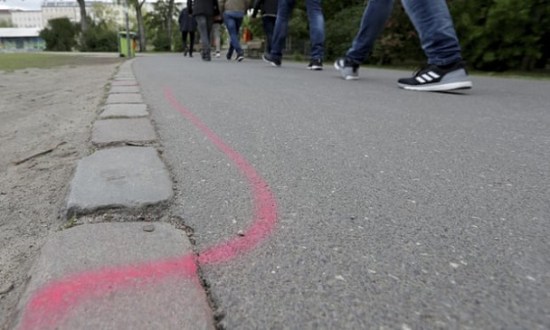
Drug dealers in Berlin are to be given designated spaces in a city centre park to carry out transactions, leading to criticism that authorities have capitulated to criminal gangs.

For years there has been a heated debate about Görlitzer Park, a popular meeting point in the trendy southern Berlin district of Kreuzberg, which has been attracting an ever increasing number of drug dealers. Local people said they were reluctant to let children and pets roam free there.

After repeated attempts by police to clear the dealers failed, the park manager declared areas where they should be allowed to operate, identified by spray-painted pink boxes.

“This method has purely practical reasoning behind it. It’s not that we’re legalising the selling of drugs.”

Germany’s Once Mighty Air Force?

That must have been a long, long time ago.

All of the Reasons Germany’s Once Mighty Air Force Is Dying – The German magazine Spiegel recently revealed that most of the Luftwaffe’s—the modern German air force’s—128 Eurofighter Typhoons are not flightworthy.

In fact, only about ten of the aircraft are ready for operations, Spiegel said. This raises doubts about Germany’s ability to meet its NATO defense commitments.

“The problem is complicated.” Uh, no it’s not. This is nothing new. The Germans simply don’t care.

Well, We Certainly Don’t Want To Spark Controversy

Do we? German conference on Islamic veil sparks controversy.

Veils

The Islamic veil – Symbol of dignity or oppression? I’m going to go out on the limb here, folks. I’m going with oppression. Just sayin’.

Islamic veils are a hot topic in Germany, particularly due to a growing Muslim population. Now, outcry over an academic conference on the issue has surprised even its organizer, who says freedom of speech is at stake…

Germany’s Muslim population, which has rapidly increased in recent years due to immigration from Muslim-majority countries, was estimated at between 4.4 and 4.7 million people or approximately 5.5% of the country’s total population in 2015, according to the Federal Statistical Office. The number is doubtless higher now, according to the agency, but updated official figures exist.

With these demographic changes come societal debates — one of which, that of the Islamic veil, has been a continual source of discussion. The latest veil controversy, which made headlines all across Germany, has occurred over a planned academic conference — something that even its organizer did not expect.

“Dissenting opinions must be respected and tolerated.” Must they? For how much longer?

I Want Whatever The New York Times Just Had

While the New York times asks itself “Why Is Socialism Coming Back in Germany?” a young, supposedly up-and-coming SPD politician has just made himself a national laughing stock by suggesting the “collectivization” of BMW.

Kühnert

Not even Germany’s ex-communist partially Stalinist now socialist (or whatever they call themselves this week) Left party comes up with bat shit crazy ideas like that. Everyone is asking themselves what this guy has been smoking.

No, New York Times. Socialism might be alive in well down in Venezuela these days but it will continue to have a tough stand in Germany, flirtatious as the Germans may seem at times.

Die Empörung über die Sozialismus-Thesen des Juso-Vorsitzenden ist groß. Die SPD-Spitze spielt die Aussagen herunter.

Are We Having A Recession Yet?

I don’t get it. I thought the German boom had boomed out. That’s all they’ve been talking about here for the past few months. More fake news, I guess.

April

Speaking of employmentGerman Joblessness Falls in Sign of Confidence in Growth Rebound – German unemployment continued its decline, suggesting companies are keeping faith in the prospects for Europe’s largest economy.

The number of jobless people fell 12,000 in April, more than economists expected, to 2.22 million. The labor agency said demand for workers continues to be very high.

This is the lowest unemployment rate for April in 30 years.

Arbeitslosigkeit – niedrigster Aprilwert seit 30 Jahren

Above Average?

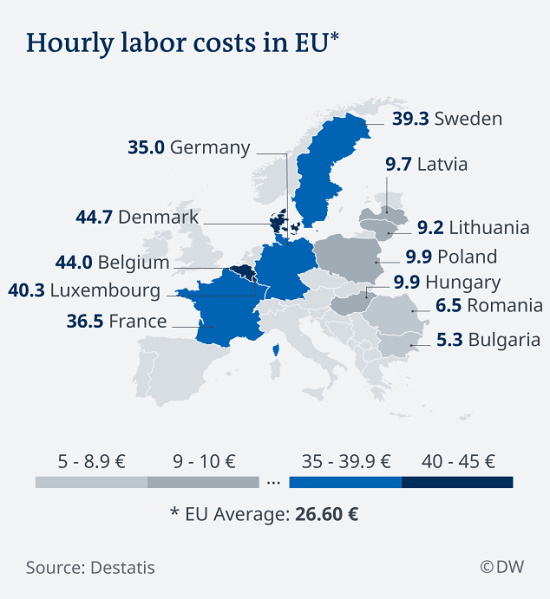
Germany’s labor costs above EU average? Sure. But take a closer look. Forget about Eastern Europe.

Cost

Germany is one of the lowest when it comes to labor costs in Western Europe. And maybe there’s a connection here somewhere but it’s unemployment rate is also one the lowest.

“This convergence of relative labor costs results from the fact that in countries with low labor costs, growth rates have been well above those of countries with already high labor costs for many years.”

German Of The Day: Handelskrieg

That means trade war.

Handelskrieg

A trade war between the United States and Europe is coming and the fallout could tip Germany into recession, according to analysts at German lender Commerzbank…

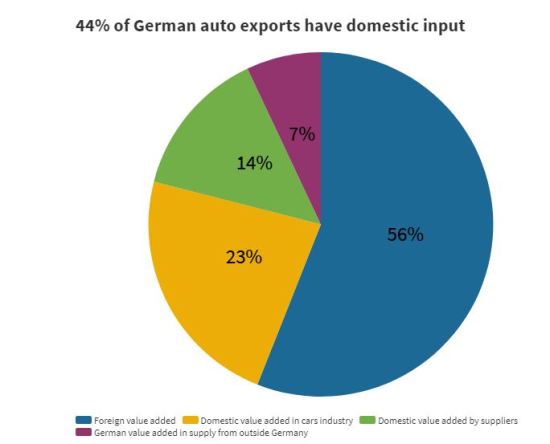
Official German statistics supplemented by the bank’s own research show that in 2018, the United States was the top export destination for German cars, accounting for about 12% of the total with a value of 27 billion euros of parts or finished vehicles.

The bank estimated that a Trump-ordered tariff increase of 25 percentage points on EU auto imports would slash that figure for Germany down to around 14 billion euros per annum.

When factoring in how much of that export figure is actual German “added value,” the bank estimated that total economic output for the country could fall by around 0.25 percentage points.

“All the more dangerous in a situation where the German economy is only just managing to avoid a recession,” it read.

German Of The Day: Mangelhaft

That means deficient. As in the deficient quality of the oil being imported to Europe via a Russian pipeline – this import having now been suspended by Poland?

Oil

That means Germany can’t get the oil, either. It’s not like Germany’s dependency on Russian gas and oil is deficient, however. That’s as high a quality dependency as you can get.

Germany and Poland have suspended imports of Russian oil amid contamination concerns, prompting a rare crisis over supply from the world’s second-largest exporter.

The sudden suspension of imports from the Soviet-built Druzhba pipeline, which runs from Russia via Belarus to central Europe, risks starving major European refineries of their major source of crude.

Händler großer Ölkonzerne, die Raffinerien in Deutschland betreiben, bestätigten dies: Die Versorgung über die noch von der Sowjetunion gebauten “Druschba”, auf Deutsch “Freundschaft”, sei gestoppt.

Germans Are Just Crazy About The EU

Or at least that’s the impression you get consuming the media reports here.

Manfred

Manfred

In reality, however, nobody really knows what it is or how it works, much less who to vote for. Not even when a German is running for European Commission president in the upcoming election.

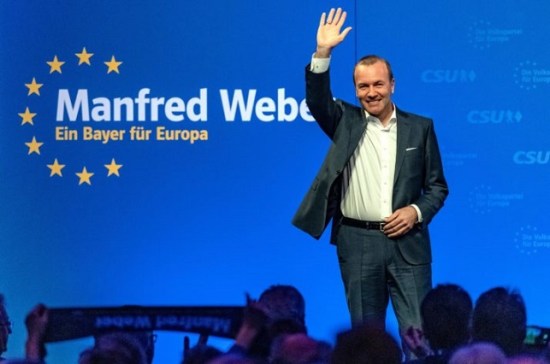
Only around one in four Germans (26 percent) knows who Manfred Weber is, just a month ahead of a European election he hopes will help propel him to being the next European Commission president.

But Weber, the lead candidate for the European People’s Party (EPP), is not alone in having a relatively low profile on the domestic political scene. According to a YouGov poll commissioned by dpa, 45 percent of Germans do not know any of the nine leading party candidates for the European Parliament election.

Our Next Promise Will Show More Promise

Not.

Defense

The longer Germany’s grand coalition stays in power, the more doubtful it is that Berlin will raise defence expenditure to the levels that it has promised its US and European allies. A failure to meet Germany’s commitments will corrode the mutual trust that is the essential ingredient of a successful international military alliance.

Inadequate German defence spending weakens Nato, the foundation stone of the nation’s security for 70 years. It damages US-German relations, which are at a post-1945 low because of the Trump administration’s disruption of the liberal world order. Ultimately, it undermines the credibility of the government’s claim that Germany stands for a robust, autonomous European security and defence strategy less reliant on Washington.

The Christian Democrat-Social Democrat coalition that assumed office in 2017 informed Nato at the start of this year that it would spend 1.5 per cent of gross domestic product on defence in 2024. This figure was below the 2 per cent to which Angela Merkel, Germany’s chancellor, and other national leaders had committed themselves at a Nato summit in 2014.