Accidents Do Happen

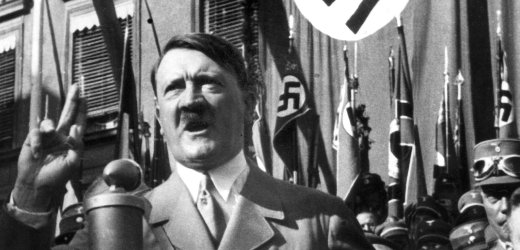
A German construction company has apologized to the city of Goslar after laying bricks in the shape of a swastika at a new shopping center there (this is the town that finally got up enough civil courage to revoke Adolf Hitler of his honorary citizenship last year, after all).

Swastika

The builders claim that the shape of the bricks was purely accidental but when trying to contact the particular worker responsible to ask him about some other shapes discovered at the shopping center (the Nazi party eagle, several pairs of SS bolts and a big “I Love Adolf” mosaic)  he could no longer be found for questioning.

“We have no leads, we are keeping our options open and investigating. We are speaking to the building firm responsible for the new footpath. They claim it was not deliberate but just an innocent mistake, and have already changed it.”

The Red Parts Is Where All Them There German-Americans Live

Germans

California still looks like a pretty safe bet.

It’s time to break out the bratwurst as the United States celebrates German-American Day on Oct. 6.

Commemorating the founding of Germantown, Pa. in 1683, the holiday celebrates America’s largest ancestry group, with 49 million people claiming part or full German heritage.

Dumm Gelaufen

Hard luck – for this not-tricky-enough maneuver by a group of German Dornier 17 bombers near Kent in the summer of 1940. For this one plane in particular, I should say (very interesting video). But, in a way, it turned out to be good luck for all of us now.

Dornier 17

The plane in question is believed to have crashed on 26 August 1940, brought down by an RAF fighter called the Boulton-Paul Defiant.

The stricken bomber flew south, rapidly losing power and height. The pilot tried to bring his plane down on the water. But when his wingtip touched the surface, he lost control and the plane apparently flipped, coming to rest on its back. The pilot and observer survived; the other two crew members died.

“This aircraft is going to be the only one of its type in existence in the world. There are little bits and pieces – the RAF Museum have a tail section, for one. But this aircraft is complete and therefore its price from a historical viewpoint is invaluable.”

The Time Tunnel

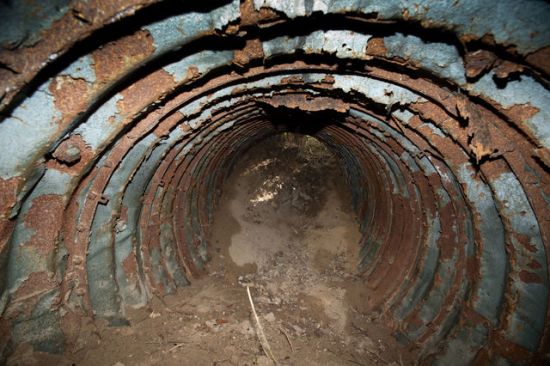
A section of an ingenious tunnel built by U.S. and British spies to intercept Russian phone conversations in Cold War Berlin has been found after 56 years in a forest 150 kilometers from the German capital.

The 450-meter-long tunnel, built in 1955, led from Rudow in West Berlin to Alt-Glienicke in Soviet-occupied East Berlin. By tapping into the enemy’s underground cables, Allied intelligence agents recorded 440,000 phone calls, gaining a clearer picture of Red Army maneuvers in eastern Germany at a time when nuclear war seemed an imminent threat.

German Historian Unclear As To What Happened Between 1939 and 1945

Completely clueless as to what happened in Germany and environs during what appears to have been a rather turbulant period roughly between 1939 and 1945, a young German historian has written a book in which he asks his readers to ask their grandparents if they might possibly know.

“Whatever it was, it must have been a pretty big deal,” the historian said. “And as my studies now indicate, immediately after this whatever it was event, conversations about it between parents and children appear to have been nearly impossible as it was, well, hell if I know. That’s part of the mystery. And that’s why I’ve written this book.”

Time is running out. The answer to how a cultured, civilized nation did something “I dunno” (text slightly altered here) lies in the minds of the dying generation that took part, many of whom are ready and willing to talk at the end of their lives.

Endless War And Violence?

And it’s the worse that it’s ever been. And it’s only getting worse, right?

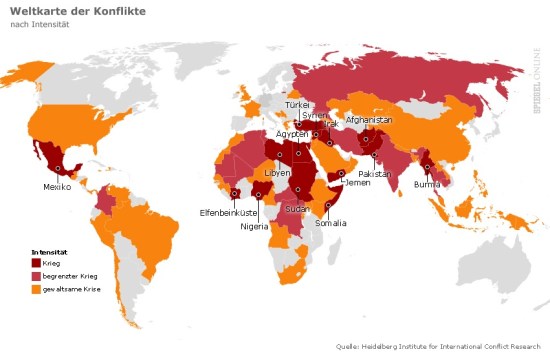
And if you ask this Heidelberg research group who just put out their “Conflict Barometer,” they will tell you that more wars took place worldwide in 2011 than at any time since 1945 (and 2012 doesn’t look all too promising, either).

But what does that mean?

If you really want to put our dreadful, horrible and unspeakably violent age into true historical perspective, do yourself a favor and take a look at what this guy has to say about it.

Thanks for the letting me stumble on to/over this, ¡No Pasarán!

In ihrem “Konflikt-Barometer” zählen Heidelberger Forscher so viele Kriege wie seit 1945 nicht mehr.

Well We Can’t Excel At Everything

Like when it comes to anti-Semitism and bad old fashioned anti-Jewish thought crime.

Honestly, let’s put this latest study in perspective and maybe not paint the Germans as being the Hollywood Nazis they aren’t for once (but just this once).

Sure, 20 percent is a lot. But you know that you know you thought it was higher (or wanted it to be). And “the study — which draws on several different surveys and other research — puts Germans in the middle of the pack in Europe, showing more latent anti-Semitism in countries such as Poland, Hungary and Portugal, and less in Italy, Britain, the Netherlands and France.”

And what happens to that 20 percent once you subtract the extremist right/Islamic fringe and those who think like and/or support them? I’m all for subtracting them, by the way, but we don’t live in a perfect world. What can I say? It’s a never ending story.

Ob auf Fußballplätzen, im Netz oder in islamistischen und rechtsextremen Milieus – Judenfeindlichkeit ist in der deutschen Gesellschaft noch immer gegenwärtig.

Die Deutsche Seele

A little German never hurt anybody. I’m too lazy to translate this, in other words (Thea Dorn’s interesting observations about “The German Soul” this week in Die Zeit):

Wir Deutschen selbst sind die einzigen, die notorisch nicht wahrhaben wollen, wie viele unserer Ängste samt der daraus resultierenden Verhaltensweisen von einer typisch deutschen Mentalität zeugen: Jedem Briten ist klar, dass es sich beim “Waldsterben”,  das die Gemüter in den achziger Jahren erschütterte, um einen urdeutschen Spleen gehandelt hat. Kein Franzose versteht, mit welch plötzlicher Radikalität unser Land den Ausstieg aus der Atomkraft vollziehen will. Die Amerikaner waren perplex, als Deutschland unlängst sein Ja zum militärischen Libyen-Einsatz verweigerte. Wir selbst und die Welt würden uns besser verstehen, wüssten wir noch, dass ein deutsches Universal-Lexikon bereits im Jahre 1747 wortreich den “jetzigen Verfall der Wälder in Deutschland” beklagte und Martin Luther mit dessen noch älterer Befürchtung zitierte, dass es Deutschland “vor dem jüngsten Tage” an “wildem Holze” mangeln werde. Dass die im Vergleich zu anderen Völkern überstark empfundene Angst vor einer atomaren Verseuchung aufs Engste mit der deutschen Reinheitssehnsucht zusammenhängt, der schon immer jede Verunreinigung, die sich nicht mit Schrubber und Seife bekämpfen lässt, ein Albtraum war. Dass der vermeintlich neue deutsche Pazifismus seinen größten lyrischen Ausdruck bereits 1779 fand, als Matthias Claudius dichtete: “‘s ist Krieg! ‘s ist Krieg! O Gottes Engel wehre, / Und rede Du darein! / ‘s ist leider Krieg! – und ich begehre / Nicht schuld daran zu sein!” Nur weil wir all dies vergessen haben, können wir heute unsere uralten Ängste als Fortschrittssignale ausgeben.

Germany Will Lead!

But only from behind. It’s another one of those German schizoid personality disorder things.

When history dictates humility, and modesty proves so profitable, reticence endures.

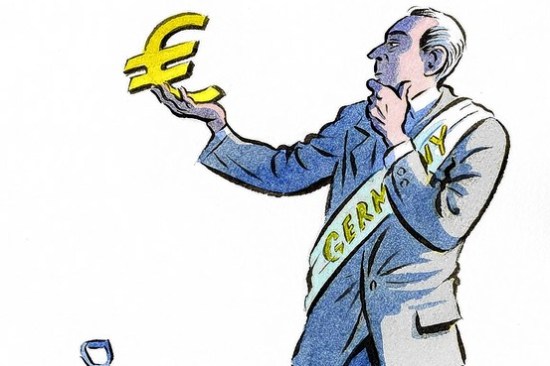
Germans tell the pollsters they fear for their money—and then add that they like both Europe and the euro. They sense that it is cheaper to throw up firewalls than to pay for the devastation of the blaze. They bridle at rewarding the vices of the “Club Med” countries. But their real horror is to be left alone in Europe once more.