German Of The Day: Wut-Burger

No, not Wut-Bürger (enraged citizen). Wut-Burger (Angriest Whopper), from Burger King. For enraged citizens, of course.

Wut-Burger

Talk about your Umsatz (sales). They’re going to be going through the roof. Just like all of the Wut-Bürger out there who are going to be ordering these things – available tomorrow!

So like take a chill pill already, folks. Or, better yet, have a relaxing refreshment along with your order. “Would you like a supersize beer with that Wut-Burger, Mr. Wut-Bürger?”

Der Wut-Bürger ist seit Monaten in aller Munde – aber einen Wut-Burger, den hat die Welt noch nicht gesehen.

News Flash: Wealth Unevenly Distributed Here

Germans everywhere were shocked to discover today that the nation’s wealth has not been evenly, uniformly and fairly distributed as had previously been believed.

Wealth

“Wah? Howya figure?” asked one dumbfounded German upon being informed by Spiegel-Online that the upper ten percent of his fellow countrymen possesses 60 percent of Germany’s wealth while the lower half only owns a lousy 2.5 percent of it (leaving lots of wealth left over somewhere else if I’ve done the math correctly, but still). “This sure is news to me. We Germans have all been raised in the confidence that we live in an ideal, egalitarian society in which things like income inequality are absolutely unthinkable and unheard of, much less possible. Why, these are amerikanische Verhältnisse or something! Why weren’t we informed of this earlier?”

Spiegel-Online apologized for this but then comforted their distraught readers by explaining that at least every German household enjoys having some 214,000 euros ($240,000) at its disposal – on average.

Jeder Haushalt besitzt 214.000 Euro – im Schnitt.

Kenya, Jamaica, It’s All Rhineland-Palatinate To Me

Or, if you prefer, German of the day: Koalition.

Palette

That means coalition, as in coalition government. And a working one is going to be hard to conjure up after the mixed results of Sunday’s state government elections in Germany (no one is willing to work together with the AfD).

SEVERAL German states, and perhaps the whole country one day, may have a political future as Kenya or Jamaica. Or as a traffic light. Germany could also become Germany, and other things besides. Unfortunately such talk—which is all the rage among German wonks since three regional elections on March 13th—makes little sense to people outside of Germany. That is because it refers to the colours of political parties and the coalitions they could form to produce governing majorities. Thus a “Kenyan” government would be some combination of black, red and green, as on Kenya’s flag. Jamaica would mean black, yellow and green. A traffic light would be red, yellow and green. Germany would be black, red and yellow. Motley as these descriptions may be, they point to a bigger change in Germany’s political landscape since March 13th. What is going on?

Der FDP-Bundesvorsitzende Christian Lindner steht einer von der SPD geführten rot-grün-gelben Koalition mit FDP und Grünen in Rheinland-Pfalz wohlwollend gegenüber.

Trump, Trumper, am Trumpsten

Am Trumpsten means “the most Trump-like” in German. Well it does now. I just made that up. That’s the cool thing about German. You can make up words right and left (in this case right?) and no force in the universe can stop you.

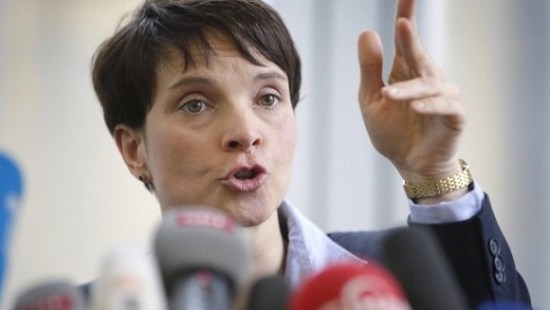
AfD

Anyway, it’s state election time in Germany today and Germany has a Trump-like problem. Germany’s Trump-like problem: Right-wing, anti-foreigner movement poised for big election win.

The problem has the same root cause the American Trump-like problem has, too. Nobody “up there” takes the worries of these folks “down here” seriously, particularly with regard to the refugee crisis. It’s time to dish out some punishment, see? This anger won’t lead to anything constructive, of course, but nobody who votes for the Trumps of this world thinks that far ahead or very much cares. Get your popcorn ready. It’s gonna be ugly.

„Die AfD könnte deutlich besser abschneiden als erwartet.“

But What About Datenschutz?

That means data privacy and is way big medicine here in Germany indeed. Just go ask Google, Facebook, the Boy Scouts, whoever.

Names

So like how on earth could German counter-terrorism police be “investigating documents (illegally acquired) said to reveal the identities of a large number of fighters of so-called Islamic State?” Without their expressed written permission, I mean. Do Julian Assange and Edward Snowden know about this?

Don’t these terrorists have the right to keep the German state from snooping into their, uh, Islamic state? Somebody call the nation’s Datenschutzbeauftragter (data protection officer) immediately. This is an outrage or something.

22 000 Namen von Islamisten enthüllt | ISIS-Geheimdienstchef verlor USB-Stick mit Terrordaten

German Of The Day: Heile Welt

Heile Welt

To grasp this trauma (the refugee crisis) it helps to understand the German zeitgeist that developed (mainly in the former West Germany) in the post-war years, and lingered in the reunited country. Germans call it Heile Welt. The term means something like “wholesome world”, and describes an orderly, idyllic state. It may connote the nurturing environment parents create for their children to protect them from life’s ugliness, or a private oasis of peace amid public chaos. It was a state of mind that Germans clung to after the second world war…

Foreigners were allowed into this Heile Welt, but not entirely accepted. To man its assembly lines, Germany invited workers from southern Europe and especially Turkey. The millionth arrived in 1964 and got a motorcycle as a gift. By the time the programme ended in 1973, 4m foreigners lived in West Germany. But they were called “guest workers” rather than immigrants, on the premise that they would ultimately leave again. Unsurprisingly, most stayed. Yet mainstream Germany continued to see itself as ethnically homogenous—a Heile Welt in a tribal sense…

Gnomic wisdom: Some Germans react by fleeing into ever tinier Heile Welten. “We are becoming ever more like our garden gnomes.”

German Of The Day: Durchwinken

That means to wave through.

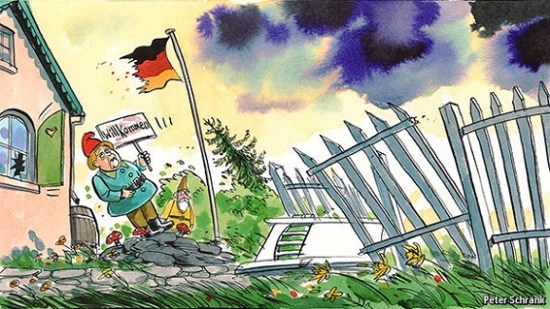
Merkel

And Angela Merkel HERSELF has just learned, like just today, an entire new German sentence with the word Durchwinken in it: Die Politik des Durchwinkens muß beendet werden. That means: The policy of just waving refugees through from one country to the next must now be stopped.

Like I said, she just learned it. It is quite a mouthful, isn’t it? So it’s certainly easy to understand why it took her this long to learn it.

“A refugee does not have the right to say ‘I want to be granted asylum in a particular country’ in the European Union.”

“Es gibt eben nicht ein Recht, dass ein Flüchtling sagen kann, ich will in einem bestimmten Land der Europäischen Union Asyl bekommen.”

77 + 13 = Null Ahnung

Null means zero in German. Null Ahnung means “I have no idea” or “I haven’t a clue.”

Gone

So just do the math:

The other day we found out that 77 percent of the migrants who came to Germany in January did so without having any identification papers. Now we learn that 13 percent of all migrants located in Germany just get up and, well, disappear. They get registered with the authorities somewhere when they arrive and then puff! They’re gone.

Ergo… When it comes to migrants in Germany, this 77 + 13 = uhm, wait a second… nearly 100 percent “I have no idea” or “I haven’t a clue” about what the hell is going on here in this country anymore. And something tells me I’m not the only one.

Knapp jeder achte registrierte Flüchtling verschwindet nach seiner behördlichen Erfassung.

This Reveals The Dark Side?

Like just right now for the first time already or something? Ain’t nothing new here. I thought the BBC was more im Bilde (in the picture) than this: “Migrant attacks reveal dark side of Germany.”
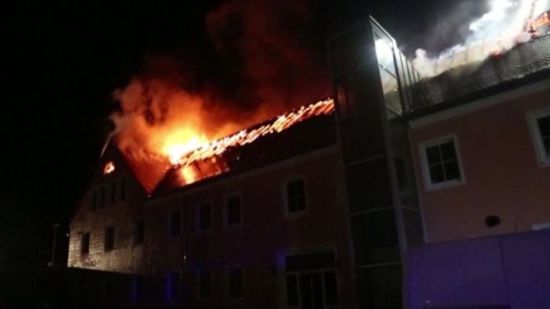
Arson

This dark side has always been here, folks. It’s just that for some inexplicable reason, a whole lot of people – like Angela Merkel, for instance – don’t seem to be aware of it. You would think that she, of all people, would know what country she has “under” her (it’s about half starry-eyed Gutmenschen and half of those arsonist folks, just in case you were wondering) but sometimes, I guess, even she is going to be the last one to know.

Oh, another example of her being the last one to know: The coming introduction (reintroduction?) of a real live German border fence (see Austria). Better late than never, Frau Merkel. Although it’s probably too late for any graceful exit you may still have been hoping for.

Keep your eyes peeled on the coming regional elections in Germany, folks! Beginning on March 13 at a media outlet near you.

Attacks on Germany’s refugee shelters are increasingly common. Government statistics reveal that last year there were about 1,000 such attacks, five times the number reported in 2014.

German Of The Day: Unproblematisch

That means problem-free or uncomplicated.

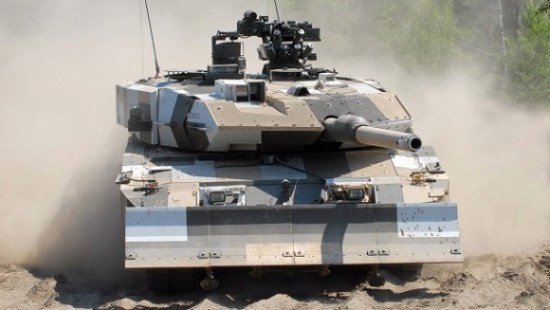
Exports

And that is what Germany’s economics minister Sigmar Gabriel (SPD) has to say about the significant rise in German arms exports. It’s problem-free. And totally uncomplicated.

He is the economics minister, after all. What could be more “economical” than increased arms sales? And you also need to know that this guy took office in 2013 promising to significantly restrict arms exports. So, well, there. At least his heart is in the right place.

SPD-Chef Gabriel hatte sein Amt Ende 2013 mit dem Versprechen angetreten, die Rüstungsexporte deutlich einzuschränken. Nun räumte er ein, dass seine Halbzeitbilanz „Licht und Schatten“ aufweise.