Where’s The Money?

All of a sudden. For all of that five-year-plan-renewable-energy-turnaround-ideology-project-like-stuff in Germany, I mean. She is gone, señor.

Gabriel

Or at least more and more German citizens are finally waking up and simply just aren’t prepared to keep on paying ever more for less and less of whatever it was that this so-called energy turnaround of theirs was supposed to be delivering.

That is why Superminister Gabriel (didn’t he used to sing with Supertramp?) is now urging (ordering) German parliamentary lawmakers to start cutting state subsidies for renewable energies – for German industry – because they are rich and capitalistic or something and are therefore evil (he’s an SPD Superminister) and haven’t really been milked properly for this one yet. And the po folks just aren’t willing to keep paying more and more, like I said [By the way, the S in SPD stands for “social” and everything with “social” in it means “free lunch.” Read Margaret Thatcher’s quote down there on the right if you want to learn more.].

Of course why the energy turnaround has to keep on turning around the way it does like this in the first place is the really interesting question here, I find, but certainly not one that anyone here in Germany appears to be willing to ask. At least not quite yet anyway.

Yup, renewable turnaround money has sure gotten tight around here these days. Not even a Swabian housewife can help out anymore.

“We need to break the dynamics of ever-rising electricity bills, while ensuring a stable supply of energy for all.”

Silvester Still More Deadly Than Atomkraft

More Germans get injured and die EVERY year by fireworks while celebrating on New Year’s Eve than have ever been injured by German nuclear power plants (no fatalities).

Fireworks

Especially now, I suppose, now that the last few reactors running will soon be turned off for good.

No, I haven’t the slightest idea what the connection is here, either. Ha! Other than perhaps… Germans FEEL that nuclear energy is more dangerous although they KNOW that getting drunk and shooting rockets at one another is a very real and present danger. And hey, what you FEEL wins. Loses?

System One Thinking: System one thinking is automatic, unconscious, lightening fast and generates strong feelings of certainty. System one decisions are difficult to put into words other than ‘it feels right’.

Zerfetzte Hände, schwere Verbrennungen, Tod: Die Silvesternacht hat nicht nur viel Freude, sondern auch einiges Leid gebracht. Mehrere Menschen starben durch Raketen und Böller, andere stürzten aus dem Fenster oder vom Balkon.

German Word Of The Day: Zwangsumlage

Zwangs- = compulsory. Umlage = levy, share in the costs. Put those two together and what do you get? Forced to share. But we’re talking about money here folks so let’s  just call it another tax and get it over with already.

Strom

This latest planned tax consists of forcing German households to purchase so-called “smart meters” or modern electricity meters that are supposed to regulate energy consumption by drawing electricity from that so wonderfully green German energy grid whenever this energy is cheaper. You know, like when hell freezes over?

This will only set back German consumers another 70 or 80 euros after already having been hit with a seven percent energy bill increase planned for next year, too (the seven can and will change, of course, and we all now in which direction it will be going).

Turn it around as much as you want. Anyway you turn this German energy turnaround around, you’ll always get the same result. Once you’ve turned it around, I mean. She is like way too expensive, señor.

But what can you expect from a government that is about to go retro and way back in the Wayback Machine to the good old days of SPD Never-Never Land again?

“Verbraucher sollten mit attraktiven Angeboten überzeugt, statt mit immer mehr ordnungsrechtlichen Einbaupflichten gezwungen werden.”

PS: The next German word of the day will be Abzocke. Here’s a tip: It means rip-off.

CO2 Is Bad, Right?

Germany has produced 2 percent more CO2 than it did the previous year, 20 million tons more. Oh yeah, and there had been an increase in CO2 production the year before that, too.

CO2

Uh, I thought that this Energiewende (energy turnaround) thing was supposed to reduce these emissions. I mean, after turning off all of the German nuclear power plants and all, CO2 emissions just had to have dropped, right? I was never very good at science, though, much less at rocket science. This Scheiße is clearly way too complicated for me.

“Nach ersten überschlägigen Schätzungen dürften sich die energiebedingten CO2-Emissionen in Deutschland um etwa 20 Millionen Tonnen oder um reichlich zwei Prozent erhöhen.”

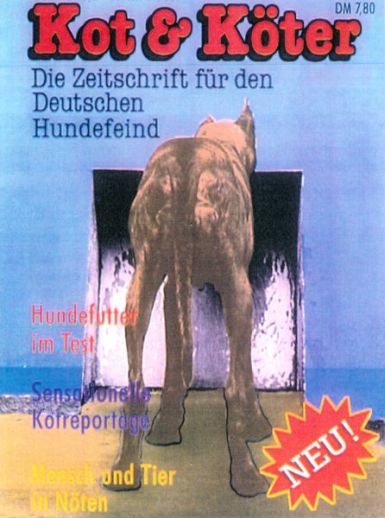
PS: Speaking of Scheiße, it turns out, to my amazement, that there actually are Germans who don’t like dogs. There seems to be a new anti-dog movement in the making that is being spearheaded by a magazine called Kot und Köter (Crap and Muts). I guess this had to happen sooner or later. And Kot causes CO2 emissions too, right?

Kot

Debacle, Disaster, Fiasco…

Just a reminder here again: “There is no free lunch.” Honest.

Lunch

Government intervention at its best (again). Germany’s deliberate attempt to make its energy greener using price guarantees and mandatory quotas for green energy IS NOT WORKING.

Try and remember: The whole idea was to make renewable energy more competitive and, therefore, in the end, cheaper. Well this attempt is so not working right now that German consumers pay higher prices now than ever before and German industry is soon to follow. And this, even though there is actually an oversupply of power. In essence, an energy bubble has been created because Germany’s renewable energy producers get a guaranteed minimum price for what they produce (this now includes farmers and communities and anybody else who can still get into the ponzi scheme).

Imagine you have various consumers going to a grocery store. Some of them want to buy a bottle of beer for 1 USD. Others would like to buy a bottle of champagne for 30 USD. In normal life people would just pay 1 USD for the beer and bubble-lovers would pay 30 USD for champagne. The German energy market is different. People who want the champagne pay 2 USD for it and those who want beer have to pay 2 USD. It’s a good deal for the champagne drinkers, getting subsidized by the beer buyers.

…Perhaps the least fair part of the whole scheme is how these prices disproportionately impact low-income households, who are forced to subsidize green energy for richer families to support politicians’ green energy visions.

Our Energy Turnaround Will Work

But only as long as we keep using the nuclear energy we supposedly turned around from.

Energy

According to an analysis by the Breakthrough Institute, Germany’s current installed solar panels will end up costing ratepayers $130 billion over the next 20 years through above-market-rate feed-in tariff contracts, compared to $15 billion for a state-of-the-art nuclear reactor that will generate over half the electricity of Germany’s entire solar fleet over a similar 20-year period…

The largest advantage of nuclear power is its ability to provide reliable, baseload power year-round 24 hours a day. Solar and wind can be economical as distributed energy resources, whose greatest value is suppressing demand load on the grid. But nuclear power provides baseload power and will therefore be the most technically optimal replacement for large fossil-fueled power stations like coal plants.

Speaking Of Green Disasters…

“Germany’s Green Energy Disaster: A Cautionary Tale For World Leaders”

Green

“The costs of our energy reform and restructuring of energy provision could amount to around one trillion euros by the end of the 2030s.”

The Green Shirts vs. The Environment

Guess who’s going to win?

Green

One would assume that ecology and the Energiewende, Germany’s plans to phase out nuclear energy and increase its reliance on renewable sources, were natural allies. But in reality, the two goals have been coming into greater and greater conflict…

Since the party’s founding in 1980, it has championed a nuclear phaseout and fought for clean energy. But now that this phaseout is underway, the Greens are realizing a large part of their dream — the utopian idea of a society operating on “good” power — is vanishing into thin air. Green energy, they have found, comes at an enormous cost. And the environment will also pay a price if things keep going as they have been.

“We should overcome the temptation to sacrifice environmental protection for the sake of fighting climate change. Preserving a stable natural environment is just as important.”

Big Phasehout Payout On The Way

A three-month closure imposed by the government on RWE’s Biblis A and B reactors as an immediate response to the Fukushima accident was illegal, a German court has ruled.

Phaseout

The administrative court for the German state of Hesse has found the state ministry of the environment acted illegally on 18 March 2011 when it issued an order for the immediate closure of the Biblis units.

This decision, as well as a tax on nuclear fuel levied in anticipation of continued operation of nuclear plants before the phaseout decision, have cost German nuclear operators dear: RWE estimated that the phase-out cost the company over €1 billion ($1.3 billion) in 2011 alone.

Any claims for damages against the state of Hesse would be decided in subsequent civil court proceedings.

More Green Energy Jobs

More jobs lost to green energy, I mean.

Offshore

Worlee-Chemie GmbH, a family-owned company that has produced resins in the city of Hamburg for almost a century, is trying to escape the spiraling cost of Germany’s shift to renewable energy.

A 47 percent increase on Jan. 1 in the fees grid operators set to fund wind and solar investments is driving the maker of paint ingredients to Turkey, where next month it will start making a new type of hardening agent at a factory near Istanbul.

The levy will cost Worlee 465,000 euros ($620,000) this year, the equivalent of 10 full-time salaries, or one-third of the company’s tax bill. As German labor costs rise at the fastest pace in a decade, the price of weaning the country off nuclear energy by 2022 is crushing the so-called Mittelstand, the three million small and medium-sized businesses like Worlee that account for about half of gross domestic product.

Wow. Now that’s what I call government intervention in action. This German energy turnaround thing is working out practically as well as the European cap-and-trade system itself.

“It could be the proverbial straw that breaks the camel’s back. It comes on top of tax, general production costs, raw-material availability and bureaucracy, which have led to a deterioration of the investment climate in Germany.”