Germans Stingy With Their Organs Too

Even after they’re dead, I mean.

Organ donations

Organ donations have dropped sharply in Germany following a scandal over alleged corruption at several transplant clinics. The German Foundation for Organ Transplantation says the number of organs donated fell almost 13 percent to 3,917 last year, the lowest figure in a decade.

Which reminds me of a joke…

An elderly patient needed a heart transplant and discussed his options with his doctor.

The doctor said, “We have three possible donors; tell me which one you want to use.

One is a young, healthy athlete who died in an automobile accident.

The second is a middle-aged businessman who never drank or smoked and who died in his private plane.

The third is a hospital administrator who just died after 30 years of service at a large medical center.”

“I’ll take the administrator’s heart,” said the patient.

After a successful transplant, the doctor asked the patient why he had chosen the donor he did. “It was easy,” the patient replied. “I wanted a heart that hadn’t been used.”


Brilliant “Master Solution” Falling Apart

When “good guys” like the Deutsche Bank get raided after being suspected of incorrectly claiming some €211 million in tax rebates from the trade in carbon tax certificates, then it’s time to also suspect that the days of this nonsensical European emissions trading have finally reached their end.

Cap-and-trade

In case your were wondering: Emissions trading or cap-and-trade is a market-based approach used to control pollution by providing economic incentives for achieving reductions in the emissions of pollutants.  A central authority (usually a governmental body) sets a limit or cap on the amount of a pollutant that may be emitted. The limit or cap is allocated or sold to firms in the form of emissions permits which represent the right to emit or discharge a specific volume of the specified pollutant. Firms are required to hold a number of permits (or allowances or carbon credits) equivalent to their emissions. The total number of permits cannot exceed the cap, limiting total emissions to that level. Firms that need to increase their volume of emissions must buy permits from those who require fewer permits.

Well, it turns out that the European “carbon market” is now flooded and recent EU efforts to fix the system have only served to highlight how lame it is, yada, yada, yada, thus further eroding the price of a ton of carbon dioxide emissions permitted. Government intervention at its best again, in other words.

You know how that old saying goes: “The nine most terrifying words in the English language are ‘I’m from the government and I’m here to help.’

EU-Klimakommissarin Connie Hedegaard will den Preisverfall der CO2-Zertifikate stoppen, der nach ihrer Meinung ein System unterminiert, das einst als Meisterlösung für die weltweite Klimaverschmutzung gepriesen wurde.

German Security Officials Now Ready To Consider Introducing More McDonald’s Restaurants

After the German city of Bonn narrowly escaped a deadly bombing last week – and unable to locate the suspected radical Islamist perpetrators due to a lack of recorded surveillance images – German authorities are now ready to consider intensifying the use of CCTV surveillance in Germany by dramatically increasing the number of McDonald’s restaurants allowed to open for business here.

Achtung, baby!

“Violent criminals could be deterred and crimes and planned attacks more quickly cleared up with increased McDonald’s video technology in public spaces,” one Interior Ministry spokesman said. “I mean, like we’ve got to do something now, don’t we?”

The only surveillance images that could help the police in the hunt for the Bonn perpetrators come from the McDonald’s fast food chain. Unlike Deutsche Bahn, the McDonald’s restaurant on Platform 1 did record activity with its surveillance cameras.

Ronald McDonald Sees All

You can run, suspected terrorist types, but you can’t hide from the Golden Arches.

Ronald sees all.

After discovering and destroying a “highly dangerous” explosive device at Bonn’s central train station, German police are now patting themselves on the back for having already made their first arrest in the case, all thanks to the dreaded (in Germany) security camera footage in use there.

No, not the footage from the security cameras aimed at the platform where the device was found – there was no coverage there – this footage came from the security cameras used at the central station’s US-Amerikan McDonald’s restaurant.

You know, die totale Überwachung (the total surveillance) state and all that? Germans don’t like that kind of stuff for some reason (that terrorist suspect dude doesn’t like it much either, I bet). It has to do with data privacy or Google Street View or something. I forget.

Would you like fries with that?

Zwar appellieren Datenschützer, bei der Überwachung öffentlichen Raumes die Verhältnismäßigkeit zu wahren. Doch etwa in Ballungszentren Großbritanniens hat man sich an flächendeckende Kamerapräsenz längst gewöhnt – und davon kann die Polizei häufig profitieren.

Secret Weapons Deals?

Since when has any of this been a secret?

Made in Germany.

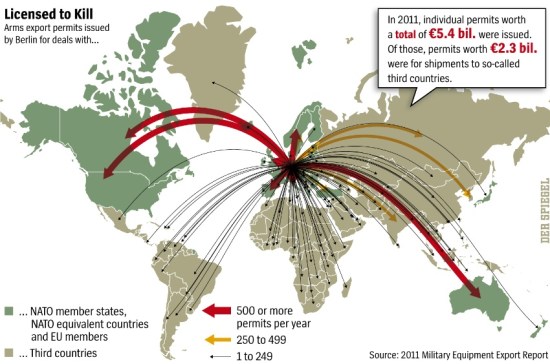
That Germany is the world’s third largest weapons exporter, I mean (preferably to the Middle East these days, by the way). So what’s the problem here? Germany is simultaneously the world’s number one pacifist nation too, you know.

But to make matters even, uh, better, some here are unabashedly calling this enlightened policy “the Merkel Doctrine” now: It’s better to maintain peace by selling weapons, rather than have to fight for it. They have to be German weapons, of course. But still. You know, help those who help themselves while you’re helping yourself at the same time?

Wait a minute. Hasn’t that always been the doctrine here?

Waffen verkaufen, statt selber zu kämpfen.

Google Now Evil Panic Mongering And Cheap Propaganda Machine Or Something

German lawmakers were clearly shocked upon learning that Google would not be warmly welcoming their proposed legislation to let publishers charge search engines for displaying newspaper articles.

The search engine giant has reacted instead by initiating a campaign to mobilise public opinion against the proposed bill and calling for the public to “defend your web,” a company spokesman noting: “An ancillary copyright means less information for consumers and higher costs for companies.”

German Justice Minister Sabine Leutheusser-Schnarrenberger said that she for one was astonished that Google was trying to monopolise opinion-making. “Why, that’s our job,” she might have said.

“The campaign initiated by Google is cheap propaganda.”

———-

Warum das Leistungsschutzrecht keine gute Idee ist:

Generell sehen die Forscher die Gefahr, dass auf deutsche Presseprodukte gar nicht mehr verlinkt werde, „jedenfalls nicht unter Verwendung von Snippets, die für effiziente Internetrecherchen jedoch elementar sind“. Sie warnen in ihrem Schreiben, das namhafte Urheberrechts- und Medienrechtsexperten unterstützen, vor negativen Folgen für die deutsche Volkswirtschaft. Ihre Schlussfolgerung: „Gesamthaft betrachtet scheint der Regierungsentwurf nicht durchdacht. Er lässt sich auch durch kein sachliches Argument rechtfertigen.“

The N-Word

You know, it starts with an n and ends with an r*? Do not even think about using it over here in Germany these days, people. Not that you would even want to or anything, even if you could. I’m just sayin’.

Why is this the case? I’ll tell you why. Because everybody’s all touchy these days. German power grids are less stable than they ought to be and nobody wants to address the reason why that is. Folks have gotten all sensitive and defensive because, well, because of that “power networks more unstable since n-word drop-out” thing.  And no, I didn’t think up that subtitle. I’m just quoting it, sort of. Civilized folks don’t use the n-word. And I ain’t a-gonna use it either.

Kritisch werden könnte es nach Auffassung von Fachleuten generell vor allem in Süddeutschland, wo der Strom der abgeschalteten Atomkraftwerke fehlt.

* “Nuclear”

National Weapons Registry Planned For Nation In Which Practically Nobody Owns A Weapon

Except criminals, of course (but they won’t have to get theirs registered).

Germany is introducing a national firearms registry that will be operational next year, implementing a European Union directive two years ahead of its due date.

The register will pool nearly 550 local-level databases of gun owners, the Interior Ministry said in an e-mailed statement today. The EU weapons directive requires every member state to put in place a national registry by December 31, 2014.

…In a second step, the registry will also track producers, traders and importers of legally bought weapons in Germany.

“The national weapons registry contributes significantly to the security in Germany.”

German Blue Cards Going Like Hotcakes

A mass influx of skilled foreign laborers with “blue cards” to Germany is causing unexpected bureaucratic headaches and unsettling the already unsettled German xenophobic population at large.

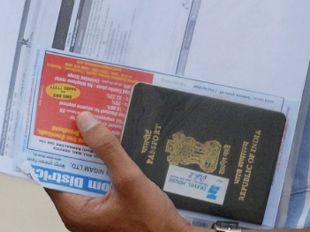
So far, a grand total of 139 (that’s 1-3-9) foreign professionals have received the coveted card, camparable to the US-Amerikan “green card,” since its introduction in August.

“Wow. We had no idea just how bad people wanted to come here,” said one suprised immigration official. “This was way too easy. But how are we going to find jobs for all these folks now?”

Skilled employees from outside the European Union have apparantly been lining up everywhere and eating their achy breaky yearning little hearts out in earnest for this envied piece of blue plastic for quite some time now, partly due, it seems, to Germany’s celebrated image of being an overly bureaucratic and unwelcoming place for foreigners of all non-German kinds.

“German immigration law is still complicated and not very transparent for foreign skilled employees.”