Angela Merkel Won The Election?

Sure, she won. But just what did she win?
Jamaica

She won a much more streamlined CDU, for instance. That’s her party. Although still the biggest fraction in the Bundestag, they are a whole lot smaller now and will therefore be much easier for her to manage.

She won a junior partner that now has foam all over its mouth, the CSU in Bavaria. They lost even more votes than her party did. The CSU folks are so furious about this that they are preparing to fire their boss, Horst Seehofer, someone who she never got along with so that’s cool, but they have had it SO up to here with her Kuschelpolitik (cuddle policies) that they are also about to make some big demands she could still dodge in the past but will now have to agree to if she wants to stay in power (a ceiling for the number of refugees allowed to enter the country, for example).

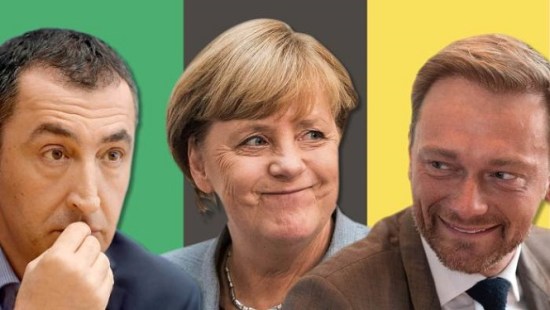
She won a once in a lifetime opportunity to form a three-way government with two parties having completely different world views – the Greens (green counter-culture romanticism) and the FDP (free market liberalism). She has to make it work with them because that’s the only realistic option she’s got so they have her more over the barrel than the CSU does.

She also won a brand new political party in Germany, the AfD, her very own creation, which now sits fat and sassy as the third biggest fraction in the Bundestag, still completely radioactive but thoroughly able to slow everything down and make things ugly as the second biggest opposition party after the SPD – a former partner of hers she just helped murder on Sunday.

Wow. No wonder she looks so happy.

I’m telling you, either that woman has entered a completely different realm of human consciousness or they keep her pumped up with some REALLY good stuff the rest of us will never, ever be able to get our hands on.

Angela Merkel started her election campaign hoping for a wealth of options for forming a coalition government — from a repeat of the grand coalition with the Social Democrats to alliances with either the centrist Free Democrats (FDP) or the Green party. After Sunday night, the chancellor’s dance card contains just one name: Jamaica.

 

Can We Keep Schönefeld Open, Too?

Tegel was only voted 8th worst airport in the world recently, after all. Schönefeld was numero uno. But now another vote is in.

Tegel

Berliners voted to keep the historic Tegel airport open even after a new international hub is completed, creating a headache for the German capital’s government, which wanted it closed.

Tegel sprang up in just 90 days in 1948 to support the Berlin Airlift, a huge operation to ship supplies and thwart a Cold War Soviet blockade. It is much-loved by many Berliners and business travellers for its proximity to the city center.

Berlin’s government will now have to rethink its plans to close Tegel after some 56 percent of voters supported the non-binding referendum on Sunday, the same day as Germany’s federal election, to reconsider the proposal.

“The result has created a very, difficult situation that could be legally and financially challenging.” Another chance for the Berlin Senat to excel, I say.

Rocket Science This Ain’t

Wow, I’m so thankful that somebody finally cleared this up for all of us.

AfD

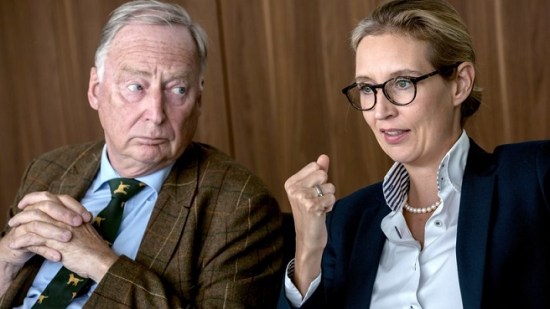
German far-right leader says Merkel’s refugee policy enabled his party’s rise.

Well I guess we’ll know more about this development later on today.

Washington Post: You were for decades a member of [Angela Merkel’s Christian Democratic Union]. As far as you’re concerned, did you leave the CDU or did the CDU leave you?

Alexander Gauland: Angela Merkel changed the CDU from a party that had convictions to a party that’s an empty balloon. There’s nothing in it any longer. A lot of decisions of Angela Merkel — transitioning to renewable energy, refugees, changing of the military from conscription to volunteer — ran opposite to what we called in former times “the soul of the CDU.”

Washington Post: Do you find that Germany is more divided now than it has been in previous years?

Alexander Gauland: Yes. It is more divided now. Because in the beginning of the refugee crisis, all media and all politicians were for refugees. The people who didn’t like this very much didn’t find their opinion in the media. And they couldn’t discuss their fear about what was going on in Germany. And that did divide the German society into the people who want to help [refugees] and the other ones who said we have enough problems in this country.

Das Ende der Bundesrepublik

“The Slow Death Of Europe’s Social Democrats?”

How ya figure? They’ve been dead for years already, Spiegel Online. Don’t any of you over there ever read the papers?

SPD

I would even ALMOST venture to say that it’s ALMOST time for a social democratic walking dead rennaisance. But the key word here is ALMOST. It won’t be anytime soon. They’re going to get annihilated in this election on Sunday. Again.

In 2000, social democrats or socialists were part of the government in 10 out of the 15 countries that made up the European Union at the time. These days, though, the picture is a drastically different one. There is a real chance that German Social Democrats will no longer be part of Chancellor Angela Merkel’s coalition following Sunday’s vote and the same could happen in Italy after voters there go to the polls next spring. Were that to happen, center-left parties would only be part of six EU governments out of 28 member states, all of them on the European periphery: Malta, Portugal, Romania, Sweden, Slovakia and the Czech Republic.


If I Had A Vision I’d Go See My Doctor

Die Mitte (the middle) is where it’s at, folks. Well it’s certainly where I’m at. And you can’t have visions from here in the middle. I mean, I may not always know what I stand for but I always know where I’m standing..

Mitte

And that’s what Germans want, the middle. The middle of the middle, even. The middler the better. No meddling with the middle. We’re right in the middle of an election campaign, after all. Did you know that Mittelmaß (literally “the middle measure”) means mediocrity in German?

Sure, there was a little Abweichung (deviation) from the middle with that batshit crazy refugee number of mine. Quite a big deviation, actually. But I apologized. Sort of. And now I’m back home, smack dab in the middle of where you want me to be. Just call me. Mutti. Mutti in the middle.

See you on Sunday!

Perhaps the closest she came to setting out a vision was a year ago, as she presented this year’s budget in parliament. Germany, she said, has seen a lot of change since World War II, and “change isn’t a bad thing.” But she also vowed to defend the status quo in the broadest sense of the term: “Germany will remain Germany, with all that we love and hold dear about it.”

“Whoever has visions should go see a doctor.”
– Helmut Schmidt

399,000 Euros

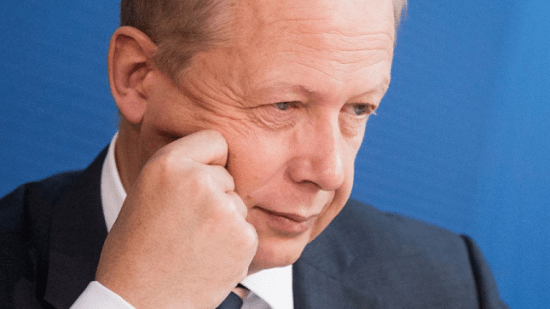
That’s what one regional director among the “public-sector broadcasters” (state TV) earns here annually – that guy down there. There a dozen or two of these directors out there, by the way.

Intendant

Why that’s more than the President of the United States makes (not that our current President particularly cares about what he gets paid).

Is TV that good here in Germany, you ask? Why yes, it is. Just ask that regional director. It is in fact so good that all Germans are permitted to finance it with a so-called Abgabe, or contribution. Contribution sounds better than tax. Contribution contributes more to the warm and fuzzy feeling everybody has here about state-run TV. And it also contributes to that guy’s ridiculous salary, too. But quality has its price. And as viewers are told time and time and time again, what they are watching is Quality pur (pure).

Wenn man immer geringere Bezahlung fordere, könnten sich am Ende nur noch Milliardäre leisten, eine öffentlich-rechtliche Anstalt zu leiten.


Speaking Of German Efficiency…

Sure, border control authorities losing 48 of the 51 illegal migrants (undocumented migrants?) they placed in their detention facilty is certainly a tough act to follow but I live in a place called BLN (that’s how some folks refer to Berlin here) so let’s give it a try.

Polizei

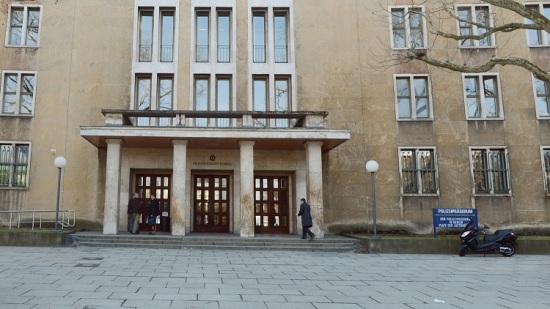
In Berlin they like to take things a level higher, you see. Take the police, for instance. Please. Berlin has the only big city police department where the robbers break in and nobody seems to care. Thieves broke in to Berlin’s police headquarters near the Airlift Memorial in Tempelhof on Monday night and stole some militaria. The cops tried to keep a lid on it, of course, but the Lügenpresse got their hands on the story someehow.

I don’t care much about this robbery, either, I must say. House break-ins have risen dramatically in Germany these past years but the police have increased their solve rate to around two percent of the cases. So, like, what on earth is there to worry about?

Getting back to German Efficiency; the thieves are the really efficent ones here. But that’s only because they are rarely German.

“Wenn jemand hier einen Anschlag plant, rennt er durch, und keiner der dort Angestellten wäre fähig, es zu verhindern.”

The Case Of The Missing Migrants

It’s not all that mysterious, really. And certainly nothing new.

Migrants

After finding 51 migrants in a Turkish truck at the Polish border on Saturday, 48 of those 51 detained have now disappeared without a trace from the initial reception facility they had been placed in. That’s German efficiency for you, I guess. No wonder this migrant smuggling business is booming here these days. It’s a piece of cake.

Authorities said that the migrants were traveling from Iraq, adding that none of them had passports or other papers.

In einem türkischen Lkw brachten Schleuser 50 Flüchtlinge nach Brandenburg. Jetzt sind 48 von ihnen aus einer Erstaufnahme-Einrichtung verschwunden.


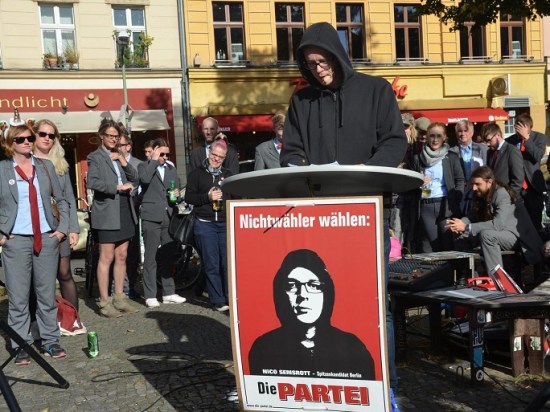
German Of The Day: Nichtwähler

That means non-voters.

Non-voter

And who do German non-voters vote for? Die Partei, of course.

Twelve straight years of Angela Merkel have left politics feeling a little dry for young people in Germany. But now a satirical party is experiencing a surge in popularity after it was set up as a joke at the expense of the old system…

In the last few months the party has seen its membership swell to reach more than 25,000, just shy of the 26,000 members of the rising and much-publicised extreme-right party Alternative fur Deutschland (AfD), which is expected to enter parliament for the first time this year.

Nichtwähler wählen: Die Partei.

First, Split Your Vote

Then overhang it on a balance seat. That’s how Germans vote, folks. And they smirk at our electoral college? Of course we do, too when we lose. But still. No wonder they can’t vote Merkel out of office. Es ist einfach kompliziert. It’s simply complicated.

Voting

How are seats calculated in the Bundestag?

The system starts to get complicated when Germans split their votes, meaning they vote for a candidate from one party in the first vote and for a different political party in their second vote. That can throw off the balance of seats in parliament so that one party is more strongly represented than they should be based on the results of the proportionate second votes.

So Germans created “overhang” and “balance seats.” Those are extra seats in the Bundestag that ensure every candidate who was directly elected gets a seat while political parties are still proportionally represented based on the number of votes they received. A German state’s population is taken into consideration when votes are converted into seats.

After Germany’s 2013 parliamentary elections, there were 631 seats in the Bundestag, including 33 overhang and balance seats.