This Guy Doesn’t Have A Chance

Of replacing Angela Merkel as the chairman of the conservative CDU, I mean.

Merz

1) Because Merkel doesn’t like him and forced him out of politics ten years ago, 2) he’s pro-business (and that’s a bad thing to be in German politics) and 3) he represents the conservative wing of a conservative party that stopped being conservative long ago. What’s the difference between the CDU and the SPD – or the Greens, for that matter?

I sure do wish this guy a lot of luck, though.

A former rival of Chancellor Angela Merkel who seeks to replace her at the helm of Germany’s conservative party said Wednesday he would aim to renew the party and establish close ties with Western democracies but wouldn’t push for a radical overturn of current policies.

Friedrich Merz, a corporate lawyer and former parliamentary floor leader of Ms. Merkel’s conservatives, said he could get along with the chancellor despite previous clashes that led to his gradual exit from politics nearly 10 years ago. A good working relationship with the chancellor would be crucial to ensure party backing for the ruling coalition’s political agenda.

“We need an awakening and renewal but not an overturn.”

To Rival Silicon Valley?

Good luck with that. Honest. It’s great that big industry finally wants to pump some money into Berlin again but keep your pants on already, Siemens.

Siemensstadt

The German engineering giant has unveiled plans to build a huge innovation campus in Berlin, harking back to its early days in the German capital and aiming to rival Silicon Valley in the United States.

Investment in a new campus to be called Siemensstadt 2.0 (Siemens City 2.0) will come in at €600 million ($680 million) on offices and residential accommodation, as well as laboratories and production plants, according to an agreement signed by Berlin Mayor Michael Müller and Siemens executive member Cedrik Neike on Wednesday.

The plan is to transform the historic Siemens site in Berlin-Spandau into a location for research and startup centers by 2030.

Der Weltkonzern baut in Berlin für 600 Millionen Euro seinen Zukunfts-Campus. Mit 2000 Wohnungen, Forschungslabors, Geschäften, Schulen und eigenem S-Bahn-Anschluss

How Tasteless

How could British newspapers report such things? In this way, I mean. As if they really happened. Which, of course, they did. But still.

Rape

If a German newspaper printed this it would be… Well, it wouldn’t be a German newspaper

Five Afghan asylum seekers are arrested for allegedly raping a girl, 15, in Germany – as country is rocked by sex attack on student, 18, ‘by Syrian migrants’

If it’s not in the German news, it didn’t happen.

German Of The Day: Vorsitz

That means chair (of a company). Or chairman. Or chairwoman in this case.

Vorsitz

And chairwoman of the CDU is what Angela Merkel now no longer wants to be.

Chancellor Angela Merkel of Germany on Monday took her first concrete steps to move away from political life, saying she would give up leadership of her conservative party while vowing to finish out her term as chancellor until 2021.

Ms. Merkel made her announcement, in a meeting of conservative leaders, after two disastrous results in regional elections that saw her party and its allies slump to near-record lows.

“Zeit, ein neues Kapitel aufzuschlagen.”

Berlin Is The Place

The place where you don’t want thriving companies offering gainful employment and increasing property value in your neighborhood.

Gentrification

I get it. It’s about gentrification again. But the problem here isn’t the evil capitalist rich swooping in to speculate and force the poor out of their neighborhoods. The problem is a classic case of “I’m from the government and I’m here to help.” The German government in general and the Berlin government in particular have been “helping” German renters for decades in ways that have discouraged Germans from owning property of their own (the vast majority of Berliners pay rent). Then when reality finally strikes (supply and demand = rising rents) the same politicians can’t help these renters anymore and leave them high and dry with rents they can no longer afford to pay. Ain’t nothing new.

Kreuzberg has long been one of the most affordable areas of Berlin, making it a haven for students, immigrants, artists and activists, a hub of culture, night life and left-wing politics. But in a pattern repeated in similar neighborhoods in many of the world’s wealthiest cities, affluent people have moved in, too, in recent years, bringing with them the social tensions of gentrification.

“They push out the people who were here before.”

Godot Has Just Left The Building

A snap election in Hesse this weekend? Yeah, maybe. But didn’t we just have one in Bavaria?

Godot

The real German problem is more subtle… She is broken, Señor. Germany, I mean. And ain’t nobody gonna fix her until she gets, like, really broken.

Waiting for Germany today is like waiting for Godot. Nothing will get fixed: neither the eurozone, nor climate, nor migration. Comfy but angst-ridden, Germans will keep having fake domestic crises, while the rest of Europe tries to keep a lid on real ones. Eventually, those real ones will erupt. And then a continent could accidentally get lost. At that point, Germans will finally get a proper crisis. Maybe it’s just as well that they kept rehearsing now.

Vor dem Knall – In Hessen findet am Sonntag nicht irgendeine Landtagswahl statt. Es wird ein politisches Erdbeben geben, die Auswirkungen wird vor allem Berlin spüren. Die Frage ist nur noch, ob es zuerst die SPD oder die CDU erreicht. Die Große Koalition steht vor dem Ende, das Land vor einer Zeitenwende

They Still Don’t Feel Anything

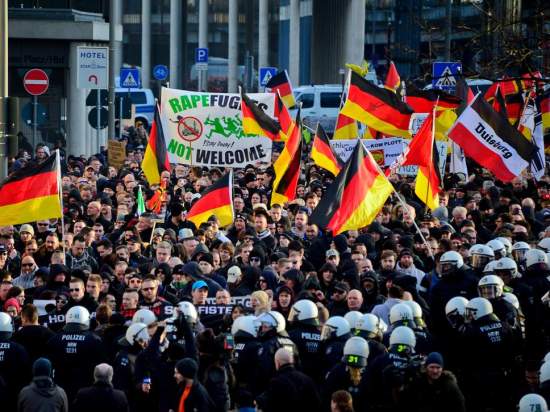
They’re still numb. And if they’re honest, they’ll admit it. Germany’s Willkommenskultur has always been a myth.

Feel

We asked Germans what they really felt after Angela Merkel opened the borders to refugees in 2015.

German chancellor Angela Merkel’s decision in 2015 to keep her country’s borders open and give shelter to hundreds of thousands of refugees was praised by commentators and leaders around the world. Her decision was also approved of by thousands of German citizens who welcomed refugees and provided clothes, food, and other support.

The term welcome culture, or Willkommenskultur, was frequently used in political debates and the media to describe the events of autumn 2015.

But a year later, the picture had changed dramatically. By the end of 2016, the public debate had shifted to focus on the so-called refugee crisis, or Flüchtlingskrise, alongside the religion of refugees and migrants, and limits to Germany’s capacity to integrate them. The change of perspective was reflected in discussions about upper limits – Obergrenzen — of the numbers of refugees that should be allowed to enter the country.

Our recently published research suggests that welcome culture has never been as widely embedded in German society as public debates in 2015 would make us believe.

Despair Is In The Air

But there ain’t nothing new about it.

Despair

Germany’s New Politics of Cultural Despair – The Authoritarian Revolt: The New Right and the Decline of the West (a book by Volker Weiss).

Nothing against new takes about how the West is in decline (again? still?) but the West has been in decline for as long as anyone alive can remember, not to mention for as long as a whole bunch of folks who are no longer with us could.

Take Oswald Spengler and his The Decline of the West, for instance – from 1922! Nothing against declination, folks, but how much longer is this decline of the West going to last? As a wise man once said: What has been will be again, what has been done will be done again; there is nothing new under the sun.

In modern times, fears of social change and spiritual impoverishment can always tempt the malcontented to imagine that the present is an interregnum destined to yield to a new age of faith and wholeness.

The Two-Party Is Over?

And it couldn’t have happened to a nicer bunch of folks. Or Volk, if you prefer.

SPD

The German Social Democrats’ (SPD) existential crisis can no longer be treated as a typical party crisis. The party captured a mere 9.7% of the vote in regional elections in Bavaria this month, and it is trailing both the populist Alternative für Deutschland (AfD) and the Greens in national opinion polls. With another important regional election fast approaching in Hesse, polls indicate that the SPD will lose still more support, albeit not as dramatically as in Bavaria…

Most likely, the fall of the CDU/CSU-SPD duopoly will undermine German hegemony in Europe, even if no other country can replace Germany in that role. At the same time, the weakening of the SPD will diminish the socialist faction in the European Parliament, where a similar eclipse of two-party rule could be in the offing. Yet without the twin pillars of the European People’s Party and the Party of European Socialists, the parliament will be incapable of making even insignificant decisions. As Germany and the SPD go, so goes Europe.

Germans Have Chutzpah, Too

Jew got to hand it to this guy.

Jew

A 71-year-old chairman of the small Jewish community in the city of Pinneberg in the German state of Schleswig-Holstein faces an accusation from the magazine Der Spiegel that he is not Jewish, deceiving Jewish members since 2003.

When confronted with this fact, the man went ballistic.

“Walter, come off it. You’re not even fucking Jewish.”

“What the fuck are you talking about?”

“You’re fucking Polish Catholic.”

“What the fuck are you talking about? I converted when I married Cynthia!”

“Yeah, and you were divorced five fucking years ago.”

“Yeah? What do you think happens when you get divorced? You turn in your library card? Get a new driver’s license? Stop being Jewish?”

“It’s just part of your whole sick Cynthia thing. Taking care of her fucking dog. Going to her fucking synagogue. You’re living in the fucking past.”

“Three thousand years of beautiful tradition, from Moses to Sandy Koufax, YOU’RE GODDAMN RIGHT I’M LIVING IN THE PAST!”

Der gefühlte Jude.