German Of The Day: Abschiebung

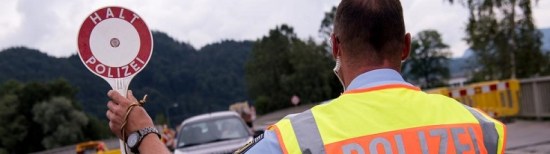
That means deportation. And those who have no business being here in Germany must understand that the Germans might actually deport them. One day. Eventually.
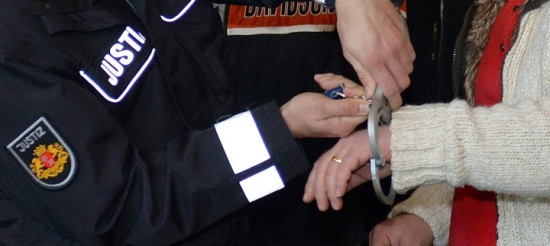
Smugglers

Of course those who do get deported only come right back to Germany again with the help of Schlepper (human trafficking smugglers). But still.

Take this head of a Lebanese criminal family clan, for instance. Please. German authorities finally got tough with him and deported him to Lebanon but he just turned around and came right back with the help of today’s highly efficient, extremely lucrative and internationally active human trafficking industry (thanks be to you, Angela Merkel & Co.). He made a mistake filling out his asylum seeker form in Bremen though and the cops were able to bust him again. I think for behavior like that they really ought to come down hard on this guy and deport him.

Demnach habe Miri sich „mit Hilfe von Helfern“ einen Pass verschafft und sei zunächst „heimlich über Syrien in die Türkei“, dann „mit Hilfe von Schleppern auf dem Landweg in die Bundesrepublik Deutschland“ eingereist.

German Of The Day: Grottenschlecht

That means abysmal, godawful, extremely bad, mega-bad and really sucky.

Merz

And after the CDU’s latest election disaster in Thuringia, Angela Merkel/Mini-Merkel adversary Friedrich Merz has grown the cojones (that’s Spanish so you’ll have to look that up somewhere else) needed to call Angela Merkel and her team’s “leadership” skills just that. Which, of course, they are. Somebody has to. Not that it’s going to make a difference or anything. But somebody has to.

German, European stability prospects unclear after Thuringia election – The far-right Alternative for Germany (AfD) led by Björn Höcke — whose local political faction is being investigated for extremism — doubled its vote share to place second with 23%. The CDU placed third with 22%, followed by the SPD with 8%. The environmentalist Greens and the liberal Free Democrats (FDP) both finished with about 5% of the vote, the minimum needed to reenter the regional parliament.

„Das gesamte Erscheinungsbild der deutschen Bundesregierung ist einfach grottenschlecht.”

German Of The Day: Geschwindigkeitsbegrenzung

That’s a beauty, isn’t it? Some prefer using the word Tempolimit instead. To save time. Both mean “speed limit,” however. And no, it can’t happen here.

Speed

A measure to introduce a 130 km/h (roughly 81 mph) speed limit on the network of motorways that has crisscrossed the country since the ‘30s was introduced by the German Green Party was rejected on Thursday by a majority of Bundestag members. Germany is currently the only country in Europe with stretches of unrestricted motorways, with neighboring countries conforming at the very least to the 130 km/h limit similar to the one proposed.

Bundestag lehnt Tempolimit auf Autobahnen ab.

German Of The Day: Schleierfahndung

That means targeted or dragnet searches.

You know. Like the kind you do on your nation’s borders that aren’t actually borders anymore because you belong to something called Europe now (apparently you didn’t belong to Europe in the past) and doing so would send an “anti-European signal” so you don’t really want to but you’re going to anyway? Yeah, those kind.

Germany is to carry out more random border checks to discourage migrants from moving illegally around the European Union (EU).

The move will see more police officers sent to border zones in an attempt to crack down on “secondary migration” — the illegal movement of non-EU migrants between EU member states — according to a Sunday tweet from the Interior Ministry.

“Anti-europäisches Signal.”

German Of The Day: Kater

That means tomcat. But it also means hangover.

Kater

And here you thought that the courts of the country you live in made wacky court decisions (and they do).

A German court has ruled that hangovers are an “illness”, in a timely judgement days after the annual Oktoberfest beer festival began in Munich.

The case landed before judges in Frankfurt when plaintiffs claimed a firm offering anti-hangover “shots” and drink powders to mix with water was making illegal health claims.

“Information about a food product cannot ascribe any properties for preventing, treating or healing a human illness or give the impression of such a property,” the sober ruling from the superior regional court on Monday said.

Ein Alkoholkater ist eine Krankheit. Hersteller von Nahrungsergänzungsmitteln dürfen daher nicht damit werben, dass ihr Produkt gegen den Kater hilft oder ihm vorbeugt, wie das Oberlandesgericht (OLG) Frankfurt am Main in einem am Montag veröffentlichten Urteil entschied.

German Of The Day: Abzocke

That means rip-off.

Abzocke

You know, like the way the German government uses any opportunity it can to rip-off taxpayers (nobody pays more taxes than Germans do)? The latest Abzocke planned is to double the air travel tax in order to fight climate change. And it will definitely not be the last Abzocke to use fighting climate change as an excuse. It’s a brilliant Masche (scam). I mean, when hasn’t the climate changed? They can keep on introducing rip-off tax tricks forever.

Germany’s ruling conservatives have proposed doubling taxes on domestic flights, as part of a wider package to cut CO2 emissions.

The decision was taken by the leadership of the Christian Democrats (CDU), who form a coalition with the Christian Social Union (CSU) and the Social Democrats (SPD).

“We will invest, together with the aviation industry, to make electric-powered flight standard for short-haul flights and to create synthetic fuel to achieve climate-neutrality on medium- and long-haul flights,”

German Of The Day: Diktieren

That means to dictate. You know, like dictators do?

Herbert

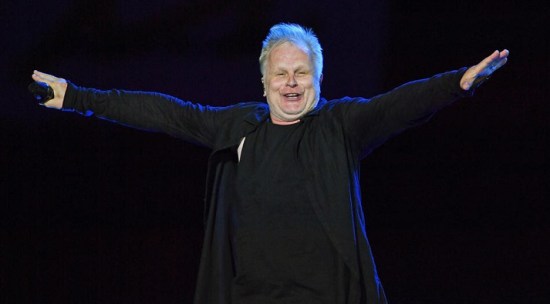
When Gutmenschen (do-gooders) go bad. Like all left-leaning artists everywhere, German singer Herbert Grönemeyer routinely goes out of his way to demonstrate how he is on the right side of history by being on the left side of history. But unlike many of his anti-right-wing friends, he actually comes right out and admits on stage that if the populace doesn’t think the right way (namely left) then “it’s up to us to dictate what society must look like.” Sounds vaguely familiar, doesn’t it? Think Germany 1933.

Grönemeyer: „dann liegt es an uns, zu diktieren, wie ‘ne Gesellschaft auszusehen hat.”

German Of The Day: Strafzins

That means “punitive interest rate” and refers to a rates below zero.

Strafzins

It’s an accurate word invention. The ECB has cut rates again and those who save are punished.

The German term “Strafzins”, or “punishment rate” is widely used in the country’s media to refer to interest rates below zero. And a day after the ECB cut rates for the first time since the spring of 2016, it is back in the news.

This is despite the fact there is an alternative German word for negative rates: negativzins (as Michael Steen, formerly of the FT and ECB global media chief, pointed out on Twitter).

Admittedly negativ also has . . . negative connotations. But the use of “straf”, or “punitive”, reflects a widespread perception across Germany that the ECB is penalising savers through its monetary policy.

“They want to pump us up with the credit drug.”

German Of The Day: Respektlosigkeit

That means disrespect. I don’t know what it means in Chinese, though. Failing to kowtow?

Wong

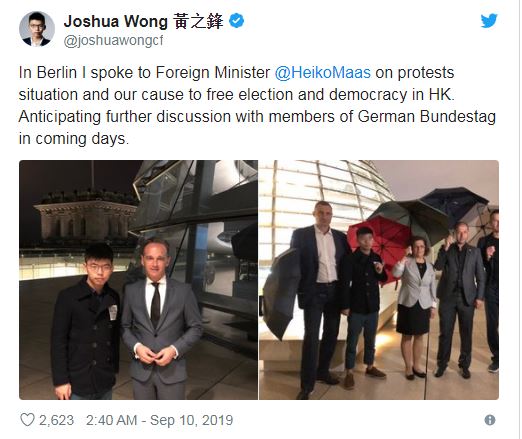
German foreign minister meeting with Joshua Wong ‘disrespectful’: China – Beijing has slammed democracy activist Joshua Wong’s meeting with Germany’s foreign minister as “disrespectful.” Wong has urged countries to stand by Hong Kong protesters against the long arm of China in the city.

Don’t worry, China. Angela Merkel is already cowering in a back office of the chancellery somewhere and has already made it clear that she won’t meet with him. She knows it would be Wong for her to do that.

“It is extremely wrong for German media and politicians to attempt to tap into the anti-China separatist wave.”

Isn’t That Special

Germany Isn’t Special – To pull its weight, it needs to start seeing itself as a normal country, subject to the same pressures as all its neighbors.

Germany

Polls before this weekend’s elections in states in the former East Germany show the right-wing Alternative for Germany (AfD) comfortably capturing 20 percent or more of the vote. This is just one of the ways in which the country at the center of Europe is confronting a new state of affairs.

Ever since reunification, Germany has built its liberal democracy on a few key pillars—a disavowal of the extreme right, a focus on economic performance, and a steadfast relationship to the United States—to avoid a return to the conflagrations of the past. By following these guidelines, the country has won itself respect around the globe. But it has also persisted in treating itself as a special case, not subject to the pressures affecting its Western peers. That, in turn, has led to resentment among its partners. It is time for Germany to buck its postwar policy traditions and begin to see itself for what it is: a normal power.

A German friend of mine summed it up more succinctly: Die Deutschen wollen immer eine Extrawurst haben. The Germans always want “an extra sausage” = special treatment. Are those days finally over? In the real world, I mean? Stay tuned.