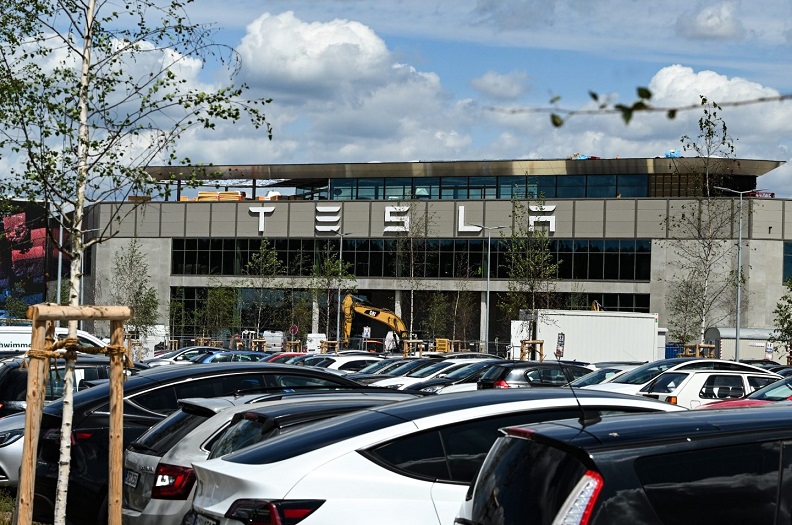
Tesla is lapping German automakers in the global EV race – even in Germany.
Germany’s automakers announced bold plans the last several years to shift to electric cars and challenge Tesla Inc.’s dominance. Instead, they’re only falling further behind.
Tesla delivered 889,015 cars in the first half of this year, more electric vehicles than Volkswagen AG, BMW AG, Mercedes-Benz Group AG and Porsche AG sold combined.
How on Earth did this get through the German Media Brain Police Censorship Office?
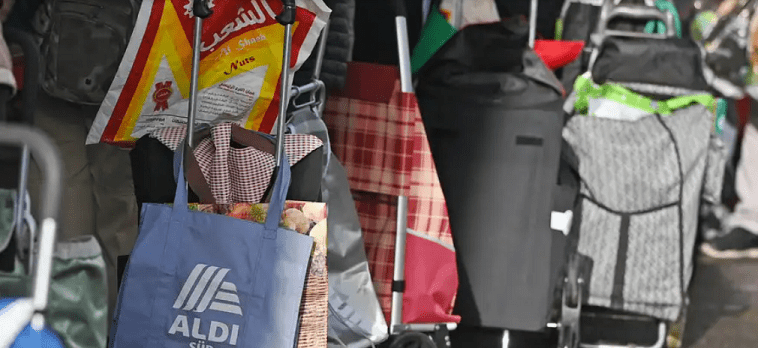
German food banks in crisis – Inflation and an influx of refugees have put growing pressure on food banks. Will the German state step into the breach?
But why do food banks exist in a country like Germany in the first place? Can the German state step in to explain that?
German food banks are there to help people living in poverty, namely those who have less than 60% of the median net income at their disposal. In Germany, going by this definition, around 13 million people are considered to live below the poverty line.
But to be willing to actually use them ourselves? Nein, danke!
German Defense Companies Could Be Europe’s Arsenal of Democracy – But for the Bundeswehr to fight will take a culture shift, not just weapons orders.
More than a decade ago, the German government made the deliberate decision to kill the ability of the Bundeswehr, Germany’s military, to fight a conventional land war in Europe and strip it of the equipment, manpower, and resources to do so. In 1990, as the Cold War was ending, the then-West German Bundeswehr alone was still able to field 215 combat battalions in a high state of readiness. Today, Germany has around 34 battalions, and the word “combat” is a bit of a misnomer. They are at such a low state of military readiness that when the 10th Tank Division conducted an exercise late last year, its entire deployed fleet of 18 Puma infantry fighting vehicles broke down…
It’s more like a Vollbremsung. That’s German for full braking or emergency stop.
Germany’s highest court just cancelled the Green’s latest rush-rush trick, I mean plan to save the planet at German taxpayers’ expense.
Germany’s Green Slowdown – While voters may still broadly support net zero goals, they’re not necessarily on board with the escalating costs of the transition.
… Today, it’s the Greens’ proposed ban on new gas boilers in homes that’s causing trouble. Against a backdrop of sliding poll ratings, the party’s partners in the coalition forced a dilution of the plan last month in a package that also included a massive road-building program.
In another blow to the policy — dubbed Habeck’s Heating Hammer by the opposition — Germany’s constitutional court has made a highly unusual intervention in the legislative process and ordered the government to give parliament more time to scrutinize the plan.
What could possibly go wrong this time? China being Germany’s biggest trade partner, I mean.
German industry urges reduced dependency after China export controls – German industry on Tuesday warned that Europe must become more self-reliant in the hunt for raw materials needed for cleaner, more digital economies, after China caused alarm by announcing restrictions on some metals used for semiconductors.
China’s commerce ministry said on Monday it would require export permits for eight gallium products and six germanium products from Aug. 1 to protect national security.
German inflation surges more than expected to 6.8% – Spain becomes first major eurozone economy to beat ECB’s 2% target in almost 2 years.
German inflation was higher than forecast this month, even as Spain became the first major eurozone economy to beat the European Central Bank’s 2 per cent target in almost two years.
The divergence between Germany’s 6.8 per cent rate for June and the 1.6 per cent recorded by Spain highlights the dilemma faced by the ECB, which is focused on core inflation, which excludes volatile energy and food prices.
You know. As in the Sick Man of Europe? The Incredible Shrinking (or was it Sinking) Country?
German Economy Shrinks Faster Than Expected – It’s a rare thing to happen, but Germany now looks like the sick man of Europe, a phrase previously often used to describe Britain.
The health of the business sector dropped significantly in June, according to recent data. The Ifo Business Climate index for Germany, which measures the health of the commercial sector, registered 88.5 in June, down from 91.5 in May. Higher numbers show economic strength, whereas lower ones show a weakening of the economy.
German house prices fall by record 6.8% as higher mortgage costs deter buyers – First-quarter drop in Europe’s largest property market is biggest since index began in 2000.
German energy prices are so high they’re driving companies to relocate, industry body says…
In May, the German government revealed plans to set aside around 4 billion euros ($4.4 billion) each year to subsidize electricity prices for energy-intensive industries, in an attempt to shield businesses from high electricity prices.
“A lot of family-owned companies … have very operational plans to relocate.”
German tabloid Bild to replace range of editorial jobs with AI – Hundreds of redundancies expected as Axel Springer tells staff certain roles will ‘no longer exist as they do today.’
Germany’s Bild tabloid, the biggest-selling newspaper in Europe, is to replace a range of editorial jobs with artificial intelligence as part of a €100m costcutting programme expected to lead to hundreds of redundancies.
The newspaper would “unfortunately be parting ways with colleagues who have tasks that in the digital world are performed by AI and/or automated processes”, its owner, Europe’s largest media publisher, Axel Springer SE, said in an email to staff.