Germans being pathalogically hypersensitive whenever it comes to data protection issues, whether they be actual issues or not, Deutsche Telekom has cleverly exploited these wildly popular fears during this year’s CeBIT technology fair by suggesting to “the 3.6 million prosperous German small and medium sized firms who have not yet taken the leap to storing their data using cloud computing” that their “German cloud” can offer them the safety and security that those leaky and toxic foreign clouds could never offer them – even if those foreign clouds wanted to offer them safety and security in the first place which, of course, they don’t.
Telekom’s cloud – some 30 datacenters spread across Germany – is, well, spread across Germany, so nothing can ever possibly go wrong, one Telekom spokesman tells us. “And we are not playing on peoples’ fears, either” another spokesman added. “It’s just that when servers are situated outside of Germany there is a risk that companies will use your data for commercial purposes or, worse, they will be spied on by the secret services.”
Let’s all sing together: Paranoia strikes deep. Into your life it will creep. It starts when you’re always afraid. You step out of line, the man come and take you away…
This will be “a cloud computer model for the German market and in the German language.” Made for Germans. By Germans. In Germany.
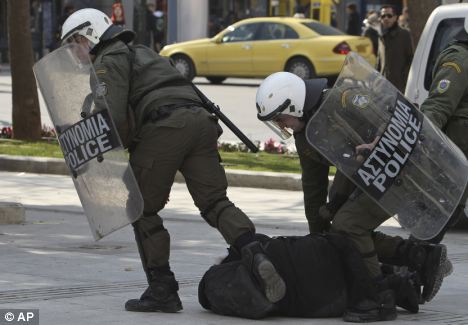
How about a little more sensitivity here, Greece? Germans are only trying to help.
And it doesn’t look like they’re going to stop trying to help you anytime soon, either. That’s why if they can’t get that “budget commissioner” they proposed to help monitor the Greek government’s (lack of) management of its finances, some 160 German tax collectors have now selflessly volunteered for assignments in Greece to help gather Greek taxes more efficiently. And as you can imagine, when it comes to taxation and tax collection, German efficiency can really hurt.
A recent flurry of acrimonious exchanges between Athens and Berlin reflect deepening doubts among mainly northern members of the 17-nation euro zone about Greece’s ability and willingness to overhaul its economy to satisfy lenders’ demands.
This year’s winner of the Golden Bear for best film at the Berlinale was actually a real dog, German film critics and other intellectual thinking folks and artist types everywhere are saying.
It’s not that the Italian film “Caesar Must Die” was bad in a cinematic sense or anything. It just didn’t meet the standards that modern film-makers and their kind aspire to, that’s all.
It was, in other words, too “humanist,” not at all a “strong, political film from young, engaged film-makers” (the film-makers who made this non-political film are old, engaged film-makers) and, worst of all, “it was a very conservative selection.” Pfui (yuck)!
Geez. If they had wanted to watch human, uplifting drama they would have gone to some other film festival. I don’t know which one that would be, of course, but it certainly wouldn’t/shouldn’t be the Berlinale.
“The jury shunned almost all the contemporary films that were admired or hotly debated at an otherwise pretty remarkable festival.”
That’s German for deficient coverage. And German readers might be reading that word a lot in the weeks to come, at least when it comes to the electricity supply in Germany.
„We have been observing for weeks now that something with the system just doesn’t seem to be right,” one market expert said.
And in a letter from Germany’s Federal Network Agency to the power traders it deals with, it makes clear its concern about the rather volitile situation going on at the moment and has even warned of the collapse of the German power network. It almost happened on Febuary 6, already, they wrote, as “substantial undercoverage continuing over several hours” nearly brought the system to its knees.
Hmmm. Last year at this time, during one of the coldest winters ever, there wasn’t any problem with the German electricity supply at all. What on earth could have possibly happened since then and now to have caused this disturbing situation?
Nach dem Reuters vorliegenden Schreiben stand das Stromnetz in den vergangenen Tagen mehrfach vor dem Kollaps.
Five minutes of excitement is better than no excitement at all.
A group of young conservative politicians, concerned about Germany’s catastrophic demographic development (or the lack of it), received less than a warm welcome by their very own Chancellor Angela Merkel herself today: They’re pushing for a tax on the childless, you see.
Although most politicians are normally crazy about raising taxes or introducing new ones, Frau Merkel made it quite clear that the buck (the euro?) stops here. Like practically everybody else in Germany, she doesn’t have any kids, either.
„Ich glaube, die Diskussion der Einteilung in Menschen mit Kindern und ohne Kinder ist hier nicht zielführend.“
Those filthy-mouthed British. “Shitstorm” just won Germany’s Anglicism of the Year award (2011). Wow. I wonder if “Crap Tornado” came in second?
The punchline: “The jury’s decision is meant to emphasize the positive influence of English on the German language.” I don’t make this stuff up, people.
Mit der Wahl will die Jury den positiven Einfluss von englischen Ausdrücken auf die deutsche Sprache hervorheben.
As usual. But at least we get to look at Angelina Jolie for awhile this year.
She and her husband what’s-his-name have been here for days now and refuse to go home, giving the notoriously anti-Hollywood Berlin Film Festival that all important Hollywood touch.
But as for the movies, the only Lichtblick (bright spot) I have heard about so far is a film called Barbara, “a harrowing reminder of what life was like two decades earlier behind the Iron Curtain and Berlin Wall that stood just a few meters to the east of theatres where the Berlinale is based.” You know, it’s a film about how suffocatingly horrible communist East Germany was. But who wants to see that? Here in Berlin of all places, I mean.
“It’s not a film about East Germany, it’s a film about how people survive in a country that was on its way out.” – Hmm. Sounds like a film about Syria.
“An Islamic extremist who admitted killing two U.S. airmen at Frankfurt airport last year has been convicted of murder. The state court in Frankfurt found 22-year-old Arid Uka guilty Friday and sentenced him to life in prison for the March 2 attack on Afghanistan-bound servicemen as they boarded a bus at the airport.”
Well, that simply isn’t true. You may have known that there is no death penalty in Germany, but don’t be tricked by that ridiculous “life in prison” misnomer that Germans like to use all the time (lebenslänglich). Nobody spends life in prison here.
What Germans mean with a life sentence (in Germany) is 15 years. After that the convict gets paroled. Or, as in this terribly severe case, paroled and then “threatened” with possible deportation.
Here’s a little tidbit about the dark side of “Germany’s jobs miracle.”
“BEST LOW WAGE SECTOR IN EUROPE”
Job growth in Germany has been especially strong for low wage and temporary agency employment because of deregulation and the promotion of flexible, low-income, state-subsidised so-called “mini-jobs”.
The number of full-time workers on low wages – sometimes defined as less than two thirds of middle income – rose by 13.5 percent to 4.3 million between 2005 and 2010, three times faster than other employment, according to the Labour Office.
Germany can only hope that other European countries do not emulate its own wage deflationary policies too closely, as demand will dry up: “If everyone is doing same thing, there won’t be anyone left to export to.”
PS: Like I noted on a post the other day, the USA and Germany have more in common than they think. Now the Greeks are burning German flags, too.
I call it Hurt Feelings Burnout Syndrome (HFBS). With an emphasis on the BS. Oh man, I had to laugh out loud while reading the latest on the poor, misunderstood German front.
It appears that many German intellectuals are very concerned about how their European neighbors think of them (Germany) these days. Needless to say, it isn’t very highly at all. And some have come to the stunning conclusion that they are so disliked at the moment because, now get this, they are so big and strong. Imagine that.
Germany is the USA of Europe – only with a different history.
You don’t need to puzzle for very long about the question of why so much Nazi name-calling is going on at the moment: For the first time since 1945, Germany has appeared in full strength again. Not because anybody wanted it, but because the European debt crisis has made the most economically powerful country the most politically powerful one, as well. Germany is now intervening in the internal affairs of others in a big way.
Slowly but surely, the country is taking over a role for Europe that the USA has played for the rest of the world for so long, as being the country that uses (and sometimes misuses) its power, the country that is to blame for everything, the country that is supposed to save everything and is reviled for the way it does it. What has America not been accused of? The CIA has always been behind everything and American imperialism has always been the motivation.
How moving. Or something. And the rest of the story? Now folks are calling Germans Nazis again (as if they had ever stopped). Boo-hoo-hoo already. Come on, Germany. Wake up and smell the coffee. You’re the big kid on the block. Run with it. Enjoy. It comes with the turf.
And in a related story (I find), it turns out that Germans are also now “burning out” like flies (it’s hard to carry on when nobody likes you, I guess). This imaginary disease (yet another American import – are we having irony yet?) is currently running rampant among Germany’s workforce, with nearly 1 out of 10 sick days in Germany in 2010 being attributed to it (tendency rising). Another connection to US-Amerika? Oh my God. No wonder so many Germans are getting sick. Please note: The high-brow daily Frankfurter Allgemeine Zeitung questioned why burnout was being written so much about in Germany, while in France, which is economically a lot worse off, “it’s hardly a preoccupation at all.”
Remember: HFBS is incurable, but there are many effective treatments. One of them is shutting the #!?#! up.
Man braucht wirklich nicht lange an der Frage rumzurätseln, warum die Nazi-Vergleiche im Moment so oft gezogen werden: Zum ersten Mal seit 1945 tritt Deutschland wieder mit voller Macht auf, nicht weil man das gewollt hätte, sondern weil die europäische Schuldenkrise das ökonomisch stärkste auch zum politisch mächtigsten Land gemacht hat. Deutschland greift nun tief ein in die inneren Angelegenheiten Dritter.
Allmählich bekommt das Land für Europa eine ähnliche Funktion, wie sie die USA lange Zeit für die ganze Welt hatten. Als jene Macht, die ihre Kraft gebrauchte, manchmal missbrauchte, die an allem schuld war, die alles retten sollte und sich dafür beschimpfen lassen musste, wie sie es tat. Was wurde den Amerikanern nicht alles Übles angedichtet, immer steckte die CIA hinter allem Bösen, stets wurden die Amerikaner des Imperialismus geziehen.
PS: I hate to admit it, Germany, but I guess we’ve got more in common than we would like to admit (thanks for the idea, Old Phat Stu).