German Of The Day: Lügenpresse

That means the lying press. And, like, welcome to the club already, Germany. It appears that many Germans were not aware of this up until now. I mean, when has the media anywhere ever not been guilty of “embellished and inaccurate reporting?”
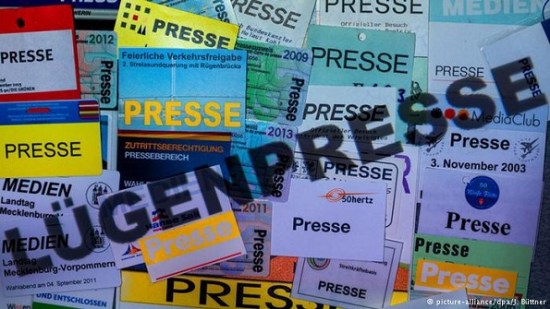
Lügenpresse

In a recent German survey, 44 percent of respondents said they partially, or wholly believe the media regularly lies to the people, as the Pegida movement asserts. Media experts (the people helping with the lying?) examine whether that’s true.

Media outlets in Germany “are controlled from the top,” and therefore spread “embellished and inaccurate reporting.” Nearly half of the 1,000 German citizens recently polled by the Dortmund-based Forsa Institute agreed with these statements.

Currently, the refugee situation dominates media reports. But Germans are simultaneously experiencing the crisis first-hand in their own towns and cities – and often finding dramatic differences between their perceptions of these events and journalists’ representations of them…

For example, Sebnitz: In this village of 8,000 residents in Saxony, where right-wing radicals often make headlines, the son of a German-Iranian couple, both of whom are pharmacists, died accidentally. The immediate headline read: “Neo-Nazis Drown Child.” In truth, the boy drowned after having a heart seizure. A newspaper that reported on the actual facts of the accident nevertheless added: But the way the mood is in Sebnitz, neo-Nazis could well have done it.”

Above all, the issue is often about choice of words: BBC World reported: “Dutch politician Geert Wilders acquitted of hate speech charges in The Hague.” Germany’s national news broadcast, Tagesschau, formulated the same story thus: “The Islamophobe and right-wing populist politician, Geert Wilders…”
You Can Fool All Of The People Some Of The Time

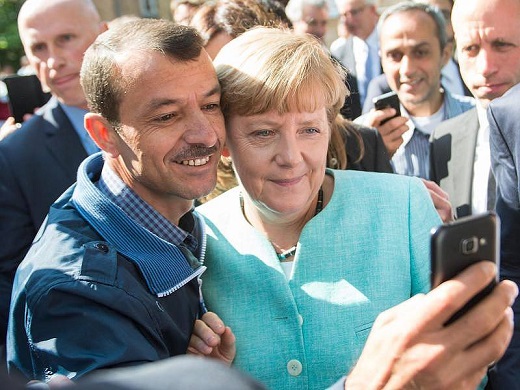
Roughly half of Germans asked are dissatisfied with chancellor Merkel’s refugee policy. This has come out in a survey taken by the INSA Opinion Research Institute in Erfurt. 48 percent disagreed with the statement “For the most part I am satisfied with the chancellor’s handling of the situation.” 41 percent agreed. 11 Percent did not specify.

Merkel

Despite Chancellor Angela Merkel’s warm words and saintly intentions to shoulder the refugee crisis, her efforts are meeting resistance at home. The populace feels overwhelmed and unsupported, not knowing where to accommodate so many people.

„In der Flüchtlingspolitik hat die Bundeskanzlerin die Deutschen mehrheitlich gegen sich. Und zwar aus ganz unterschiedlichen Gründen: Die einen nschen sich noch mehr Offenheit gegenüber den Flüchtlingen, die anderen Orbans Härte.“

I Thought Germany Already Had All Driverless Cars

Just try crossing a busy street here and you’ll see what I mean.

Driverless

But word is that only one in five Germans would be happy to ride in an autonomous car, according to a survey by Germany automobile industry monitoring association KueS.

I guess Germans just can’t stand the idea of losing control. Over the car that’s already out of control, I mean.

If we took the lead in autonomous vehicles, we could over-take the Germans, the Spanish and the French in a huge new industry. We just need to keep our foot on that accelerator – while browsing some play-lists on Spotify and sending a few e-mails of course.

This Is The End

The end of German society as we know it, I mean. The latest survey says it’s all over but the Heulen (crying).

Germans

A shocking 71 per cent of Germans, it turns out, would risk crossing the street even when the pedestrian signal is red.

39 per cent of Germans said they had taken public transport without paying for a ticket.

And 20 per cent of cyclists said they would run a red light.

Asked what most represents Germany to them, 63 per cent of respondents named Volkswagen, ahead of Goethe (49 per cent), Angela Merkel (45 per cent), and the national anthem (44 per cent). Somewhat alarmingly, Adolf Hitler came seventh, named by 25 per cent of those polled.

Alarm In Germany: Esteem Level For Russia Now Sinking Dangerously Close To Esteem Level For US-Amerika

German political scientists everywhere were stunned at the latest unexpected Infratest dimap survey findings in Germany. For some inexplicable reason, 81 percent of Germans asked have lost their trust in Russia and do not believe that the country respects basic democratic rights.

Russia

Unable to explain this unexpected finding, one scientist warns that if this drop in esteem were to continue and surpass the 96 percent mark “we will then have reached the lack of esteem level traditionally reserved for the United States of America, a country we all know to be much more deserving of our lack of esteem although none of us can rationally explain why that is, and this would be a real rotten deal for Russia. And none of us want that.”

Nur 13 Prozent der Deutschen glaubt an das Minsker Abkommen.

Germans Confused Why Everybody In Europe Wants TTIP Except Them

It’s like I say, folks: A real German says no first and asks questions later (that was oddity 255, if you’re interested). And if US-Amerika is involved in the calculation (see TTIP), all bets are off.

TTIP

“The EU has published a survey according to which citizens are downright euphoric about the free trade agreement TTIP. In all, 25 Member States [of the 28] there will pour sheer enthusiasm over the completely secretly negotiated agreement, but for one small exception: Germans are mostly against the TTIP.”

Die EU hat in Deutschland einen merkwürdigen Zusammenhang zwischen der Befürwortung von TTIP und der „Demokratiezufriedenheit“ der Bürger ausgemacht. In anderen Ländern lasse sich ein solcher Zusammenhang nicht feststellen.

Capitalism Causes All This Awful German Affluence

And it must be stopped immediately (the capitalism, not the affluence). And let’s get rid of democracy while we’re at it.

Democracy

Survey says… Nearly a third of Germans believe that capitalism is the cause of poverty and hunger.

The poll of 1,400 people found that 59 percent of Germans in the formerly communist east consider communist and socialist ideals a good idea for society. In western Germany, 37 percent said they considered communist and socialist ideals to be good…

The survey found that more than 60 percent of Germans believe there is no genuine democracy in their country because industry has too much political influence and that the voice of the voters plays only a subordinate role.

Although not covered by this particular survey, capitalism and democracy are clearly also the cause behind the German obesity problem, the German six weeks of vacation a year problem, the German lowest unemployment rate and highest per capita (does that word come from capitalism?) savings in all of Europe problems, too. To name just a few.

Einer Studie zufolge glauben mehr als 60 Prozent der Bürger, dass in Deutschland keine echte Demokratie herrscht.

Germans Worried About Being Liked

Or at least they’re suspicious about it. And rightly so, I say. I mean, wouldn’t you be worried if you were a German and people claimed that they liked you? As a country, I mean? It just doesn’t make any sense. It must be an international conspiracy of some kind and the very idea of being liked as a country that is Germany needs to be rejected out of hand before being thoroughly analyzed by German German popularity experts and then officially rejected out of hand for good, officially like.

German Popularity

Amazingly, people outside of this country like Germany. According to the English, Germany is the most popular country, even! Yes, the English! The very ones who used to hate us are now celebrating us. Only question is … why?

Would Numbers Lie?

News products can be that way. On the one hand the numbers tell us today that the mood in the German economy has picked up yet again and that German companies are looking ahead to 2015 with renewed confidence.

Positive

At the same time we read how Germany’s National Office for Statistics has determined that one in every five Germans is a victim of poverty.

A contradiction? Not necessarily, I guess. That’s why everybody’s kind of happy sort of around here these days. And that’s why I, for one, believe everything I read.

Die Stimmung in der deutschen Wirtschaft hat sich im Dezember erneut verbessert: Der Ifo-Index legte zum zweiten Mal zu.