Germany Increases Pressure On Russia By Selling It An Oil Company

Berlin is set to approve the sale of one of Germany’s largest oil producers to a Russian consortium, in a move that may undercut U.S. and E.U. sanctions aimed at punishing Russia for its role in stoking the conflict in Ukraine.

Oil

Der Verkauf galt wegen der Rolle Russlands in der Ukraine-Krise als politisch umstritten. Die Bundesregierung hat bei derartigen Transaktionen ein Mitspracherecht nach dem Außenwirtschaftsgesetz.

Is The Party Over?

While Germany has so far led the regional recovery, it is feeling the pain of increasing political tension. The European Union agreed last week on its widest-ranging sanctions yet over Russia’s backing of rebels in eastern Ukraine. Russia counts Germany as its biggest trading partner in Europe.

Germany

“The manufacturing-sector outlook does not look encouraging.”

Die Konjunktur läuft nicht mehr rund – Industrie-Aufträge mit stärkstem Minus seit 2011

From Russia To Iran With Love

From Germany, I mean. It’s complicated.

German businesses are cooling on Russian investments amid anger over Russia’s role in the Ukrainian conflict, while simultaneously warming on another big country hit by Western sanctions: Iran.

Iran

According to Küntzel, German leaders have at least two other reasons for helping Iran defy the United States. The first is German resentment of defeat in the Second World War followed by foreign occupation, led by the US. The second reason is that Iran is one of the few, if not the only country, where Germans have never been looked at as “war criminals” because of Hitler.

This Is Supposed To Be News?

It’s never been any different.

Trust

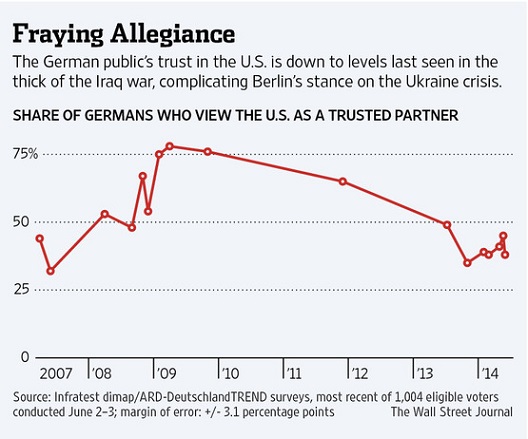
A poll published by research firm infratest dimap last week indicates German trust in the U.S. has plummeted to lows not seen since the thick of the Iraq war. Another poll, published in May, showed those Germans surveyed were more interested in deepening their country’s ties with China than they were in doing so with the U.S. A third, published in April, showed that nearly half wanted Germany to take a “middle position” in the Ukraine conflict rather than standing firmly on the side of the West.

Pissed Off German Accidentally Says Something Meaningful

Putin-Understanders: “Warmonger! Warmonger! Stop the Nazis in Ukraine!”

German Foreign Minister Frank-Walter Steinmeier: “The world does not consist of peace angels on one side and villains on the other. The world is unfortunately more complicated than that. And thank God there are still a few people out there who address this complexity and look for ways out of the crisis in Ukraine.”

“Dieses Maß an Hass und Dummheit, das mir auf dieser Veranstaltung entgegenschallte, hat mich in einem so hohen Maße empört, dass diese Rede so zustande kam, wie sie zustande kam.”

Poll: Four In Five Germans Have No Problem With Germany Being World’s Third Largest Arms Exporter

No, wait. That was four in five Germans would like to see their armed forces take part in fewer military missions abroad. But still.

Arms

Damn. And almost two-thirds think Germany should show caution on foreign affairs. Even more caution than they are already being so overly cautious about already, I mean. Well the Germans certainly have been reckless these past few years, haven’t they?

Calls from abroad for greater German participation showed the respect Germany had won, but could also put Germany under too much pressure.

PS: Speaking of pressure, according to former German Foreign Minister Joschka Fischer himself, “Russia is striving a major power role. That must not and will not be accepted by Europe.”

Die russische Strategie, verloren gegangenes Territorium zurück zu holen, könne man nur mit Entschlossenheit und Härte begegnen, nicht mit Verständnis. „Ein starkes Europa ist Voraussetzung für Sicherheit“, sagte der Ex-Außenminister.

German Word Of The Day: Bluff

In German, “Bluff” means to mislead by a display of strength or self-confidence when in fact their is no strength or self-confidence there. To display, I mean.

Bluff

But there’s one problem with this weapon (real sanctions): It can only be used if all EU members agree. In the EU, sanctions need to be decided unanimously. This worked for levels one and two, because they were primarily symbolic acts that affected people close to Putin and imposed no real burden on the EU. But level three would be different, making it unlikely that the EU would agree on sanctions that would have a strong effect on Russia. Europe’s strongest weapon is actually a bluff.

“Clearly there will be economic sanctions if Putin sabotages the vote, but it’s unclear what would constitute sabotage.”

PS: Personally, I think there is only one person on Earth who could possibly stand up to this Putin person. And he’s not even a person himself

German Of The Day: Putin-Versteher

That means Putin-Understander.
Versteher

The battle of opinion regarding Ukraine has introduced a few new words to the main stream of the German language, and a few that had been leading a niche existence up until then. The best known one is Putin-Understander.

Most Russlandversteher (Russia-Understander) are, like Mr Schmidt and Mr Schröder, on the political left. The Social Democrats believe they have learnt from Ostpolitik, the eastern policy begun by Chancellor Willy Brandt in the 1970s, that when it comes to Russia rapprochement works and confrontation does not. The Left, a party that largely descends from former East German communists, goes further, channelling well-honed anti-American and Russophile instincts and seeing the Ukraine crisis as a natural Russian response to NATO’s expansionism. A Left leader, Katja Kipping, draws in American snooping, attacking Germany’s refusal to interview Edward Snowden, a whistle-blowing ex-contractor for the NSA hiding in Russia. She has called Chancellor Angela Merkel “the USA’s poodle.”

Der Meinungskampf um die Ukraine hat der deutschen Sprache auch ein paar neue Wörter beschert oder solche, die vorher ein ausgesprochenes Nischendasein führten, in den Hauptstrom der Sprache geschwemmt. Das bekannteste Beispiel ist der Putin-Versteher.

Stop Hurting Russia’s Feelings Already

Who would have expected that? The German Left Party itself (they used to be called the PDS or Partei der Stasi) has expressed grave concern over the EU’s aggressive stance toward the Soviet Union, I mean Vlad Putin’s democratic Russia.

Wagenknecht

Rosa Luxemburg, I mean Sahra Wagenknecht herself has sharply critisized European crisis management with regard to the Ukraine conflict, saying it consisted of “vile Russia bashing right out of the Cold War” and that the West is pursuing a vicious anti-Russian policy of exclusion and unniceness and rottenness and that everybody, those damned faschist Ukrainians included, should finally just leave our commrades, I mean Russian partners alone already.

May Day, May Day… Earth to Wagenknecht. Earth to Wagenknecht. Can you read me?

Das ist übles Russland-Bashing aus Kalter-Krieg-Zeiten.