Of course non-German speakers can say pretty weird stuff, too.
Of course non-German speakers can say pretty weird stuff, too.
Now that’s a German word for you. And no, not just because it has Verbot on the end of it, although that certainly helps.

Zweckentfremdung means misappropriation, and in this case the Verbot has to do with using apartments for something they were not meant to be used for; for renting. Well, actually, this particular misappropriation Verbot means renting them at a high rate to those awful and dreadful tourists who come to Berlin for a limited time instead of renting them out for much, much less to people who will be paying that much, much less for a much, much longer time. Which is, uh, better.
You guessed it, we’re back here in Berlin again and trying to rent your property for the most the free market will give you is an absolute sin in these parts and must be stopped immediately. And that’s what the Berlin SPD is now trying to do with this here new-fangled, old school Socialist-type Zweckentfremdungsverbot. And you and I both know that it will be yet another roaring success. Until it backfires and gets quietly repealed a few years down the road again, that is.
Experten setzen große Hoffnungen auf das Verbot. Denn dann sind Vermietungen an Touristen und Firmen künftig nicht mehr möglich.
PS: That picture up there kills me, too. Being willing to pay 500 euros (roughly $675) to someone who finds an apartment for you is considered a complete Skandal here so that’s why “the state” needs to jump in and take those 500 euros from somebody else to pay, so-to-speak, only it will be more like 5000 euros then, which is then OK.
That didn’t take long. After planning to introduce “Herr Professorin” or Mr. Madame Professor at the University of Leipzig for both men and women professors, the FU Berlin is now thinking about doing the same.

Did Delta House dump some LSD in the faculty water cooler over here or something?
“All are equal in Leipzig. All women, that is.”
In Leipzig sind jetzt alle gleich, nämlich Frauen. Professoren gibt’s nicht mehr, nur noch Professorinnen, gemeint bleiben damit natürlich auch noch die männlichen Akademiker, die jedoch nur noch in einer Fußnote erwähnt werden.
If you have your doubts and worries about where your language is going in matters of political correctness, just be glad that you don’t speak German.

Squirming as everyone does these days to find a way to neuter anything and everything that can be neutered because, well, I’m still not quite sure why that is… The University of Leipzig has now made a very important contribution to this valiant endeavor, I think.
In German, calling a man a Professor and a woman a Professorin simply isn’t as geschlechtsneutral (gender-free) as it needs to be in this complex time we live in, it seems. That’s why the head smart folks what’s in charge of proper correct-type language usage here have decided to simply matters drastically. From now on Leipzig professors of either sex will be referred to as “Herr Professorin” or Mr. Madame Professor.
I know, I know. You think that I’m pulling your leg and that this is some kind of a prank or a punk or whatever it is they call it these days, but it isn’t. Honest. It’s here. We’ve come a way long way baby. And this is where we are now.
Mit “Professorin” können somit künftig auch Männer gemeint sein, “Dozentinnen” umfasst sowohl männliche als weibliche Personen.
You already knew that Berlin’s Left had problems with all of those annoying, gentrifying foreign out-of-towners who won’t leave town. Now Ärger (resentment) has broken out with gentrifying German out-of-towners from Swabia (the region around Stuttgart in southwestern Germany) who won’t leave either.
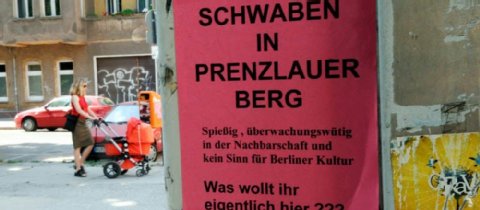
More specifically, “native” Prenzlauer Berg Berliners of the poltically correct kind are pissed off these days about the confusion that reigns whenever they want to order their local breakfast buns in the morning (called Schrippen here). The upwardly mobile Swabians who now live here too prefer calling them by the name they use for them down south in their own neck of the woods: Wecken. And this is just plain wrong. Or something. And an issue. A German issue even. A classic German petty bourgeoisie issue even, even.
In fact, this German petty bourgeoisie issue has become such a German petty bourgeoisie issue that Bundestag Vice President Wolfgang Thierse (SPD) himself felt compelled to note in a recent newspaper interview that “I’m annoyed whenever I go to my local baker and find out that there are no more Schrippen for sale, only Wecken. In Berlin we say Schrippen – and the Swabians ought to get used to that.”
This would be funny except that he meant it. Which makes it funny after all, come to think of it. And I’m not even making this stuff up, people.
“Ich ärgere mich, wenn ich beim Bäcker erfahre, dass es keine Schrippen gibt, sondern Wecken. In Berlin sagt man Schrippen – daran könnten sich selbst Schwaben gewöhnen.”
Not an Americanismcism, OK?
Those filthy-mouthed British. “Shitstorm” just won Germany’s Anglicism of the Year award (2011). Wow. I wonder if “Crap Tornado” came in second?
The punchline: “The jury’s decision is meant to emphasize the positive influence of English on the German language.” I don’t make this stuff up, people.
Mit der Wahl will die Jury den positiven Einfluss von englischen Ausdrücken auf die deutsche Sprache hervorheben.
I don’t usually tend to panic when reading newspapers, but when German journalists start writing articles critical of the media’s “eternal ramblings about doomsday,” I get very nervous indeed. This is news, in other words, primarily because this isn’t news to me.

Evelyn Finger’s main concern here is the German obsession with “the” Krise (crisis) in general (crises plural) and the latest so-called Krise der Demokratie (crisis of Democracy) in particular.
“In the meantime (it started out long ago with “the oil crisis,” she believes) we have become all too accustomed to terms like education crisis, energy crisis, climate crisis and, most recently, financial crisis, debt crisis and euro crisis. We have all hoped that these crises would not prove to become any more threatening than they already are, especially since our linguistic capacity to express more crisis seems to have been exhausted: World financial crisis! But a new threatening term has been spooking the debates as of late: A crisis of Democracy. Is there really such a crisis or is the chatter about it the real problem?”
We all know the answer to that question, of course. She rightly finds this obsessive German Angslust (passion for fear) ridiculous and has no trouble exposing it for what it is; mindless, self-indulgent, neurotic nonsense. But I do wish she would have had the decency to have warned me first. I don’t like stumbling accross articles like this in German newspapers, articles that make sense by expressing something we used to call “common sense.” If I had wanted to read articles like that I wouldn’t have bought a German newspaper in the first place.
But thanks anyway, Evelyn. You may have shaken me up a bit, but I really do hope you have a pleasant week.
Das Wort Krise hatte seinen Schrecken schon fast verloren. Es klang in den letzten Monaten auch bei dramatischer Nachrichtenlage etwas schwach und durch häufigen Gebrauch abgenutzt.
Not that anybody out there knows who the German President is or could really care less if they did, but a new German verb has just entered the language (in his honor?) referring to, well, referring to what, anyway?

The new German verb refers to the manner in which scandal-plagued President Christian Wulff has sought to manage revelations that he accepted a favourable home loan from a businessman, holidayed at the villas of the wealthy and left a threatening message for the editor of Bild newspaper.
It’s called wulffen and actually has two meanings (at least two), according to the director of the German Language Association in Dortmund. The first is to talk on and on unprompted. The second means to be evasive about a particular issue without actually telling a lie.
Damn. I really had no idea that politicians the world over have actually been wulffen with me the whole time.
“It means something in-between.”
As you may have noticed, Germans are always stressed out about stuff, even stuff that isn’t particularly stressful. So it shouldn’t come as a surprise to anyone that the Society for German Language has just chosen “Stresstest” to be the German word of the year (you didn’t know it was a German word, did you).
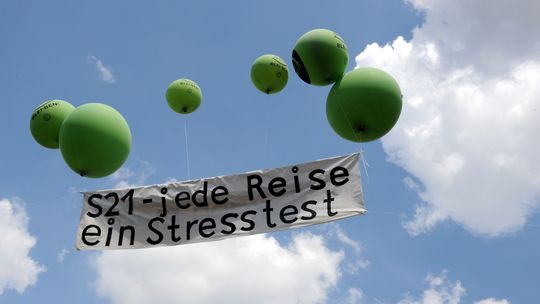
You name it, the Germans have stress tested it this year (or have been stress tested by it). Whether banks, nuclear power plants, train stations in Stuttgart, rained out summers or having patience with the euro (not), this term has become a “firm component of everyday language.”
I don’t see what all the fuss is about, though. Ain’t nothing new. I remember when they used to call stress test life.
Der ursprünglich aus der Medizin entlehnte Begriff sei im Laufe des Jahres “auffällig oft” verwendet worden.
 Observing Hermann