Trump To Follow Germany’s Lead

After Germany introduced a ban on German vehicles in the city of Hamburg today, President Donald Trump has announced plans to do the same in US-Amerika, as well. Sort of.
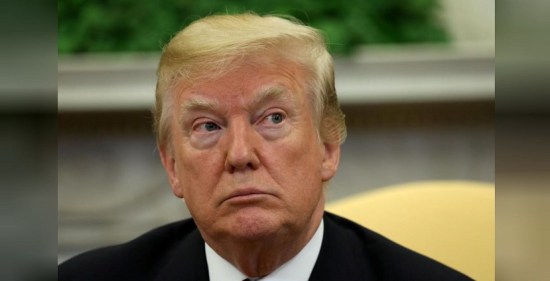
Trump

A report that U.S. President Donald Trump has threatened to pursue German carmakers until there are no Mercedes-Benz rolling down New York’s Fifth Avenue dented shares in the luxury car manufacturers on Thursday.

An excerpt from German magazine Wirtschaftswoche’s article, which cited several unnamed European and U.S. diplomats but did not include any direct quotes, could not be independently verified, while a United States Embassy spokesman in Berlin referred questions to Washington.

The news and current affairs magazine said Trump had told French President Emmanuel Macron in April that he aimed to push German carmakers out of the United States altogether. Macron’s administration in Paris declined to comment on the report.

Eine harte Antwort wäre für die deutsche Wirtschaft riskant: US-Präsident Trump hat neben den Metall-Zöllen auch Zölle auf ausländische Autos ins Spiel gebracht.

Torpedoes Are Ready For Firing

Alarm Bells Ringing As German Court Prepares Diesel Verdict That Could Torpedo The Industry.

Daimler

This is widespread criminal activity here, people. VW may have gotten Dieselgate rolling, then Audi & Co. gets caught but now its Daimler’s turn.

Daimler AG, the automaker which produces the Mercedes-Benz line of luxury vehicles, is facing growing scrutiny after US investigators reportedly found that it installed software to cheat diesel emissions tests on cars, Bloomberg and Reuters reported.

I got three words to say here: Made in Germany. Here are three more: Betrug mit System (systematic fraud). Get this diesel Dreck (filth) out of here already.

Meanwhile… Tesla vehicles now dominates luxury segment in Europe, outselling flagship gas-powered German cars

Tesla Model S übertrumpft in Europa erstmals deutsche Premium-Konkurrenz.

VW?

As in Very Wicked?

VW

What’s with German automobile companies these days? As if their latest foray into organized crime wasn’t enough, now it’s reported that VW was active in helping Brazil’s military dictatorship persecute opponents back in the day. Volkswagen and military dictatorships? No way.

The accusations are not new, but have resurfaced through a new investigation done by a group of German news organizations. According to the group, Germany’s largest car manufacturer, Volkswagen, was an active participant in the persecution and oppression of political opponents of Brazil’s military dictatorship that was in power from 1964 to 1985.

The company’s Brazilian subsidiary, Volkswagen do Brasil, which has been active in the country since the early 1950s, is accused of spying on some workers and looking into their political convictions, information that was then handed over to the police.

Damn. This gives Made in Germany a whole new meaning – again.

Deutsche Medien haben nach eigenen Angaben Belege dafür gefunden, dass Volkswagen sich in der Zeit der brasilianischen Militärdiktatur aktiv an politischer Verfolgung und Unterdrückung beteiligt hat.

At Least It’s Not A Life Sentence

Or lebenslänglich*, as the Germans like to call it. It’s only 169 years.

Life

Or could be. For Volkswagen managers who get arrested in US-Amerika, I mean.

A U.S. judge on Thursday ordered a Volkswagen executive charged in the Justice Department’s diesel emissions investigation held without bail pending trial. Oliver Schmidt was arrested Saturday at Miami’s International Airport as he planned to fly home after a vacation. He was one of six current and former VW executives charged this week in U.S. District Court in Detroit. The other five are in Germany and are unlikely to be extradited…

Schmidt is charged with eleven felony counts, which could be punished by up to 169 years in prison, the government said.

VW-Manager drohen bis zu 169 Jahre Gefängnis

* There is no such think as a life sentence in Germany, by the way. A life sentence is 15 years here.

German Engineering At Its Finest

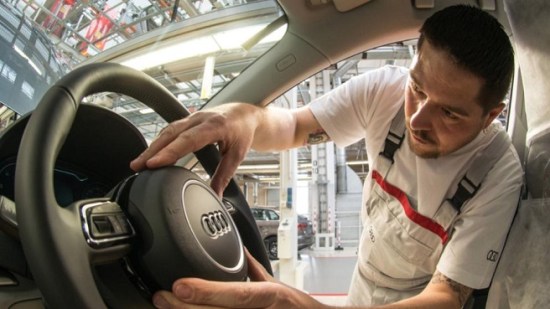
Fortschritt durch Technik. That’s Audi’s motto and means progress through technology.

Audi

And their latest advance in defeat device technology is a great step forward in consumer deception indeed.

Audi’s defeat device, camouflaged as a warm-up function, keys in on movements of the steering wheel to detect if the car is in the lab or not. Once in normal traffic, however, this warm-up function is deactivated and the vehicle switches to a higher fuel consumption mode, thus producing more CO2. Brilliant, don’t you think?

Come on, America. Why can’t you produce technology like this? These new fangled electric cars everybody is talking about these days don’t have any of this cool stuff.

So schummelte Audi bei CO² – Mit einer Software sollen Messergebnisse manipuliert worden sein.

Call The European Emission Commission

They won’t answer or anything. But still.

Strange, these guys never stop producing dangerous emissions themselves.

Dieselgate
But when it comes to Dieselgate in Europe, it’s back to “I know nothing” again. How Eurocratic or something.

Meeting minutes, correspondence and conversation records that SPIEGEL ONLINE and the Swedish daily Svenska Dagbladet have obtained now show that the European Commission and member states knew, since 2010 at the latest, that the extremely harmful emissions from diesel cars were strikingly higher than legal levels.

Germany’s Favorite Sports Car?

Hey, times change. Just ask the folks over at Volkswagen.

Mustang

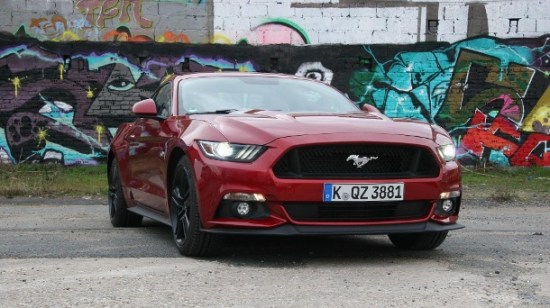
In Germany, the land of the Autobahn, where speed is regarded as a national right, the best-selling sports car last month wasn’t the locally-built Porsche 911. It was the Ford Mustang.

The Mustang is relatively expensive in Germany compared to the United States. Prices for a four-cylinder turbocharged model there start at about €38,000, or roughly $43,000. Prices for that model in the U.S. start at less than $26,000. Prices for the powerful, V8 Ford GT start at the equivalent of almost $50,000, while the car costs about $32,000 in the U.S. (Car prices in Germany are quoted with taxes and fees included, which is not the case in the U.S.).

Despite the higher price, the GT is, by far, the most popular version of the car in Germany, according to Ford (F).

The Mustang has a huge price advantage over what is otherwise the best-selling sports car in Germany, the 911. That starts at €96,000 in Germany, or roughly $110,000, for a base model with no options.

Die Chefs von VW denken vor allem an ihre Millionen-Boni. Doch wofür? Dafür, dass der Konzern mit voller Wucht gegen die Wand gefahren wird?

If The Lawsuit Fits, Wear it

I’ve got your unresolved emissions issues for you right here, pal.

VW

But what’s $48 billion to Volkswagen? Wait a minute. Actually, wow. That’s quite a bit.

Remember when Germans used to be greener than green?

Although such U.S. lawsuits are typically settled at a fraction of the theoretical maximum penalty, analysts said the size of the claim meant Volkswagen (VW) could face a larger bill than previously anticipated.

Dieselgate Actually US-Amerikanische Conspiracy Or Something

But you knew that already, I hope.

Diesel

It was a few researchers from West Virginia (at least one German researcher working in the US was involved here, too, by the way) who brought down the might of the German automotive industry, exposing VW’s Dieselgate cheats. Do you think Germany is pleased about that?

Displeased might not be the right word, but the very healthy sense of irony in Germany came out strong as the industrial nation had to reckon with podunk yahoo America getting German tech on the global shitlist (see the FIFA scandal, “unfortunately” a similar situation). Let us not forget that VW is Germany’s biggest automaker, and making autos is Germany’s most proud export business.

This video comes from the publicly-funded ZDF TV network.

American cars. Non-manipulated. Out of love for the environment.

VW Too Big To Fail?

Then it’s too big. Think GM (Government Motors). Only different. As in much worse.

VW

At Volkswagen AG, political connections come already fitted.

When it comes to Volkswagen, German chancellors don’t intervene in company decisions. But the unique arrangement in Lower Saxony (it holds 20 percent of the company) has spawned alumni in high places with an interest in the boardroom, including Merkel’s Social Democratic predecessor, Gerhard Schroeder. Schroeder, who sat on VW’s supervisory board for eight years as state premier, was known as the “auto chancellor” when he led Germany from 1998 to 2005 because of his perceived closeness to the car industry.

Following him to Berlin after serving at his side in Lower Saxony was Frank-Walter Steinmeier, now in his second stint as Merkel’s foreign minister. Sigmar Gabriel, who succeeded Schroeder as state premier — and VW board member — is now vice chancellor and economy minister. He also heads the Social Democratic Party, Merkel’s junior coalition partner. Christian Wulff, a Christian Democrat like Merkel who succeeded Gabriel in the state capital Hanover, made it all the way to the German presidency, before resigning in 2012 amid a legal probe.

Im Abgas-Skandal, dessen Auswirkungen noch unübersehbar sind, rückt die Frage nach der Mitverantwortung der deutschen Politik in den Fokus. Und weil die politischen Spitzen der Republik wie geschockt schweigen und selbst die sonst geliebten Talkshows meiden, werden Vorwürfe laut, die Bundesregierung habe mit Volkswagen gekungelt und möglicherweise sogar von den Manipulationen gewusst.